Saturday, February 12, 2011
When in Rome....
"In the fire blue forests, faded and forgotten
I crawled through the cotton fields, picking for cotton
The overseer sneered, his whipping was rotten
With ecstasy.
In child-like terror I tore out the tap roots
Cards of the lash were calling to follow suit
I dashed for the swamps, the hounds in hot pursuit
Jealously.
All through the night a figure of fright, as I hid my head
And the buried their nose in a cut of my cloths, now torn in shreds
And they never would leave until they believed that I was dead
But I'd never curse their names
Oh, who am I to blame
I know I'd do the same
Endlessly.
And all the high-born ladies
So lovely and so true,
Have been handed to the soldiers
When in Rome do as the Romans do.
Frail and afraid in the mists of the morning
The snakes and the spiders were sadly performing
The bark of the dogs kept up the warning
Inside the wood.
Sweating and swearing I crawled from the manger
The highway appeared to take me from danger
Is there anyone here who would pick up a stranger?
Oh I wish you could.
Then someone replied "would you like a ride?"
"Come in" he said.
We drove for a while, he gave me a smile and a piece of bread
The hammer was hard in the chrome of the car as I cracked his head
Then we took off in a spin
Oh I smashed his skull again
Oh thank you my good friend,
I feel so good.
And all the high-born ladies
So lovely and so true,
Have been handed to the soldiers
When in Rome do as the Romans do.
Late in the evening I came to the city
I fell to the sidewalks sighing for pity
A diamond was dropped from the hands of the pretty
To be so kind.
Cowards and corpses were busy competing
The rhymes of the riots were busy repeating
I raced to the corner and sped from the speeding
To save my mind.
Latches and locks, companies of cops ran from the rain
There was silk in the stores for the whims of the whores
That shone with shame.
I asked for a light from a priest in the night
Then I fanned the flames.
And the traffic all stood still
To see if someone had been killed
I was glad to leave a thrill
So far behind.
And all the high-born ladies
So lovely and so true,
Have been handed to the soldiers
When in Rome do as the Romans do.
A monk and his mother were dancing so dandy
A topless nun was handing out candy
The beautiful bishop broke out the brandy
The kiss we crave.
They stuttered and stammered, would I feel like staying
We fell to our knees, feverishly praying
the salt in the salt-peter seemed to be saying
Be brave, be brave.
I reached reached for a robe, I preached and I probed
And I taught the tune.
And the greed for the guilt was played to the hilt
As I promised doom
I toyed with their fears, until coins and tears filled the room
Then I took off down the road
Laughing madly like a toad
God bless every soulless soul
That would be saved.
And all the high-born ladies
So lovely and so true,
Have been handed to the soldiers
When in Rome do as the Romans do.
A chorus of children were passing the hours
I joined in their fun and gave them my flowers
Covered with kisses and showered with showers
That they repaid.
Taken and trusting, would I be their teacher?
She looked so appealing, I wanted to touch her
Just out of reach, unable to reach her
Their hands were raised.
Charmed by the chalk, the lessons were taught, inside the class
They studied the rules of the samurai schools, they had to pass
The room was adjourned, the lessons were learned,
I turned on the gas
And I watched them make their pleas
They passed the test with ease
I gave them their degrees,
They made the grade.
And all the high-born ladies
So lovely and so true,
Have been handed to the soldiers
When in Rome do as the Romans do.
Feeling my weakness, a coward for company
I joined the ranks of the hot and hungry
To teach what it means to have love for your country
We marched away.
We lowered our lives for the lines of a border
We danced with the mothers, played with the daughters
We followed our fantasies, following orders
It was child's play.
After the war the bullets were bored so we capped the game
With cynical smiles we put them on trial to place the blame
Now what kind of beast would love such a feast
Have you no shame?
So we hung the by the feet
Oh, we shot them in the street
Oh, the victory was sweet
on victory day.
And all the high-born ladies
So lovely and so true,
Have been handed to the soldiers
When in Rome do as the Romans do.
The bread and the circuses came to be nearing
The Saviour or somebody must be appearing
Pagans and pageants were all disappearing
Inside my head.
The stones on the statues were staring and stalling
Caesar and Cassius were cursing and calling
The empire had risen and now it was falling
Or so it seemed.
The crown and the cross seemed empty and lost in dark despair
And luminous lies, death in disguise were everywhere
The canvas was cold, the story was old, I said my prayers
Then I crowned him on the head
Oh, I blessed him as he bled
Oh At last, the king is dead
God save the queen.
And all the high-born ladies
So lovely and so true,
Have been handed to the soldiers
When in Rome do as the Romans do.
Now nothing remained for building or burning
The losing of lovers was all I was learning
A time for escape and a time for returning had come to me
Back through the ashes and back through the embers
Back through the roads and the ruins I remembered
My hands at my side I sadly surrendered
Do as you please.
The hero was home, proven and grown, I fell on the floor
Mad with romance they started to dance, their star was born
I bled like the rain, exploded in pain, then I screamed for more
Oh, make me feel sublime
Release me from my mind
Oh, Kill me one more time
And set me free.
And all the high-born ladies
So lovely and so true,
Have been handed to the soldiers
When in Rome do as the Romans do."
Bob Dylan has "Desolation Row." Phil Ochs has "When in Rome."
I think it's a tie.
Tuesday, April 20, 2010
Albums of Magic and Beauty....
While Pet Sounds (1966) is clearly Brian Wilson's most realized work, it is the first in a series of four releases that define the band's best period. It's taken this long to see this work without looking at it through the prism of the collapse of Brian's Smile album, his "teenage symphony to God." Released in its wake, Smiley Smile (1967) seemed like someone talking you through a tour of a house they loved, but after a fire. And swept up in the wake of that odd record - an album that the years have definitely redeemed - were two of the best Beach Boys albums of all.
Also released in 1967, and the last of their albums to be issued in both stereo and mono, Wild Honey is the funkiest the Boys ever got, and side one opens with four really strong tracks and is still a blast to put on today. "Wild Honey" "Aren't You Glad" "I Was Made To Lover Her" and "Country Air" are high energy and imbued with a new post-Smile confidence. Side two opens with "Darlin'", the most successful single off the album (#19 US #11 UK) and the song I most vividly remember from the only time I ever saw The Beach Boys when they opened for the Maharishi Mahesh Yogi at Philadelphia's Spectrum in what would be a mostly disastrous tour in the Spring of 1968 (canceled after drawing only 200 people to their show in New York City). They wore white suits and had a large horn section and played on a stage that was covered in flowers.
In 1968 The Beach Boys released Friends, the album that remains my own favorite to this day. I am a sucker for records with great opening tracks and, at 38 seconds, "Meant For You" is about as perfect as it gets (when I recorded the third Many Bright Things album I opened it with the 26 second track, "Many Bright Friends", as my own private little homage).
The album has twelve tracks and the tenth "Busy Doin' Nothin'" is classic Brian Wilson. Legend has it that the directions given in the song actually led to his house outside of Hollywood. It's also a perfect Bossa Nova.
Here's the title track. Enjoy.
Thursday, March 25, 2010
Tim Buckley
I have always loved Tim's voice, even though I find the son, Jeff, a second rate parody of the father (to paraphrase Oscar Wilde, "Only someone with a heart of stone can listen to Jeff Buckley sing 'Hallelujah' without laughing."). It is his second, third and fourth LPs, Goodbye and Hello (1967), Happy Sad (1969) and Blue Afternoon (1969) that are my favorites, though I appreciate the later, more experimental, efforts.
What I think of as his best album wasn't released until fifteen years after his death in 1975 at the age of 28. Dream Letter: Live in London 1968 (1990) is a double live LP (yes, it was released on vinyl as well as CD) that manages to capture all his best qualities. It also has my favorite of his songs, "Morning Glory." There is a cover version that is on the very first Blood, Sweat and Tears album, Child Is Father to the Man (1968), their debut (the band founded and led by Al Kooper and not the one featuring vocalist David Clayton Thomas) and another of the "best records by anybody ever."
A wonderful song; this version from Late Night Line Up from the BBC has surfaced on Youtube and is as perfect as perfect gets. Enjoy.
Monday, February 9, 2009
The Day the Earth Stood Still....
February 9, 1964. Forty-five years ago today The Beatles made their first appearance on The Ed Sullivan Show and... pick one.
(1) The "Sixties" officially started.
(2) The decline and fall of Western Civilization got underway.
(3) Two months and eighteen days after we buried a President it was OK to smile again.
The first wave of rock & roll had been repelled. By February 9, 1964 Elvis was in the Army, Chuck Berry was in prison, Jerry Lee Lewis was in exile, and Little Richard had gone to church. Put in their place were the teen idols: Bobby Rydell, Paul Anka, Fabian, Dion. In a government laboratory scientists were able to successfully remove every molecule of soul and humanity from the songs of Fats Domino and Little Richard and grow Pat Boone in a test tube.
But the first battle had been fought with conventional weapons. On February 9, 1964, The Ed Sullivan Theater was added, just below Hiroshima, Nagasaki and the Bikini Atoll, to the list of sites where nuclear weapons had been detonated.
Watch it today, and the energy is still there.
Friday, October 17, 2008
R.I.P. Levi Stubbs
Four Tops lead singer Levi Stubbs, who possessed one of the most dynamic and emotive voices of all the Motown singers, died in his sleep today at the Detroit house he shared with his wife. He was 72.
With Stubbs in the lead, the Four Tops sold millions of records, including such hits as "Baby I Need Your Loving," "Reach Out (I'll Be There)" and "I Can't Help Myself (Sugar Pie, Honey Bunch.)"
The group performed for more than four decades without a single change in personnel. Stubbs' death leaves one surviving member of the original group: Abdul "Duke" Fakir.
Stubbs "fits right up there with all the icons of Motown," said Audley Smith, chief operating officer of the Motown Historical Museum. "His voice was as unique as Marvin's or as Smokey's or as Stevie's."
In the summer of 1967 I was 13, about to turn 14. I was growing up in Philadelphia, 3,000 miles from the intersection of Haight and Ashbury. That summer for me was the Summer of Motown. And above all other voices, the voice of Levi Stubbs stands out in my memory as the lead singer in the soundtrack of our lives.
It's funny, but the one song I can't find a video of on Youtube is perhaps their best, "Bernadette."
One song I did find however is Billy Bragg's brilliant "Levi Stubbs' Tears."
With the money from her accident
She bought herself a mobile home
So at least she could get some enjoyment
Out of being alone
No one could say that she was left up on the shelf
"It's you and me against the world kid" she mumbled to herself
When the world falls apart some things stay in place
Levi Stubbs' tears run down his face
She ran away from home on her mother's best coat
She was married before she was even entitled to vote
And her husband was one of those blokes
The sort that only laughs at his own jokes
The sort a war takes away
And when there wasn't a war he left anyway
Norman Whitfield and Barratt Strong
Are here to make everything right that's wrong
Holland and Holland and Lamont Dozier too
Are here to make it all okay with you
One dark night he came home from the sea
And put a hole in her body where no hole should be
It hurt her more to see him walking out the door
And though they stitched her back together they left her heart in pieces on the floor
When the world falls apart some things stay in place
She takes off the Four Tops tape and puts it back in its case
When the world falls apart some things stay in place
Levi Stubbs' tears...
At the 60's soul music blog, The In Crowd, there is a download link for the compilation album The Four Tops: The Ultimate Collection, and this description:
"The Ultimate Collection series was a rare success from Motown, one of the first of the label's many compilation series to do justice to some of the finest performers, arrangers, and musicians of the soul era. Nearly every artist with an entry was given the luxury treatment, with a disc-filling running time, excellent compilation decisions, and a pleasing design scheme that reflected the artists in their prime. The Four Tops' entry is arguably the best in the series, since the 25 tracks prove the perfect length to summarize the group's decade at Motown. From 1963 to 1972, the group reached the R&B charts 28 times."
Here's the download link. Enjoy, and rest in peace Levi.
Thursday, August 28, 2008
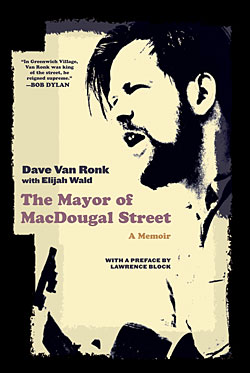
The Mayor of MacDougal Street....
Pekar's book is, in essence, a Classics Comics telling of the history of the student free speech movement and anti-war movement of the late 1960s. It's beauty is in its remarkable succinctness, the direct result of its being a comic (or "graphic novel" if you prefer).
As succinct as Pekar's book is, it is in Van Ronk's memoir that I found the most cogent critique of the anti-war New Left I've ever found. Van Ronk writes:
“[M]ost of these people were not really radicals, just a bunch of very pissed-off liberals. They had no grounding, and indeed no interest, in theory, and their disdain for studying history and learning economics infuriated me. The core problem with the New Left was that it wasn’t an ideology, it was a mood – and if you are susceptible to one mood, you are susceptible to another. They wanted the world to change, but essentially it was a petty bourgeois movement that had no connection with what was really going on. The working class at least has some power – if the working class folds its arms, the machinery stops – and as for the ruling class, its power is obvious. But what power does the middle class have? They have the power to talk: yak, yak, yak. To interpret, reinterpret, and re-reinterpret. And that is the history of the New Left in a nutshell" (emphasis added, p. 200).
Now log onto Amazon and go get your self a copy; I can't recommend a book more.
Sunday, June 29, 2008
The Supremes Redux....
Between 1961 and 1963, the Supremes released eight singles, none of which charted within the Top 40 positions of the Billboard Hot 100. Jokingly referred to as the "no-hit Supremes" around Motown's Hitsville U.S.A. offices, the girls tried to make up for their lack of a hit by taking on any performing chore that was available at the studio, including doing hand claps and singing backup for Motown artists such as Marvin Gaye and The Temptations. During these early years, all three members took turns singing lead on various songs: Mary Wilson favoring the soft ballads; Florence Ballard favoring the soulful, hard-driving songs; and Diana Ross favoring the more mainstream pop songs. Most of their early material was written and produced by Berry Gordy or Smokey Robinson.In December 1963, the Supremes song "When the Lovelight Starts Shining Through His Eyes", peaked at number 23 on the Billboard pop chart. "Lovelight" was the first of many Supremes songs written by the Motown songwriting and production team of Holland-Dozier-Holland. Also, in late 1963, Berry Gordy made Diane Ross, now going by Diana, the official lead singer of the group, because he felt her distinctive, nasal quality would help the group cross over to white audiences. Ballard and Wilson were periodically given solos on Supremes albums, and Ballard continued to sing her solo number, "People", in concert for the next two years.
In the spring of 1964, the Supremes recorded a single titled "Where Did Our Love Go". The song was originally intended by Holland-Dozier-Holland for The Marvelettes, who rejected it. In August 1964, while traveling as a part of Dick Clark's Caravan of Stars tour, "Where Did Our Love Go" reached number one on the US pop charts. It was also their first song to reach the UK pop charts, going to number three.
"Where Did Our Love Go" was followed by four more US number-one hits: "Baby Love" (also a number-one hit in the United Kingdom), "Come See About Me", "Stop! In the Name of Love" and "Back in My Arms Again." Between late 1966 and early 1967, the Supremes charted four more number-one hits in a row: "You Can't Hurry Love", "You Keep Me Hangin' On", "Love Is Here and Now You're Gone", and "The Happening."*
The rise of The Supremes coincided with the arrival of the British Invasion and, for a brief moment that felt like it lasted forever - like most brief moments do when you live through them - the Top 40 charts (which we studied like clerics poring over scriptures) were weekly battles between The Beatles and The Supremes.
My memory of the Summer of 1965 was of an ongoing battle between the boys and the girls at the local public swimming pool over the juke box and the back and forth of "Can't Buy Me Love" "Baby Love" "Help!" "You Can't Hurry Love" created the most perfect soundtrack imaginable.
To this day, "She Loves You" and "Baby Love" hold the top 2 positions in my own personal "Best Songs of the Sixties" list.
In 1964 The Supremes released the LP, A Bit Of Liverpool, a collection of British Invasion covers of songs by The Beatles, Gerry & The Pacemakers, The Dave Clark Five and The Animals. It's fun to hear Lennon & McCartney channeled through Motown.
There are, of course, arguments made now with the benefit of four decades of hindsight that understand the success of The Supremes in terms of "market forces making black music more palatable to white audiences," which is proof that arguments can be both accurate and utterly beside the point at the very same time.
"Baby Love", like The Beach Boys' "Surfer Girl" or Chad & Jeremy's "Summer Song" or The Happenings' "See You In September" these songs represent the very last moments of innocence in a culture that would never know that kind of innocence ever again.
* The first 4 paragraphs are taken from the Wikipedia Supremes entry.
Saturday, May 3, 2008
The Bicycle Ride
Hofmann joined the pharmaceutical-chemical department of Sandoz Laboratories (now Novartis), located in Basel. He began studying the medicinal plant squill and the fungus ergot as part of a program to purify and synthesize active constituents for use as pharmaceuticals. Over the next few years, he worked his way through the lysergic acid derivatives, eventually synthesizing LSD-25 for the first time in 1938. After minimal testing, LSD-25 was set aside as he continued with other derivatives. Four years later, on April 16, 1943, he re-synthesized LSD-25 because he felt he might have missed something the first time around. That day, he became the first human to experience the effects of LSD after accidentally ingesting a minute amount.
Three days later, on April 19, 1943, he decided to verify his results by intentionally ingesting 250 ug of LSD. This day has become known as "Bicycle Day" as Hofmann experienced an incredible bicycle ride on his way home from the lab.
"Everything I saw was distorted as in a warped mirror," he said, describing his bicycle ride home. "I had the impression I was rooted to the spot. But my assistant told me we were actually going very fast."
Upon reaching home, Hofmann sat down on a divan and began experiencing what he called "wonderful visions."
"What I was thinking appeared in colors and in pictures," he told Swiss television network SF DRS for a program marking his 100th birthday two years ago.
For a time, Sandoz sold LSD 25 under the name Delysid, encouraging doctors to try it themselves. It was one of the strongest drugs in medicine — with just one gram enough to drug an estimated 10,000 to 20,000 people for 12 hours.
Hofmann discovered the drug had a similar chemical structure to psychedelic mushrooms and herbs used in religious ceremonies by Mexican Indians.
In addition to his discovery of LSD, he was also the first to synthesize psilocybin (the active constituent of 'magic mushrooms') in 1958. Albert Hofmann, known as the 'father of LSD', continued to work at Sandoz until 1971 when he retired as Director of Research for the Department of Natural Products. In his retirement, Hofmann served as a member of the Nobel Prize Committee. He continued to write, lecture, and play a leading role as an elder in the psychedelic community until his quick and relatively painless death from a heart attack at the age of 102.
"I think that in human evolution it has never been as necessary to have this substance LSD. It is just a tool to turn us into what we are supposed to be. ” — Albert Hofmann
Thursday, January 17, 2008
Impossible Objects....
And it had to be the guitar. In early rock and roll the guitar wrestled with the piano and the saxophone for standing as the primary musical voice. But you can't toss a piano in the car or over your shoulder, and you can't play the sax and sing. Besides, both sax and piano meant lessons, and learning to read music, and months, or even years, before you became competent as a player. While that was necessary to work inside the complexities of jazz or classical music, rock and roll was emerging as a much simpler musical form, one that stressed the rhythm over the melody. Three chords and a basic understanding of how to tune the thing and in a matter of weeks you could have your own repertoire.
No matter what clever electronic devices show up, now or in the future, it is hard to imagine anything replacing the visceral experience of being fourteen and sweeping your hand across the strings of a $100 worth of a cheap electric guitar and an amplifier cranked up to create some distortion. In that noise, in those harmonic overtones and the squeal of feedback, there is some murky affective understanding of everything that's ever happened or ever will happen. For a culture like ours, one so openly hostile to history, it may be where we've hidden history until we grow out of those fears.
What I am interested in is looking at the individual guitars that seem to hold some collective sense of that inside them. Historically important, associated with musicians who have written chapters of their own in rock music history texts. The whole concept of "best guitar player" is a trap; there are more great guitar players out there today than ever before (click on the Scotty Anderson link). Guitar playing is like a virus that runs rampant through virtually every culture on the planet. The players below occupy positions of historical importance for various reasons, many having to do with being in the right time at the right place. I don't make any case for them as "best"; in many instances they don't even make my own personal list of favorites, for whatever that's worth. But anyone who has ever been moved by their playing must feel a certain twinge of desire at the idea of possessing these objects; letting your hand run over the strings, up and down the neck, as if, whenever time travel becomes possible, it will involve some incantation mumbled over a totem object like one of these.
#1 "Blackie"
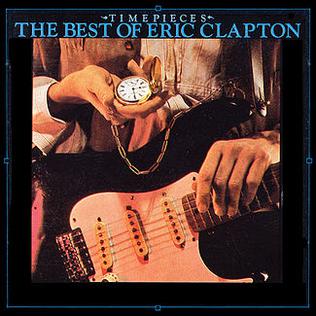
In 1970 Eric Clapton went into a guitar shop in Nashville, Tennessee and bought six vintage Stratocaster guitars for a hundred dollars each. After giving one each to George Harrison, Pete Townshend, and Steve Winwood, he took the best parts of the remaining three (built in 1956 and 1957) and assembled "Blackie," so named for its black finish. It's this guitar, pictured above on the cover of his greatest hits album, Timepieces, that holds the current record for a historically important guitar sold at auction, bringing $959,500 in the Christie's Eric Clapton Crossroads Guitar Auction.* That auction, held to raise funds for Clapton’s treatment center, exceeded the expectations of all involved.
Stevie Ray Vaughan's "Lenny" received the second highest price ever paid for a Fender Stratocaster at auction, fetching $623,500. A new world record was also set for the sale of a Gibson guitar - Clapton's 1964 red Gibson ES-335 brought $847,500. It is almost impossible not to view these prices as an attempt by the wealthiest people of my generation to buy back some pieces of their youth. It is hard to avoid the argument that the generation who shouted the loudest about the trap of materialism is now trying so desperately to reconstruct some sort of lost authentic self from the materials of their past.
But, I digress.
At an earlier auction, when Clapton first decided to sell his guitar collection to fund his drug treatment center, his sunburst 1956 Stratocaster, the guitar that graces the cover of what many believe to be his best album, Layla, set the then-record for $497,500. At the same auction his 1958 Gibson Explorer, perhaps the rarest guitar offered and one featured with Clapton in photographs and advertisements, sold for $150,000. That may sound like quite a lot of money, and it is quite a lot of money, but the Explorer would have sold for that price had it belonged to me, while a 1956 Strat that never belonged to Eric Clapton might bring $50,000-$75,000 at auction.
Why?
I think it is the combination of Clapton's place in the popular pantheon of rock guitarists, plus his identification with the Fender Stratocaster, plus the association of the specific instrument with a segment of Clapton's career. The interaction of those three elements seems to produce these results. Given that, and the continual explosion of high-end collector prices, I would not be surprised to see a seven figure price tag dangling from the headstock of the Layla Strat should it come up for auction again.
#2 "Tiger"
The sale of Clapton’s black Strat broke the record that had been set a short time before by the sale of a guitar built by Doug Irwin for Grateful Dead guitarist, Jerry Garcia. That guitar, nicknamed “Tiger” after the inlaid tiger on the top and played by Garcia for 11 years, sold for $957,500 to Jim Irsay, the owner of the NFL’s Indianapolis Colts.
Part of the value of those guitars is not only the fact that Clapton and Garcia - rock guitarists who have attracted sizable bodies of guitar mythology - owned them, but that they were played prominently and over a long period of time within those respective careers. When you listen to the Grateful Dead, if you listen to the Grateful Dead, or download a video off Youtube the odds favor that you will be listening to this one particular guitar. Irsay, who bought the guitar, also paid $2.5 million for the original "scroll" manuscript of Jack Kerouac's novel, On the Road; in addition to other guitars and objects, it is as if he is trying to create a private counter culture theme park in his Carmel, IN, mansion.
What's also interesting is the degree to which we mistakenly locate the origin of the distinctive tone of each player with the instrument, rather than the player and the unique and singular touch he brings to the guitar. This is demonstrated very well in this video of a jam session at a Mill Valley bar from the late 1980s. The crowded little stage has Commander Cody, Sammy Hagar, James Burton, Elvis Costello and Jerry Garcia. Garcia is playing what I assume is Costello's Fender Jaguar through a borrowed amp and manages to sound exactly like he did when he played the guitar pictured above. In other words - he manages to sound exactly like himself, regardless of the instrument.
#3 "Jimi's Woodstock Strat"
There are photos of Jimi Hendrix playing a variety of electric guitars throughout his too-short career but, like Clapton, he is most closely associated with the Fender Stratocaster, favoring right-handed models he would play upside down (like in the photo above).
Unlike Clapton or Garcia, Jimi was also known for smashing his guitars or setting them on fire on stage and no one guitar survived long enough to have the same lengthy associations as “Blackie” or “Tiger.” Perhaps the most important of Jimi’s Strats to survive intact is the white model he played at the Woodstock festival in 1969. The last public sale of this guitar was for $325,000 to an Italian collector. It was resold privately to Microsoft billionaire Paul Allen and is now displayed in his Seattle rock museum.
As I write this there is a similar white Fender Stratocaster leaning against the couch across from my desk, but, even if it were the same year as Jimi's, even if it were one digit in a serial number apart, it would remain a thoroughly impotent object. I doubt that I'll ever have the chance to hold Paul Allen's guitar in my hands, but I suspect one of two things would happen. Either I would be shocked by the power of the object - an effect like teleportation, suddenly standing on stage on Sunday morning in August 1969, playing the National Anthem - or, more likely, I would be shocked by the failure of the object to deliver on that imagined promise. I secretly suspect it would feel small and cold in my hands, even though I want to believe otherwise.
#4 "Old Black"
#5 "Jimmy Page's 1958 and 1959 Sunburst Les Pauls"
The most sought and valuable solid body electric guitar in the world is the Les Paul Standard model produced from 1958 to 1960.** These guitars all have a book-matched carved maple top finished in a "sunburst" (the color is darker around the edges and gets lighter as it nears the center) finish. Some maple is highly figured and produces an almost 3-D illusion of "flames" or of tiger stripes in the wood. On the collector market a price difference in six figures can result between two otherwise identical guitars if one has a highly figured top.
On their early tours and on the first Led Zeppelin album, Jimmy Page played the Fender Telecaster guitar that he'd played in The Yardbirds. But by the time of the second record this had been replaced by a 1958 Les Paul. Some time later Page was given a second Les Paul, a 1959 model, by guitarist Joe Walsh. These two guitars would be his primary instruments during his time in Led Zeppelin. The value of the Page and Zeppelin connection is added to the starting price of somewhere between a quarter and a half million dollars each guitar would have if it were owned by you or me. Who knows what a well-heeled Zeppelin fan might be willing to pay to play a classic Page riff on one of these guitars? No doubt it will be something that one of Jimmy's heirs will get to find out.
Pictured at the beginning of this post if Page playing his Gibson SG twelve/six string double neck guitar, both fitted with two humbuckers. The guitar Jimmy played on stage every time Led Zeppelin played "Stairway to Heaven." The link to that particular song could quite possibly push this guitar into seven figure territory as well.
#6 "Duane Allman's 1958 Dark Burst Les Paul"
The Allman Brothers Band had a fuller sound than most bands of their era, something they achieved by having two drummers and two lead guitarists. The twin guitar leads of Dickie Betts and Duane Allman provide the band its identity, especially live. Duane Allman is credited with introducing a style of single-note electric slide guitar playing, and the tone he achieved with that was due, in part, to the fat humbucker pick-up sound of his two vintage Les Pauls.
Initially Allman played a late 50s "Cherry Sunburst" model, one with a bright red color around the edges that turned to a yellow gold in the center. But in early 1971 he bought a second Les Paul, a 1958 Les Paul, with an exaggerated tiger stripe sunburst pattern and a dark brown tobacco sunburst finish sometimes referred to as a "dark burst" by collectors. The guitar had been owned by singer Christopher Cross, and was found for Duane by Billy Gibbons of Z Z Top. This was the guitar on the At Fillmore East and Eat A Peach albums. The guitar is currently on display at the Rock and Roll Hall Of Fame.
#7 "Pearly Gates"
Billy Gibbons' 1959 Les Paul ,"Pearly Gates," is the source of the Rev's heavenly sound. As a young musician weaned on blues and rock in southern Texas, Billy Gibbons' life was forever altered when he heard the sound of Eric Clapton's Les Paul and Marshall combination on the John Mayall and the Bluesbreakers album. Like a crusader in search of Holy Jerusalem, Gibbons set out eagerly on a quest for his first Les Paul. After stumbling across a few choice finds in the course of his search, including an original '58 Flying V, Gibbons finally found the guitar of his dreams several years later. Nicknamed "Pearly Gates" this '59 Les Pau fell in to Gibbons' hands through a series of strange circumstances and coincidences.
"In the early days of ZZ Top, we acquired an old thirties model Packard automobile," explains Gibbons. "That automobile served us well. It was huge, flashy and lowered, but not intentionally - it was just, plain old. Not long after we got the Packard, one of our girl friends decided to head to California to try out for a part in a movie. We gave her the Packard as a way to get there. Not only did she arrive, but she got the part. We named the automobile "Pearly Gates" because we thought it must have had divine connections."
According to Gibbons, the girlfriend sold the car to a collector and sent the money back to the band. Her timing couldn't have been better. "The very day that the money arrived a guy called me up wanting to sell an old guitar," says Gibbons. "It was a '59 Sunburst Les Paul. I bought the guitar and called the girlfriend to thank her for being so kind. She said, 'it looks like the car went for a good cause. Since the money that put the guitar in our lap came from selling the Packard, we'll lay claim to the name Pearly Gates. Now you can go make divine music.' Try as I may I haven't been able to find another guitar that sounds as heavenly."
Gibbons has played this brilliant burst on every ZZ Top album since their first, and its thick, sweet tones have confounded a bevy of guitar builders who have tried in vain to imitate its voice. The '59 Gibson Les Paul may be the one of the most desirable electric guitars, but Billy Gibbons 59 may be the most coveted Burst of all. [taken from Guitar World May 1997]
In the case of Gibbons we have a guitarist who lacks the top shelf heavy weight status of Clapton, Page or Hendrix, but who may have a guitar that alone has a value pushing $750,000.
#8 "The Mother of All Bursts..."
The photo is of Dan Erlewine in 1966 playing the 1959 Cherry Sunburst Les Paul that he sold to Michael Bloomfield. George Gruhn, the foremost authority on vintage instruments in the United States credits Bloomfield with single-handedly starting the market for collectable solid-body electric guitars. In the Paul Butterfield Blues Band Bloomfield played a Fender Telecaster and that guitar began to rise in popularity. Later he switched to an early 1950s gold top Les Paul and that guitar, which had been very unpopular with rock players, suddenly became sought and prices rose. When Bloomfield left the Butterfield Band to start The Electric Flag he acquired his '59 sunburst and I believe all of the sunbursts pictured above were originally bought by those players because of Bloomfield's influence.
Mike Bloomfield was, along with Jimi Hendrix, the finest blues-based rock guitarist of his generation. The guitar above can be heard in a perfect setting on "Albert's Shuffle" from the Mike Bloomfield/Al Kooper/Steve Stills Supersession album (and pictured on the cover) and can be seen in action with The Electric Flag at Monterey Pop here (though you may find yourself screaming at the screen "Show me the guitar! The guitar!!! before it can be seen clearly at the very end).
Bloomfield's guitar is owned privately by a collector and little is really known about how it was acquired. It would be very interesting to see what might happen if it were ever auctioned. I hope that Michael's guitar would be seen for the historically important instrument that it is.
#9 "Van Halen's Frankenstein"
Sometime in the late 1970s Eddie Van Halen got an idea for a guitar that sounded like a Gibson but played like a Fender. For $50 he bought a body from a pile of Charvel "seconds" and bought a neck for $80. He stuck a humbucking pickup in the bridge position and painted the body white with black stripes. Sometime later he took that body and repainted it red with black and white stripes (creating confusion among his fans that Eddie had two guitars when he really just had the one). Like many of the other guitars pictured above ("Blackie" "Lenny" "Old Black") Van Halen's "Frankenstein" has been reissued in a limited run of guitars that copy every part, every scratch and every cigarette burn (and sell for $25,000). The only guitar in this list that is from the next generation of guitarists, I'm sure Eddie's original guitar would sell in the mid-five figures; how much higher beyond that would be very interesting to watch.
#10 "Sir Paul's 1964 Höfner Beatle Bass"
The least expensive instrument on this list is also, hands-down, the most valuable; I should run that by Alanis Morissette and find out if it's ironic.
You might think that any list of the most valuable rock-era guitars would have a significant number of Beatles instruments on it, but it won't. Why that's not true gets back to the equation that adds up to the values of the instruments above. Both George Harrison and John Lennon played various guitars throughout their career with The Beatles, but if you think about that amazing body of work, there really are no specific guitars that dominate, or are even associated with particular songs.
The last live Beatles performance was the "Rooftop Concert" featured at the end of their film, Let It Be. During the Let It Be sessions and on the roof Harrison plays a Fender Telecaster custom-made with a solid rosewood body. From a collector's perspective one could argued that this guitar stands out in particular from all the guitars associated with George and John. The guitar was first offered for sale in a London auction in 1999 but failed to meet the $300,000 reserve price. The guitar was finally sold in September 2003 during an Odyssey Auction, live online on eBay, $370,000 (the total topped $434,750 when the 17.5% buyers premium was included), but that is still roughly less than half the value of all the guitars described above.
While George and John were fine guitarists, The Beatles were never known as a "guitar band" and whatever magic we suspect might live on in Beatle objects, those objects do not appear to be guitars.
With one very notable exception.
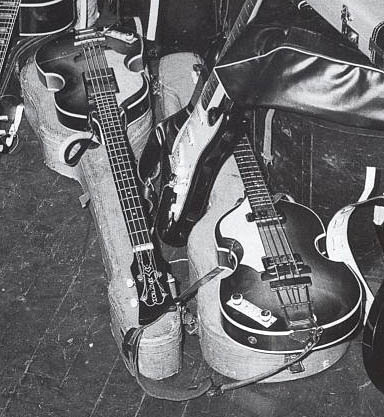
Unable to afford a Fender electric bass guitar, Paul McCartney selected a German-made Höfner "violin" bass, a left-handed 1961 model. As a left-handed guitarist he was initially attracted to the symmetry of the body design. In 1964 he received a new model (the 1961 bass was later stolen during the Let It Be recordings) and that 1964 Höfner electric bass guitar (with the set list for the Ed Sullivan Show still scotch-taped to the side) is the one instrument unquestionably infused with some major Beatles' mojo. When I think of the single most valuable and historically important instrument of the rock era, it is this one that always tops that list. I can't imagine the bass will ever come up for sale, there's no reason to believe it would ever leave the McCartney family, so it's actual value will never really be known which is probably more appropriate than anything else because that renders it priceless.
There are some other guitars that are possible additions to this list. Bruce Springsteen's Fender Telecaster/Esquire pictured on the cover of his Born To Run album comes to mind, as do the vintage Telecasters played by Keith Richards. These offer the same odd sense of rendering one's past somehow physical, material, capable of being tuched, held in your hands. There is something of that in every kind of collecting I suspect.
* In 2006 a Stratocaster signed by numerous celebrities including Eric Clapton was sold for over $2 and a half million dollars in a charity auction that raised funds for tsunami relief. That guitar represents a generous donation to a worthy cause but the instrument itself is of little value. It is akin to receiving a $15 DVD for pledging $250 to your public television station.
** The most valuable electric guitar would be the 1958 Gibson "Moderne" should one actually be found to exist. Designed by Gibson in a series of three "futuristic" guitars - the Flying V, Explorer and Moderne - most experts do not believe the guitar was ever actually produced, others believe it's possible that a small number of prototypes were built and are still out there, somewhere. Drawings for the guitar were found, and it is those that were used for the "reissue" built by Gibson in 1983. The original Moderne, should it exist, is the Maltese Falcon of electric guitars.
Monday, November 19, 2007
Cottman and The Boulevard
We’d been to the Spectrum to see The Beach Boys open for the Maharishi Mahesh Yogi who was on tour across the US in the wake of the notoriety he gained when The Beatles became momentary devotees of transcendental meditation. The Beach Boys were resplendent in their pure white suits and had a big horn section with them and played songs from their two recent albums, Wild Honey and Friends, two of my favorite Beach Boys records to this day. The Maharishi spoke seated on a platform on a stage inundated with flowers, thousands of flowers, to a crowd of about 12,000 people including me and Bob.
It was my idea to take photos of us in Maharishi-like poses, wrapped in my parent’s white bedspread, sitting on the grass, careful not to get anything but grass and bushes in the photo so it would look like we were sitting somewhere in Rikikesh; John Lennon and Donovan were just outside the frame.
It was the mise en scène of the Summer of Love.
My first memories of Philadelphia are of our first house on Levick Street, another neighborhood off the Boulevard in the Northeast, a few miles closer to downtown. What I remember is confirmed in the photos of the period – wallpaper and upholstery of deep dark greens and covered with huge yellow, red and pink flowers.
The era was summed up in one of Eisenhower’s State of the Union speeches when he said, “Things are more like they are today, then they have ever been before.”
Cowboy shows on TV and cap pistols in the back yard. One of the neighborhood kids was an albino and the proud owner of a complete Hop-along Cassidy outfit, all black with black cowboy hat, black leather gun belt and pearl-handled six shooters. Think of "Albino Bad Bob," Stacy Keach’s character from John Houston’s The Life and Times of Judge Roy Bean; now imagine him six years old.
I don’t really remember the period before Levick Street when we lived at my Grandmother’s at 22nd and Girard Avenue. I do remember staying for a week here and there with her and her second husband, Albert, a kind old man who – both in my memory and in family photos – looked remarkably like Albert Einstein. I remember meeting the black kids whose families had begun to take over the neighborhood as the white people fled toward the suburbs and playing in back alleys few Philadelphia police officers would venture into today on a dare.
In 1958 I was five years old and I can just remember the new house, brand new, all white, hardwood floors, in that section of Philadelphia known as “the Northeast.” According to the 2000 Census, the Northeast has a sizable percentage of the city's 1.5 million people — a population of between 300,000 and 450,000, depending on how the area is defined. The neighborhoods that make up Northeast Philadelphia include Lawncrest, Rhawnhurst, Tacony, Frankford, Holme Circle, Holmesburg, Mayfair, Morrell Park, Oxford Circle, Bustleton, Torresdale, Parkwood, Somerton, Fox Chase and Pine Valley.
Our neighborhood was Mayfair.
There is no rhyme or reason to the things that memory discards or retains. For some reason I can still remember the phone number I had as a kid living on the boulevard, back when phone numbers started with letters; Devonshire 3-2349 (dialed as 333-2349). Most people my age who have had to decide among 9,308 long distance plans have felt the nostalgic pull of “The Phone Company.” I don’t think it is as much affection for corporate monopolies as it is an expression of feeling unsettled by the near-fetish status of “choice” in the contemporary world. Menus the size of encyclopedia will always make me lose my appetite. I still find rotary dial phones strangely attractive, and I still seek out diners where you can choose the meatloaf, the chicken, or the fish.
The Mayfair, the movie theatre at the corner of Cottman and Frankford Avenues, was the center of the neighborhood, and the shops that lined Frankford Avenue in both directions were the center of local commerce. First established in 1929, Mayfair featured several groundbreaking concepts for city dwellers: bigger row-homes with yards in the front and parking garages in the back. The automobile became the primary mode of transportation and shopping retail centers became available close to home, as shopping districts developed along Roosevelt Boulevard and Cottman Avenue. Development also served to connect the surrounding neighborhoods of the Northeast that had previously been isolated. In these regards, Mayfair was a forerunner to American suburbanization, an early part of the population shift from the inner city to its outer regions.
Our house sat right on Roosevelt Boulevard in the middle of a block of doubles. In the late 1950s the boulevard was a six lane highway with three lanes on either side separated by a large field of grass in the middle, wide enough to play football on. By the late 60s that center section was turned into another six lanes of traffic. That expansion must have taken place sometime around 1965-67 as I can clearly remember when the road was almost finished but still closed to all traffic and we would take our bikes and ride as fast as we could on the virgin asphalt of a 12 lane highway that was all our own.
That was fun.
From the front window that looked out onto the Boulevard it was a straight shot into a new kind of retail shopping nirvana. Northeast Philly was never the suburbs, anymore than South Philly or West Philly or North Philly was. So this was an alternative to the congestion of Center City shopping. In the summer of 1967 if you walked across the Boulevard you would walk across a large parking lot into an S. Klein Department store. Behind that was the Roosevelt Mall, maybe 15-20 shops (with ample parking) that would end at Bustleton Avenue.
At Cottman and Bustleton was a large Gimble’s department store. Behind it was another mall of 20 or so shops that ran until Castor Avenue, where there was a Lit Brothers department store and another mall of shops. All of this ran along the north side of Cottman Avenue, the south side was also full of shops, tailors, realtors, auto parts, tuxedo rental, record stores, etc., all the way from the boulevard to Castor Avenue and beyond.
Before the growth of the Greater Northeast everyone who lived there would take regular shopping trips into downtown Philadelphia. By car you just hop on the Boulevard and head west; or walk a half block to Cottman Avenue and grab the B-Bus to the elevated train station at Bridge and Pratt Streets and ride the El into center city at 15th and Market Streets. From there, like Boston or Manhattan, most of the city is an easy walk.
Downtown was, like the centers of most large US cities in the 1930s through the 1950s, a brightly lit and exciting place to be.
In 1861 Justus C. Strawbridge first opened a store in Philadelphia and then partnered with Isaac H. Clothier in 1868. For the next 128 years Strawbridge and Clothier remained a family owned and run company known for its great relationship with its employees and customers. In 1876 Wanamaker's opened the first true “department store” in Philadelphia and one of the first, if not the first department store in the United States. In 1894 Gimbel’s opened their doors in downtown Philadelphia.
To understand Philadelphia you have to understand it in relation to New York City and the shadow it casts across it. Philadelphia exists in contradistinction to New York. Where New York grew vertically in a forest of skyscrapers, Philadelphia’s skyline was bound by a gentlemen's agreement that no building in the city could rise above the top of the hat on the statute of William Penn that stood atop City Hall.
And nothing would until March 1987, when a modern steel-and-glass skyscraper called One Liberty Place opened three blocks away. One Liberty Place dwarfed City Hall by 397 feet, soaring 945 feet in height compared to City Hall's actual height of 547' 11-3/4" to the top of Penn's hat, usually rounded off to 548', which coincidentally matches the career number of home runs hit by Phillies Hall of Fame third baseman Mike Schmidt.
The decline of every professional sports franchise in Philadelphia shortly thereafter created the “Curse of Billy Penn’s Hat." Philadelphia sports teams had just before then enjoyed an enviable run of success: the Philadelphia Phillies had won the 1980 World Series and the 1983 National League pennant; the Philadelphia Flyers had won back-to-back Stanley Cups in 1974 and 1975, and were a regular presence in the finals; the Philadelphia Eagles had appeared in Super Bowl XV; and the Philadelphia 76ers had won the NBA championship in 1983. In a more ominous coincidence, the ground was broken for One Liberty Place on the same day as the MOVE tragedy that left numerous members of a radical "Back to Africa" group dead and burned down several blocks of West Philadelphia neighborhood.
But I digress.
Christmas in Center City was a memorable experience. Gimbel’s had a great toy department and their Santa was the "real" Santa, since we all had seen him in the parade. Lit Brothers had the Enchanted Colonial Village with 18 great scenes like the Toymaker, the Bakery, the Blacksmith and many more. Strawbridge and Clothier was the most decorated store and the employees were always friendly. Wanamaker's had their Christmas Light Show that we had to see every year, even though it never changed.
It is a box of memories of snow and lights and music, stuffed with the colorful iconography of the American Christmas.
By the mid 1960s the downtown was faltering. It seems so odd to me that America’s love affair with the automobile, a seemingly endless supply of cheap gasoline, and the desire to park, quickly, effortlessly, and for free, would be the death of downtowns across the country. Multi-screen multiplexes replaced the giant cathedral theatres, temples of brass and velvet, holdovers of the days before television. The Goldman Theatre at 15th and Market in the center of downtown Philadelphia was among the last of these to fall. Opened in 1946, the Goldman sat 1,300 people. This is where my father took me in 1962 to see The Longest Day, the film about D-Day, the battle that my dad had been part of. In 1981 I took my wife there to see Raiders of the Lost Ark. A year or so later the building was demolished and an office building built in its place.
Downtown Philly in the 60s was an amazing place. I started high school in 1967. In hindsight, that may have been the worst moment in history to enter a super-conservative all-male Catholic High School; more on that later. By the time I was a sophomore I was able to go downtown at night and go to concerts and clubs.
What many people forget was how very little alcohol had to do with the youth culture of the late 1960s. Of all the clubs in Philadelphia I wanted to go to I can only remember one, someplace on the Boulevard where Woody’s Truck Stop was the house band back when Todd Rundgren was their guitarist and a local guitar hero, that I wasn’t able to go to because it was 21 and older.
But Heacket’s Circle, a coffeehouse in Germantown where Sweet Stavin Chain was the house band, The Second Fret on Sansome Street where The Mandrake Memorial was the house band, The Electric Factory at 22nd & Arch (Philadelphia’s Fillmore), and The Main Point out on Lancaster Avenue were open to everyone. The Academy of Music at Broad & Locust was the home of the Philadelphia Philharmonic, led by Eugene Ormandy throughout the 1960s and also a venue for shows by Phil Ochs, Donovan, Melanie, The Band and many others. Some of the best concerts I have ever seen were on that stage.
And this was all from that home base at Cottman and the Boulevard.
About a month ago my father finally agreed that it was time to move and sold the house to a young Chinese family and moved into my sister’s home outside of Atlantic City.
For years now I’ve watched the way that, as we age, the world slowly and inexorably erases all traces of us having been here. The drug store in the old neighborhood is gone. The bar we used to go to, gone. The movie theatre… what movie theatre? Little by little, piece by piece. This is why so much of what we do we do with the hope that it will outlast us. We write books, make records, blog, some of us have kids who have kids. And the books and records go out of print, the kids have daughters who marry and sooner than we thought, we’re gone, daddy, gone. Real gone.
As I was describing the miles of retail shops across our house on the Boulevard I started to tell the story about "the kid who sucker punched lead singers," but I cut it because it deserves a post of its own. Next time.
Sunday, August 5, 2007
Eight Haikus for Richard Nixon
Richard Nixon sleeps
The little girl on fire
Visits his dreams
2
Mass murderer, liar
Paranoid war criminal
But he’s not a crook
3
And Richard Nixon
Must have to stand naked
So sang Bob Dylan
4
America ends
Among the flashlights in the
Watergate Hotel
5
Nixon in China
With Kissinger on the ground
Spiro left in charge
6
Chanted in the streets
Vietnam Cambodia
He tried to kill me
7
Nixon waves goodbye
Pat and Tricia try to smile
Nightmare is over
8
Many years later
Yorba Linda, black marble
Dancing on his grave
Thursday, June 7, 2007
Room to move....
One comparison I’ve seen repeatedly throughout Mayall’s career is to jazz legend, Miles Davis. The Miles comparison is in recognition of the parade of musicians who apprenticed in one of Mayall’s bands before moving onto their own bands and careers. And that comparison is an apt one. As Richie Unterberger notes in Mayall’s biographical entry at the All Music Guide web site, "Throughout the '60s, his band, the Bluesbreakers, acted as a finishing school for the leading British blues-rock musicians of the era. Guitarists Eric Clapton, Peter Green, and Mick Taylor joined his band in a remarkable succession in the mid-'60s, honing their chops with Mayall before going on to join Cream, Fleetwood Mac, and the Rolling Stones, respectively. John McVie and Mick Fleetwood, Jack Bruce, Aynsley Dunbar, Dick Heckstall-Smith, Andy Fraser (of Free), John Almond, and Jon Mark also played and recorded with Mayall for varying lengths of times in the '60s.”
But comparisons to Miles, who, along with Louis Armstrong and Duke Ellington, represents one third of the 20th Century’s holy trinity of American music, must always be made with some awareness of their limitations. Mayall’s contributions were early with his trio of 1966-1967 LPs, Bluesbreakers With Eric Clapton, A Hard Road (with Peter Green), and Crusade (with Mick Taylor). By the end of the 60s his band rarely featured players whose later reputations would eclipse his own.
Nor was Mayall’s instrumental prowess on guitar, harp or keyboards comparable in any sense to Miles’ contributions to jazz trumpet.
Still, Miles comparisons aside, Mayall deserves his elder statesman status as richly as anyone. I almost said “as any of his peers” but caught myself. I don’t know that Mayall has any peers. He is a good ten years older than any other UK musician who occupies a similar place in music history. On one of his LPs it’s actually rather shocking to see a 1960’s rock figure in his British military uniform during his service in the Korean war.
There are two Mayall records that I would find it hard to live without. The first is, of course, his 1966 Bluesbreakers With Eric Clapton. Returning to Miles comparisons, the effect of this record on the rock music that followed was not dissimilar to the impact of either Kind Of Blue (1959) or In A Silent Way (1969) on jazz. There is a new “Deluxe Edition” on Decca, a 2 CD set that has the entire original LP in both mono and stereo mixes on the first disc and stuffs the second disc with 19 bonus tracks including a variety of BBC Saturday Club sessions and a number of rare Immediate label 45s (including “I’m Your Witchdoctor”). It’s one of those “Christmas and your birthday” kind of records.
The other Mayall LP I have burned into my brain’s hard drive is his 1969 album The Turning Point. In the context of its release it was almost as impressive a rock record as In A Silent Way was a jazz LP. 1969 was a time of supergroups, screaming electric guitars and twenty-minute drum solos. In the midst of this Mayall appeared in a quartet setting following Mick Taylor’s departure to The Stones. In any setting, but particularly in the musical climate of 1969, this is a stunningly quiet record. Mayall eliminates drums entirely, and replaces the electric guitar with not just an acoustic, but a nylon string acoustic played fingerstyle by Jon Mark joined by the flute and tenor and alto sax of John Almond (whose later Mark-Almond albums would try, with questionable results, to duplicate this sound). The result was to introduce a shocking quiet in the middle of all the loud. The 1969 Fillmore appearance was recorded and released as The Turning Point and became one of Mayall’s most successful albums. The fact that it was one of the 2 or 3 greatest records to smoke pot to late into the evening didn't hurt either.
Mayall’s longevity is also proof that Keith Richards was right when he answered a question about whether it would be silly to still be a rocker at 70 by saying that his role models were Muddy Waters and other blues greats who played until they had to be carried off the stage. At 65, Bob Dylan seems to be following similar advice. Come this November “Room To Move” “California” and “The Laws Must Change” will be on heavy rotation.
Sunday, May 27, 2007
History and Mythology and Methamphetamine
What he was doing then, long before personal computers and the internet, is what I think we would all do today if we had a high-speed internet connection, a blog, and some crystal meth. I can remember how those little lines of fine white powder just burnt like hell, very different from the coke we’d sometime share that would numb the back of your throat and make everything glow a wee little bit as it made everything slightly more interesting.
For a lot of people I think drugs are all about the pleasure. But for some, for the curious, it’s all about how they make the world more… interesting.
Anyway… I don’t do those things anymore, my body can’t survive the strains it could shake off thirty years ago. But I was playing on line a while ago and had a kind of metaphorical flashback to 4 or 5 in the morning, in that little house on the alley as I started to write something about the ancient Greeks and the British invasion.
So, you need to understand that Euhemerus was a Greek mythographer (4th Century BC) at the court of Cassander, the king of Macedonia. He is chiefly known for a rationalizing method of interpretation, known as Euhemerism, that treats mythological accounts as a reflection of actual historical events shaped by retelling and traditional mores.
The writer Robert Graves said of Greek myth: "True myth may be defined as the reduction to narrative shorthand of ritual mime performed on public festivals, and in many cases recorded pictorially." (The Greek Myths, Introduction). Graves was deeply influenced by Sir James George Frazer's mythography The Golden Bough, and he would have agreed that myths are generated by many cultural needs.
Myths authorize the cultural institutions of a tribe, a city, or a nation by connecting them with universal truths. Myths justify the current occupation of a territory by a people, for instance. All cultures have developed over time their own myths, consisting of narratives of their history, their religions, and their heroes. The great power of the symbolic meaning of these stories for the culture is a major reason why they survive as long as they do.
Myths that are based on a historical events over time become imbued with symbolic meaning, transformed, shifted in time or place, or even reversed. One way of conceptualizing this process is to view 'myths' as lying at the far end of a continuum ranging from a 'dispassionate account' to 'legendary occurrence' to 'mythical status'. As an event progresses towards the mythical end of this continuum, what people think, feel and say about the event takes on progressively greater historical significance while the facts become less important. By the time one reaches the mythical end of the spectrum the story has taken on a life of its own and the facts of the original event have become almost irrelevant.
This method or technique of interpreting myths as accounts of actual events, euhemerist exegesis, dates from antiquity and can be traced back (from Spencer) to Evhémère's Histoire sacrée (300 BCE) which describes the inhabitants of the island of Panchaia in the Indian Ocean as normal people deified by popular naivety.
As Roland Barthes affirms, "Myth is a word chosen by history. It could not come from the nature of things.”
Roland Barthes (1915 – 1980) was a French literary critic, literary and social theorist, philosopher, and semiotician. Barthes's work extended over many fields and he influenced the development of schools of theory including structuralism, semiology, existentialism, Marxism and post-structuralism.
Barthes' 1957 book Mythologies was a collection of interrogations of pieces of cultural materia conducted to expose how bourgeois society used them to assert its values upon others. For instance, portrayal of wine in French society as a robust and healthy habit would be a bourgeois ideal perception contradicted by certain realities (i.e. that wine can be unhealthy and inebriating). He found semiology, the study of signs, useful in these interrogations. Barthes explained that these bourgeois cultural myths were second-order signs, or significations. A picture of a full, dark bottle is a signifier relating to a signified: a fermented, alcoholic beverage - wine. However, the bourgeois take this signified and apply their own emphasis to it, making ‘wine’ a new signifier, this time relating to a new signified: the idea of healthy, robust, relaxing wine. Motivations for such manipulations vary from a desire to sell products to a simple desire to maintain the status quo. These insights brought Barthes very much in line with similar Marxist theory.
Now, the thing that I want to take from all of this is this notion of “mythology” not as some imaginary realm of dragons and elves, but as the end of a process that involves the removal of actual events from their concrete historical moorings.
And so we fast forward to early 1964 and the beginning of what we all now call the “British invasion.”
I started thinking about the British invasion as an example of cultural mythology when I read the article “Before the Beatles: International Influences on American Popular Recordings, 1940-63” by William L. Schurk, B. Lee Cooper and Julie A. Cooper in the May 2007 issue of the journal Popular Music and Society. It is an academic journal and, as such, most often stuffed full of the self-evident nit-picked into absurdity. I published a couple times in the journal, presented papers at their conferences over the years and, because of my odd mix of academic and music business credentials, I am a member of their advisory board (which is to say, I don't pay for the journal).
But I digress….
In their introduction the authors write that, “This discographic compilation is designed to debunk the myth of 1964 as the foreign influence watershed year in American recorded music. . . . The misconception being examined is that, until the arrival of The Beatles, Dave Clark Five, Herman’s Hermits, Hollies, Kinks, Zombies, and others in 1964, American recording charts were largely devoid of foreign-born performers.”
In 40 pages chock full of charts and tables these scholars present a very well-reasoned argument that there was a significant non-US presence in the pop charts well before the supposed invasion, and that US-artists fared far better during the invasion than is generally believed. But I would extend this conclusion a bit farther.
The mythology of the British invasion is tied to a much larger mythology of America in the 1960s, and an even larger mythology of the 1960s itself. The exit of Eisenhower, the arrival of JFK, Kennedy’s subsequent assassination, the baby boom, Vietnam, rise of drug use, etc., all neatly places the 1950s in a conservative pin-striped box and the 1970s into a polyester disco shirt box, the 80s into a Reagan-Gordon Gekko-shaped box and so on.
If there is anything the culture needs to get over more than the myth of the 1960s I don’t know what that might be.
The essence of that myth is that we had our chance, the planets were aligned, we could have had a utopia, but we blew it. Now the planets won’t align for another 9,000 years so, really, what’s the point? This is a horrible, self-centered, banal, and destructive mythology, more destructive than any Reagan-based mythos the Republicans can muster.
I still like paisley, I long for the return of ruffled cuffs and collarless jackets, and I kind of miss the beads. But perhaps it’s time to see the 1960s as the superficial paper-thin bourgeois “revolution” that it was (and take another look at the 1950s while we’re at it) and try walking forward one more time before the light fades entirely.
Wednesday, April 4, 2007
Don't We All Want To Be Freewheelin'?
Dylan's sophomore album, Freewheelin' was the follow-up to his eponymous 1962 debut, an album that sold so poorly that Dylan was nick-named "Hammond's Folly" inside Columbia Records. But where his debut presented Dylan in full Woody Guthrie mode, still making wild claims about a mythical childhood in the Southwest and being raised by wolves in the Black Hills of the Dakotas, it's on Freewheelin' that Bob Dylan finds his voice. It's here that he puts the finishing touches on his persona, adding touches of James Dean and Brando to Woody Guthrie and Ramblin' Jack.
Just like "true" Beatles fans identify themselves by denigrating Sgt. Pepper, so too is there a tendency among "true" Dylan fans to dismiss “Blowin’ in the Wind” as "overrated." But "true" fans are, when you get down to it, more often clueless idiots than not, and obsessive devotion to Bob Dylan minutia will most likely blind you to the BIG truths. That "Blowin' in the Wind" is among the greatest American songs of the 20th Century is one of those truths. I imagine it gets the short shrift now because it sounds like one of those songs, like “Amazing Grace” or "We Shall Overcome," a song that can’t possibly have an author (or a song that simply dwarfs its authorship, rendering it irrelevant). On an album of various major and minor masterpieces this really does remain the jewel in the crown.
Like many early Bob songs, “Girl of the North Country” is based on an older folk song (George Harrison based “My Sweet Lord” on “He’s So Fine” and look where it got him). It’s a timeless melody, made near-perfect by this set of lyrics; the album performance is simply sublime.
"Masters of War" has always seemed like a bit of a sore thumb here. It's Dylan's "protest songs" that are the most dated of his catalog (and the follow-up to this album, The Times They Are A-Changing, is his only dated-sounding LP from his early work). But Greil Marcus has made a strong case that the value of the song is in its emotional excess, not in its literal interpretation as “protest” song.
“Down the Highway” is Dylan playing in a classic country blues style. Not the best song here, it adds spice and variety to the record as a whole. The first album was Dylan-as-folksinger, this album is Dylan-as-Dylan and every song here is a piece in that portrait.
"Bob Dylan’s Blues" plays the essential role here of releasing some air from the profundity balloon. It also reminds me that one of the real casualties of Dylan’s post-1964 career was how his phenomenal comic abilities got lost. In 2007 it's almost impossible to imagine Dylan as a comic, but I also imagine that, in his later years, it was just as difficult to look at Chaplin and still see the Little Tramp. Remember, things change.
“A Hard Rain…” Yes, it’s based on an old Scottish ballad, but it stands there, with one foot in the 17th Century and the other in the 20th. It encompasses Kerouac, Ginsberg and the Beats and who knows how many other references I’m not well-read enough to pick up on. Dylan’s denial that the “rain” is atomic fallout shines a light on the whole problem with authorial intentionality. The songs exists apart from Bob and, set in the cold war and Cuban missile crisis, clearly includes nuclear rain at the top of its list of signifiers. It’s hard to imagine today what hearing this song in the early 60s was like. Hard as it is for a 2007 Dylan audience to imagine, people actually stopped going out for more beer and screaming “WATCHTOWER BOBBY!!!! WOOOO!” during it. People sat, dumbfounded, just stunned by it, like they must have reacted to hearing Charlie Parker for the first time, or Bill Monroe, or anything actually, genuinely NEW.
"A Hard Rain" is also the BIG BANG of what would become the singer/songwriter movement; it is the moment that redefined folk authenticity and made writing and singing original songs a requirement rather than grounds for banishment.
“Don’t Think Twice…” is AS good a song as anything else on here. It’s like a perfect miniature portrait. The album version is that rare flawless thing. It's also the sort of underhanded sly misogyny that would define Dylan's romantic relationships for the rest of his life.
“Bob Dylan’s Dream” is one of my 5 or 6 favorite Dylan songs. I like to sing it a cappella in my car (and LOUD) when I’m on the highway coming back from or on the way to a visit with my oldest and best friends. “I wish, I wish, I wish in vain. That we could sit simply in that room again. Ten thousand dollars at the drop of a hat, I’d give it all gladly, if our lives could be like that.” Jesus. Who wouldn't?
“Oxford Town” is the conjoined twin to “Masters of War” but not as good (it would need to call for the death of everyone in Oxford to be as good), not as excessive. The earlier “Emmett Till” is very much a superior song. The performance is lacking too. Richie Havens covers it on a very early record and it’s way stronger. The tell-tale sign of a lesser Dylan song is when someone else does it better ("All Along the Watchtower" excepted).
“Talkin’ WWIII.…” More great satire stuffed with brilliant one-liners. You get the impression that this guy would sound interesting putting in a breakfast order. Can you imagine the 2007 Bob Dylan doing something like this? I know. I can't either.
I wonder if the sequencing of these last three tracks, which result in the record closing slightly less impressively than it opens, has something to do with the last-minute juggling of tracks when 4 songs that were slated to be on the album got pulled and replaced. Those songs, good ones too, were more Bob-as-Woody and already too dated to make the 2nd LP – an indication of his off-the-scale growth rate at the time.
“Corrina, Corrina” was a revelation because no one knew or suspected that little Bobby was a rocker at heart. His piano-playing-kicked-off-the-HS-talent-show shenanigans wouldn’t come to light for decades yet. The 45 track “Mixed Up Confusion” never got air play or got around and sank from sight once he took the Folk King crown. Great song and a great version.
“Honey, Just Allow Me…” and “”I Shall Be Free” both give the suggestion of being wine-fueled studio improvs, though I have no idea how true or false that is. They’re outrageous and funny and help deflect a one-dimensional self-importance that would not have benefited the record over time.
Finally, there's the cover.
The amazing cover.
A simple photo of Bob and girlfriend walking down a winter street in the Village, it somehow manages to encompass the vague and uncertain concept of "freewheelin'" and the result is that an entire generation would long to be "freewheelin'."
To be freewheelin' seemed to have something to do with your relationship to the future. If the defining characteristic of what is now called "THE SIXTIES" was an ability to imagine a future as something other than the simple extension of the present then the sixties start here, in those boots, those jeans, that jacket.
Sunday, March 4, 2007
Back To Mono...
After a dozen tries I just managed to win an auction for an original UK 1st pressing of The Rolling Stones Let It Bleed on Decca, in mono.
This is the last of the major Stones albums to be done in stereo and mono editions. Beggars Banquet, the year earlier, like Let It Bleed, was only issued in the UK in mono, there is no US mono pressing.
This brings me ever closer to finishing a complete set of UK and US Rolling Stones LPs in mono. There are three things that potentially attract me to the mono versions of 60s records.
First, as in the case of The Beatles, the final mixing sessions where the album was mixed to mono was done separately from the stereo mixes and often there are significant differences between the two. The Beatles, John, Paul & George anyway, would always closely oversee the mono mixes of their albums, but leave the stereo mixes to the engineers. George Harrison, Geoff Emerick (their recording engineer) and others have long said that you've never heard the Sgt. Pepper LP unless you've heard the mono version. In the era of CD remastered editions, there are precious few examples of labels returning to the original mono versions.
Second, as in the case of the early Stones LPs, Donovan's Sunshine Superman, Procol Harum's first album and many others, there simply are no true stereo pressings, only mono. All the stereo pressings of these records are actually "electronically reprocessed stereo" a crude scam in which some echo and panning is added to the mono version. And vastly inferior.
Third, on a good turntable with good outboard equipment, early mono pressings of rock & roll records just sound better. They're punchier, louder, more energetic and "in your face" than the stereo pressings. If you ever have the chance, compare the first two Jimi Hendrix Experience LPs in mono and stereo; you'll be amazed.
For reasons I'll never understand I got into this Stones listening jag sometime before Christmas and didn't lift my head up out of it for well over a month. I came out of it a much bigger fan of the early records. In the past my early Stones collection was the greatest hits collection, High Tide and Green Grass, the best of five early Greatest Hits records I spent a lot of time with between 1965 and 1966. The other four great ones from this eara were The Best of The Animals on MGM, The Kinks Greatest Hits on Reprise, The Beach Boys Greatest Hits on Capitol, and The Best of The Lovin Spoonful on Kama Sutra. Three great British Invasion bands and two great American bands all similar in that their early LPs were comprised on one or two hit singles surrounded by filler. These LPs were concentrated bursts of what made each of these bands so great.
Imagine a set list of "Satisfaction" "We Gotta Get Out Of This Place" "You Really Got Me" "Surfer Girl" and "Do You Believe In Magic?"
Sublime.
The great tribute to The Beatles is that there was never any effort to assemble a "Greatest Hits" album for them as it would have to have been a box set housing all their existing LPs and singles in a neat new cover.