Showing posts with label US History. Show all posts
Sunday, November 20, 2011
Friday, June 10, 2011
Which side are you on?
"It is one of the characteristics of a free and democratic nation that it have free and independent labor unions." - Franklin Delano Roosevelt:
"The important role of union organizations must be admitted: their object is the representation of the various categories of workers, their lawful collaboration in the economic advance of society, and the development of the sense of their responsibility for the realization of the common good." - Pope Paul VI
"Only a fool would try to deprive working men and working women of their right to join the union of their choice." - Dwight D. Eisenhower
"The only thing workers have to bargain with is their skill or their labor. Denied the right to withhold it as a last resort, they become powerless. The strike is therefore not a breakdown of collective bargaining-it is the indispensable cornerstone of that process." - Paul Clark
"History is a great teacher. Now everyone knows that the labor movement did not diminish the strength of the nation but enlarged it. By raising the living standards of millions, labor miraculously created a market for industry and lifted the whole nation to undreamed of levels of production. Those who attack labor forget these simple truths, but history remembers them." - Martin Luther King Jr.
"Every advance in this half-century: Social Security, civil rights, Medicare, aid to education... one after another- came with the support and leadership of American Labor." - Jimmy Carter
"The history of America has been largely created by the deeds of its working people and their organizations--there is scarcely an issue that is not influenced by labor’s organized efforts or lack of them." - William Cahn, Labor historian
"Never forget, people DIED for the eight hour workday." - Rebecca Gordon
"Although it is true that only about 20 percent of American workers are in unions, that 20 percent sets the standards across the board in salaries, benefits and working conditions. If you are making a decent salary in a non-union company, you owe that to the unions. One thing that corporations do not do is give out money out of the goodness of their hearts." - Molly Ivins
"I want you to pledge to yourselves in this convention to stand as one solid army against the foes of human labor. Think of the thousands who are killed every year and there is no redress for it. We will fight until the mines are made secure and human life valued more than props. Look things in the face. Don't' fear a governor; don't fear anybody. You pay the governor; he has the right to protect you. You are the biggest part of the population in the state. You create its wealth, so I say, "let the fight go on; if nobody else will keep on, I will." - Mother Jones, 1913
"Our labor unions are not narrow, self-seeking groups. They have raised wages, shortened hours, and provided supplemental benefits. Through collective bargaining and grievance procedures, they have brought justice and democracy to the shop floor." - John F. Kennedy
"If you object to unfair treatment, you're an ingrate. If you seek equity and fair consideration, you're uppity. If you demand union security, you're un-American. If you rebel against repressive management tactics, they will lynch and scalp you. But if you are passive and patient, they will take advantage of both." - Congressman William Clay, Sr.
Labels:
Unions,
US History,
US Labor protests,
US Politics
Wednesday, May 4, 2011
The Greatest Generation....
Not to take anything at all away from the millions who served in World War II or the 400,000 Americans who gave their lives, but at least those people had guns to shoot back at the people who were trying to kill them. For sheer bravery fueled by moral certainty, I do not see an equal to the men and women who went into the deep American south in the early days of the Civil Rights Movement.
It was fifty years ago today that the first "Freedom Riders" risked their lives to fight Jim Crow. These are among the bravest and best Americans who ever called this country home. Below is a piece from the Daily Kos that's so good I'm just going to reproduce it in its entirety:
There were only 13 brave hearts when they climbed onto southbound Greyhound and Trailways buses in Washington, D.C., 50 years ago today. But within a couple of months there were hundreds of them, black and white, riding public buses into the jaws of Southern intransigence. They were jeered, threatened, harassed, beaten, jailed and firebombed. Their courage eventually helped crush that unique brand of American apartheid known as Jim Crow. But on that balmy spring day when they embarked for New Orleans, segregation ruled the land through which they were traveling, a forced and illegal separation backed up with billy clubs, tear gas, fire hoses and the fangs of police dogs and policemen.
The Kennedy brothers urged them not to go, even made it a matter of patriotism, just as they would later discourage the March on Washington in August '63. But that admonition from the nation's highest authorities didn't stop them from challenging some of the lowest authorities, the Klan-backed sheriffs and deputies who would stand smirking as mobs of their drinking buddies attacked them. When the beatings had gone on long enough, they arrested the Freedom Riders and charged them with "breach of peace" and violating various other laws, all of which amounted to what they so charmingly called "race-mixing."
Freedom Riders. To this day, those two words give me the shivers. The good kind. Three years after they put their lives on the line, I had the great good fortune in Mississippi to become momentarily acquainted with one of them and spend two months being mentored by another in Freedom Summer. The first was John Lewis, then chairman of the Student Non-Violent Coordinating Committee and now Congressman from my birth state of Georgia's 5th district. The second was Charly Biggers, eight years older than I and just then finishing a degree at the University of Colorado, where I, too, would graduate in five years.
By 1961 segregated interstate buses had been unconstitutional for 15 years. That was a consequence of the Supreme Court's 7-1 ruling in the case of Irene Morgan v. the Commonwealth of Virginia. Challenged in 1944 to give up her seat on an interstate bus to a white passenger, Irene Morgan refused. A deputy arrived with a warrant. She tore it up and tossed it out the window, saying she had done nothing wrong and had paid the same money as the white passenger. When the deputy grabbed her, she fought back. Another deputy arrived. She scratched and kicked but was eventually subdued, dragged off the bus and charged with resisting arrest and violating Virginia's segregation laws. She was thrown into jail. Her other bailed her out for $500, equal to $6100 today.
She was fined $10. But a 38-year-old attorney named Thurgood Marshall took the case all the way to the Supreme Court. He didn't argue it on due process grounds. Instead, he argued before the justices that Jim Crow laws in this instance violated the Commerce Clause of the Constitution and the Interstate Commerce Act by interfering with transportation crossing state boundaries.
But while the ruling was a landmark in civil rights law, there was no enforcement. A year after Morgan was decided, in 1947, Bayard Rustin and 17 other activists from the Congress of Racial Equality took the first Freedom Ride. They called it a Journey of Reconciliation. It turned out to be anything but, however, it would inspire new Freedom Riders a decade and a half later. Led by Rustin, mixed pairs of black and white passengers rode in the white sections of Greyhound and Trailways buses. Through Virginia, everything went all right, but in North Carolina the authorities stepped in. There were 12 arrests and Rustin spent 30 days on a chain gang.
In 1955, in Sarah Keys v. Carolina Coach Company, the Interstate Commerce Commission ruled for desegregation and explicitly said passengers could disregard local Jim Crow laws. But the commission refused to enforce its own ruling and the racist scofflaws continued as they always had. In 1960, the Supreme Court added another desegregation brick to the foundation when it reversed a lower court's ruling in Boynton v. Virginia and required the desegregation of restaurant facilities that were a integral part of interstate bus terminals. Thurgood Marshall again argued the case. That decision and the ICC's unwillingness to act set the Freedom Riders into motion.
Bayard Rustin would be on board just as he had been 14 years earlier. All the protesters had been trained in non-violent methods of resistance and all were either members of CORE or SNCC. The plan was to travel through Virginia, the Carolinas, Georgia, Alabama, Mississippi, ending up in New Orleans where there would be a rally. But the bus ride ended well short of its destination. No major incidents occurred in Virginia and there were some arrests and quick releases in North Carolina. But in Rock Hill, S.C., John Lewis was attacked and in Winnsboro, S.C., there were several arrests.
It was in Alabama, however, where segregation's enforcers chose to make their stand. What happened there has been told in great detail over the years by many Freedom Riders and other chroniclers, including James Peck, James Farmer, Taylor Branch and Lewis in his 1998 book Walking with the Wind, A Memoir of the Movement. David Fankhauser has posted his recollections on line. The following brief summary draws on some of those and other sources, including this excellent timeline:
Organized in advance behind the scenes by a police sergeant and the Birmingham Police Commissioner, Eugene "Bull" Connor—who would become even more infamous two years later—a Klan mob of more than 100 ambushed the Greyhound bus well outside the town of Anniston. They smashed its windows and slashed its tires and chased it to about five miles out of town where its flat tires made it impossible to drive farther.
Some threw a firebomb through a window, setting the bus afire. And the mob held the doors shut as they sought to burn the passengers alive. With the fuel tank in danger of exploding, the Freedom Riders escaped with their lives only because an undercover Alabama Highway Patrol officer who was secretly on the bus drew his pistol and forced the mob to open the doors. The passengers escaped, but outside the bus several were attacked, including Hank Thomas, who was beaten with a baseball bat.
Meanwhile, in Atlanta, Klansmen had boarded the Trailways bus, and when the black Freedom Riders refused to move to the back seats, they were beaten. White Freedom Riders, like 61-year-old Walter Bergman, were beaten even worse as "race traitors." When the bus pulled into Anniston, the mob boarded and beat the Freedom Riders with clubs. The driver managed to get the bus under way and drove on to Birmingham, but there was no respite there. Bull Connor egged on another mob, and several Freedom Riders were severely injured:
The FBI knows in advance that the two busses are going to be attacked in Anniston and Birmingham, but they do nothing to prevent the violence, do nothing to protect the Riders from assault, do nothing to enforce the Supreme Court ruling. Though they well know who the mob leaders are, they make no arrests. ...
Photos and news reports of the burning bus in Anniston and the mob violence in Birmingham flash around the nation—and around world—to the great embarrassment of President Kennedy and Attorney General Robert Kennedy, who calls for a “cooling off period” (meaning that CORE should halt the Freedom Ride). He blames “extremists on both sides” for the violence. Freedom Movement activists are both dumbfounded and outraged.
With one bus burned out and an end to the attacks not in the works, Greyhound and Trailways refused to carry any more Freedom Riders anywhere. Eventually, after delays and bomb threats and another menacing Klan mob seemed certain to keep the Freedom Riders trapped in hostile territory, Atty. Gen. Kennedy manages to get them all on a flight to New Orleans.
That might have been the end of it. CORE decided that the risk was too great. But SNCC chose to continue. Hundreds of people, black and white, many of them students, but not a few of middle-age, join the Freedom Rides. By summer's end, as many as 450 have taken 60 bus rides across the South. They have encountered violence from mobs and brutality from police every step of the way.
Among them are John Lewis and Hank Thomas. On May 17, just two days after the attacks in Anniston and Birmingham, they and eight others took the bus from Nashville to Birmingham, where they were again met by Bull Connor. He took them to Tennessee and dumped them by the side of the road. They made their way back to Birmingham. Soon their numbers swelled. In a few days, they embarked on another bus, escorted at high speed from Birmingham by the Alabama Highway Patrol, which disappeared at the city limits. Police stationed at the bus terminal also disappeared, and when the Freedom Riders arrived, it was met by yet another mob, this one comprising perhaps 1000 howling racists. More beatings. John Siegenthaler, a Justice Department official sent to observe the Freedom Ride, by Kennedy was beaten unconscious and left in the street. (You can read more here about the attacks and the aftermath.)
In Birmingham, over the next few weeks, there were 328 arrests. With jails overflowing, prisoners were moved to the segregated Parchman State Penitentiary, a Mississippi prison farm, an experience you can read about here. It was a grim situation, with stinging insects, bad food, worse sleeping conditions and hunger strikes. Some Freedom Riders spent more than 30 days there. My friend Charly Biggers was one of them. You can read about my intersection with him during Freedom Summer here.
The prisoners were eventually all released. And under pressure from Atty. Gen. Kennedy and the emboldened civil rights movement that he and his brother had tried to tone down, the ICC agreed to enforce its own rules. In November 1961, those went into effect, forcing the removal of separate restrooms, drinking fountains, restaurants and other facilities at interstate bus terminals. It was one more step, but not the last, along the way to dismantling Jim Crow.
Today, it's easy enough for anyone to call the Freedom Riders heroes. But they were not viewed that way in their own time, and not only in the land of Jim Crow. The White House was unhappy with them, among other reasons, because of the image of the underside of America they exposed. Local media were predictably terrible in their depiction of these fighters for justice, but the national press presented them as rabble-rousers who were, a mere 100 years after the Civil War began, pushing things too far too fast. That's always the way oppressed people are viewed, of course, no matter how just their cause, no matter how long they have waited.
Today Hank Thomas, who almost lost his life on that Greyhound bus half a century ago, is a businessman in Stone Mountain, Ga. He spoke with the Atlanta Journal Constitution on Sunday:
A few weeks ago, he had planned to travel to Anniston to meet with Cecil Lewallyn, one of the men charged with firebombing his Greyhound bus. (None of the attackers were ever convicted.) Lewallyn reneged at the last minute when he heard “The Oprah Winfrey Show” wanted to record the meeting.
Said Thomas: “They were cowards then and they are cowards now.”
Indeed. A salute to Hank Thomas, Congressman Lewis, and all the other hundreds of Freedom Riders, and especially to you, Charly Biggers, wherever you are.
= = =
If you have further interest, I highly recommend Eric Etheridge's book Breach of Peace, which includes the stories of 40 Freedom Riders, along with their 1961 mugshots and photographs of them as they are today.
Saturday, January 29, 2011
Alexis de Tocqueville x 10....
Alexis-Charles-Henri Clérel de Tocqueville (1805-1859)
"The surface of American society is covered with a layer of democratic paint, but from time to time one can see the old aristocratic colours breaking through."
"As one digs deeper into the national character of the Americans, one sees that they have sought the value of everything in this world only in the answer to this single question: how much money will it bring in?"
"What is most important for democracy is not that great fortunes should not exist, but that great fortunes should not remain in the same hands. In that way there are rich men, but they do not form a class."
"I know of no country in which there is so little independence of mind and real freedom of discussion as in America."
"In a revolution, as in a novel, the most difficult part to invent is the end."
"In the United States, the majority undertakes to supply a multitude of ready-made opinions for the use of individuals, who are thus relieved from the necessity of forming opinions of their own."
"There are two things which a democratic people will always find very difficult - to begin a war and to end it."
"I have no hesitation in saying that although the American woman never leaves her domestic sphere and is in some respects very dependent within it, nowhere does she enjoy a higher station. And if anyone asks me what I think the chief cause of the extraordinary prosperity and growing power of this nation, I should answer that it is due to the superiority of their women."
"When the past no longer illuminates the future, the spirit walks in darkness."
Sunday, August 2, 2009
Songs For Political Action....
Songs For Political Action: Folk Music, Topical Songs And The American Left 1926-1953 is a 1996 10 CD box set by the German-based Bear Family label.
Anyone unfamiliar with the Bear Family might want to take a tour of the web site and see some of the most excessive CD box sets anyone has ever imagined. It’s one thing to imagine a collection of early 60’s British skiffle performer, Lonnie Donegan. It’s another thing entirely to imagine it as an 8-CD box set with 60-page book (“More Than Pye in the Sky”).
Or, consider this: Currently in print are four different CD box sets for Dean Martin; an 8-CD & 84-page book set, another 8-CD & 84-page book set, and two different 6-CD plus DVD plus book sets (that’s 28 CDs, 2 DVDs and 4 books of Dino). You’ll also find three 4-CD Tex Ritter box sets, and page after page of multiple multi-CD boxes by Marty Robbins, Petula Clark and countless other artists from every genre and era.
When you look at a Bear Family box set of an artist you’re not particularly interested in there is a tendency to think, “How bizarre.” But, when you find that 12 CD box for one of your favorites that contains every alternate version, demo version, foreign language version, outtake, and a glossy hard cover book with full color photos of every LP, single, E.P., Indonesian flexi-disc, etc., there is a tendency to think, “It’s about time.” The Bear Family is the music collector’s dream label.
Songs For Political Action is a perfect case in point. 296 songs on 10 CDs with a 215-page hard cover coffee-table book makes for a box set that can’t be lifted with just one hand. It also makes for a stunning listening experience.
When compared to most of the developed world, America is still a very young country. It is a characteristic of youth to be disinterested in history, and that historical ambivalence is a defining aspect of the American character. The history of the American Left of the 1930s and 1940s is the history of average Americans struggling to gain the rights and rewards that most of us in 2009 pretty much take for granted.
This description from the Bear Family catalog places the collection in a concise context:
“Maybe it didn’t bring about the social and economic equality that it strove for, but the American Left of the 1930s and 1940s did leave one lasting legacy: the urban folk song revival. The energetic, politically daring music of the Almanac Singers and its predecessors, contemporaries and successors continue to resonate through today’s singer-songwriters. Spanning the years 1926 to 1953, the discs offer a comprehensive overview of this enduring music, from the labor choruses and New York’s socially conscious theatrical scene of the 1930s, to the Almanac Singers´ influential, the postwar idealism of People’s Songs and ends with the disturbing anti-Communist hysteria of the McCarthy era that silenced many of these talented, dedicated performers.”
The discs are organized historically and thematically: #1 - The Leftist Roots of the Folk Revival. #2 – Theatre and Cabaret Performers: 1936-1941. #3 – The Almanac Singers: March 1941-July 1941. #4 – Fighting the Fascists: 1942-1944. #5 – World War II and the Folk Revival. #6 – The People’s Songs Era: 1945-1949. #7 – Pete Seeger: 1946-1948. #8 – Charter Records: 1946-1949. #9 – Campaign Songs: 1944-1949. #10 – An Era Closes: 1949-1953.
Listen to songs like “I’m Going To Organize, Baby Mine” “There Is Mean Things Happening In This Land” “Farmer’s Letter To The President” “Write Me Out My Union Card” “We Shall Not Be Moved” “Bad Housing Blues” “Which Side Are You On?” “Oh, What Congress Done To Me” “Commonwealth of Toil” “Unemployment Compensation Blues” “The U.A.W. Train” “Susan’s in the Union” “Swingin’ On A Scab” “Song Of My Hands” “In Contempt” “Put My Name Down” “Talking Un-American Blues” “Joe McCarthy’s Band” and you’re listening to the history of America; the history of the individual men women who fought and died for simple things like a living wage, voting rights, the right to organize, and the dignity of the average American.
Throughout the collection there is an underlying passion for America, for the ideals and principles that America should extend to every citizen. It is fitting that the last song on the last disc is Woody Guthrie’s “This Land Is Your Land.” This passion for America, and a stubborn refusal to accept nothing less than America’s promise of a fundamental fairness, rests right on the surface of lyrics like:
“Was a high wall there that tried to stop me
A sign was painted said: Private Property,
But on the back side it didn't say nothing --
This land was made for you and me.
One bright sunny morning in the shadow of the steeple
By the Relief Office I saw my people --
As they stood hungry, I stood there wondering if
God blessed America for me.”
Guthrie was a true phenomenon in his time, extraordinarily popular. I’ve always like Grapes of Wrath author, John Steinbeck’s description:
“Woody is just Woody. Thousands of people do not know he has any other name. He is just a voice and a guitar. He sings the songs of a people and I suspect that he is, in a way, that people. Harsh voiced and nasal, his guitar hanging like a tire iron on a rusty rim, there is nothing sweet about Woody, and there is nothing sweet about the songs he sings. But there is something more important for those who will listen. There is the will of the people to endure and fight against oppression. I think we call this the American spirit.”
I think I paid about $250 or so for this box a few years back and it’s been worth that to me. When I was a kid I had an Uncle Joe who always bought me books, every birthday, Christmas, and often whenever he’d come to visit. If I had money, I’d buy a copy for every kid I know as I’m pretty sure this isn’t the history they're getting in schools today, and if anyone ever said a truer thing than “Those who forget history are condemned to repeat it.” I’d sure like to hear it.
Saturday, July 25, 2009
The Exploration of Space and the Consciousness of Cathedrals
Ignore for the moment that conservative Republicans mostly believe the moon landing was a hoax ("If it's real then why aren't there dinosaurs in the photo? Well? Answer that, smart guy!") and take a moment to reflect on the 40th anniversary of the Moon landing and contemplate the reasons why that seemed to represent the swan song for America's program of space exploration.
In a neighborhood coffee shop the other day I watched a twenty-something guy get frustrated to the point of apoplexy with his laptop computer because it took over twenty seconds to load a Youtube video. This, to me, represents the current consciousness we bring with us when we regard time.
Now consider that the nearest star to our solar system is Proxima Centauri, part of a triple star system called Alpha Centauri; Proxima is 4.22 light years from Earth. Considered to be science fiction only a few decades ago, the technology of ion drive propulsion has increased the speed of a potential inter stellar vehicle well beyond anything we've known in the past. Using ion drive propulsion, a vessel from Earth would take 81,000 years to make the one-way journey. In human terms, that is 2,700 generations of people, living and dying along the way. Or, imagine the launch of the spaceship in late 2010, and then imagine the parade celebrating it's arrival in 83015 (allowing the additional 4.22 years for the radio message "We made it!" to arrive).
Now imagine another quantum leap forward in propulsion technology allowing the ship to maintain the top speed attainable through gravitational assist, and you can cut a large amount of time off that figure. Now the travel time is reduced to 19,000 years (600 generations). You've cut 62,000 years off your travel time, not too shabby.
Nuclear pulse propulsion is a theoretically possible form of fast space travel. Very early on in the development of the development of the atomic bomb, nuclear pulse propulsion was proposed in 1947 and Project Orion was born in 1958 to investigate interplanetary space travel.
The Partial Test Ban Treaty of 1963 is largely attributed to the cancellation of Project Orion (due to the obvious design flaw that huge amounts of radioactive waste would be pumped into space), but what kind of velocities could a nuclear pulse propulsion spaceship attain? Some estimates suggest a ballpark figure of 5% the speed of light (or 5.4×10⁷ km/hr). So assuming a spacecraft could travel at these speeds, it would take a Project Orion-type craft approximately 85 years to travel from the Earth to Proxima Centauri.
Now we're talking. We've managed to slice 80,915 years off our original estimate (ignoring the nuclear pollution of the galaxy for a moment). But even 85 years in Youtube minutes is impossibly long. Such a monumental expenditure of time and money, it's difficult to imagine a Presidential administration putting energy behind a journey that would not see a "Welcome back!" parade until forty-two and a half administrations later.
If we consider what happens when inter stellar travel time consciousness collides full on with Youtube download time consciousness... you can see what the problem is. One solution might be if North Korea or Iran were to announce that they are putting resources into a space program for the purpose of inter stellar exploration. That might do it.
Within 48 hours every Republican with a hideous fake tan would be converging on Fox News demanding action be taken (just so long as poor people don't somehow benefit).
But I digress....
In 1160, Bishop Maurice de Sully had a vision in which he saw a new cathedral in the place where the current Parisian cathedral, St Stephen's (built in the 4th century) stood. Shortly after he assumed the title of Bishop of Paris, de Sully had the old cathedral demolished. Three years later, in 1163, the cornerstone for the new cathedral was lain. In 1196 de Sully died just as the nave (the central approach to the high altar in Gothic church architecture) was completed.
In 1345 the Cathedral of Notre Dame was completed and opened to the people of Paris.
Human history is nothing if not a story linked by similar multi-generational projects.
And this brings me back to one of my favorite quotations. About 15 years ago now I ducked my head inside a luncheon that was going on as part of a Women Studies conference and listened to a speaker who quoted someone who said,
"The trick is that we have to be willing to work for a future that, all along, we know we will never live to see."
There are certain things we know, now, even if reality hasn't yet caught up. One day same sex unions will be no big deal. One day people won't be thrown into prison for smoking the leaves and flowers of a weed that grows wild in all 50 states. One day there will be universal health care. One day cars will get over 50 miles to a gallon. One day humanity will spread out into the galaxy and consciousness will begin its slow spread out into the universe.
Some of these things could be achieved with a stroke of a pen; but others take time.
More precisely, they require a 12th Century temporal consciousness that allows for multi-generational projects. Who knows? Perhaps the Islamic clerics will prevail and will return the world to a 12th Century Islamic state and, in so doing, allow the work to begin. Nobody can predict the future.
Monday, July 13, 2009
"Because that's where the money is."
"Only Americans can hurt America." - Dwight D. Eisenhower
When Eisenhower took office it was not possible to drive from the east coast to the west coast in the US because at some point you would find there just wasn't a road you could take. It was during Ike's administration that the country's infrastructure was built and the post war economy was set into motion. Take a guess at what the tax rate was back then? 5%? 10%?
During Eisenhower's administration income over $400,000 was taxed at a 92% rate.
You want to build (or rebuild) a country, sacrifices are required.
People with only one home and modest means have been sacrificing like crazy during the past 8 years. They've seen their wages stagnate, their health care cover less, their savings disappear, their mortgages and credit card rates increase; more than a few have sacrificed their children to wars fought in deserts. We have been squeezed dry.
During the 2008 election, conservative commentator and occasional actor, Ben Stein, wrote a piece for the NY Times that was in the form of an open letter to GOP candidate John McCain. You should click on the link above and read it. He explains why tax cuts never work, and advises McCain that raising taxes is an essential part of our way out of the economic problems we currently face. Stein wrote:
But whom to tax? The poor are, well, poor. The middle class is struggling to pay for its middle-class life. That leaves the rich. It would be lovely if we did not have to tax them. Many have worked hard for their money. Many have created useful businesses. Many of them are fine people.
But as Willie Sutton said when asked why he robbed banks, “Because that’s where the money is.” By definition, the truly rich have a lot more money than they need. If they don’t, then they are not rich by my standards. The first step toward putting our house in order, once we are past the seemingly looming recession, is much higher taxes on the truly rich and serious enforcement to prevent offshore tax evasion.
If the definition of insanity is doing the same thing over and over and expecting different results, than the history of the Republicans' reliance on tax cuts to raise income ought to be grounds for committal. Consider this:
Between 1917 and 1924 the top tax rate in the US varied between 76% and 56%. During the administrations of Coolidge and Hoover these rates were lowered to 24%-25% and the country was plunged into the Great Depression. From 1932 until 1987, the top tax rate never dropped below 50% (indeed, between 1936-1981 it never dropped below 70%).
The notion that a high tax rate on great wealth is somehow a foreign and new idea is simply not true. The progress that the US saw in the 20th Century was possible because our leaders were smart enough to see where all the damn money was.
Somehow, somewhere along the way, we've been told the lie that taxing the wealth of the richest Americans is somehow unpatriotic. Like my Uncle Butch used to say, "What a crock."
Labels:
Barack Obama,
Tax increases,
US Economy,
US History,
US Politics
Friday, July 10, 2009
The 38th Annual Woody Guthrie Birthday Party....
In the Summer of 1971 I left Philadelphia to go to college in Clarion, Pennsylvania. Clarion would become my other hometown. That Summer I met my friend Tom DiStefano who was, like most of the friends I made in Clarion, not a college student at the time, but a local guy. His parents ran the Vowinkel Hotel in Vowinkel, PA, and we would spend the better part of the next four decades fighting over whose mom's spaghetti sauce was better.
One day that first summer I found him clutching a newspaper and sputtering in anger. He'd just read that Woody Guthrie's hometown had refused to celebrate Woody's birthday because they thought he was "un-American."
Tom was perhaps the first true believer I ever met; he believed in that "other" America, the one that wasn't going to re-elect Richard Nixon, the one that wasn't spending thousands of lives in Southeast Asia, the one that had a national health care system. To him, Woody was a patriot on par with Jefferson and Pane; fellow Thomases.
"This shall not stand."
He most likely didn't actually say that. But he did proclaim that afternoon that, if Woody's hometown wasn't up to the task, we were. Thus began preparations for the First Annual Woody Guthrie Birthday Party. It wasn't until three or four years later that we'd find out that it shouldn't be "first annual" but we did not care; it sounded good.
For a small town in rural Western Pennsylvania, Clarion had a thriving population of local musicians. Bands were quickly arranged for; the headliner would be the band with what is still to this day one of my favorite "sixties" band names: One Hundred and Ninety Eight Hubby Subby Indians. "One Ninety Eight" as they were called if time was short, was led by Scott Garvey, who played a solid body Fender electric 12 string guitar that he ran through a fuzz-wah-wah pedal that gave it him genuinely unique sound, and Terry Rhodes, the local guitar hero of the time who played a black Les Paul. Ken Ponchell, a local poet, wrote their lyrics but didn't actually perform with the band.
It's funny the stuff that I still remember (even though I may be remembering most of it wrong).
The Ross Memorial Library was set back off the town's Main Street, just behind the post office. At the back was a small auditorium that was used for local dances and events. Even though I had just started in school, I played my part by getting one of my professors to agree to sign off on the form requesting permission to use the facility and to attend as "chaperon."
As the day approached, it suddenly dawned on the organizers that neither they, nor any of the assembled musicians, actually knew an actual Woody Guthrie song.
Our young charge, Dick Eustice, an enthusiastic 15 year-old folk singer at the time, was dispatched to learn one.
The event was a success. Woody's patriotism proclaimed and celebrated. The close-mindedness of his home town, cursed and condemned.
This coming July 14th marks Woody's 97th birthday and the 38th anniversary of ours. What better way to celebrate it than this.
Labels:
US culture,
US History,
US Politics,
Woody Guthrie
Tuesday, June 23, 2009
You're Under Arrest
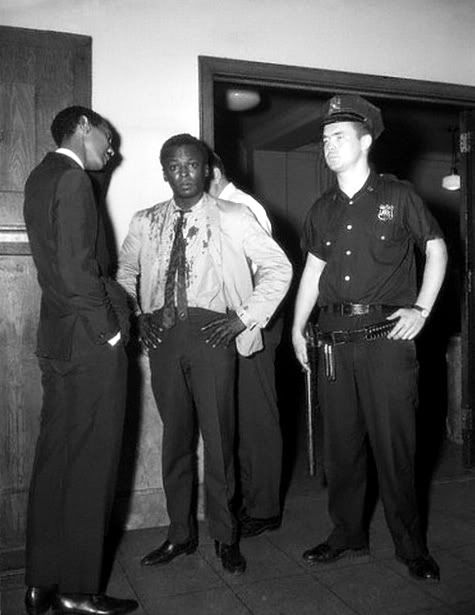
New York -- Miles Davis, 32, of 881 10th Avenue, a trumpeter now appearing in Birdland, 52nd Street and Broadway, was arrested after fighting with patrolman Gerald Kilduff, who had ordered him to move from crowded sidewalk. In the scuffle, Davis was hit on the head with a blackjack for which a St. Clare's ambulance had to be called.
On August 25, 1959, Miles Davis had these words uttered to him: "You're under arrest!" (which became the title of his 1985 album). After doing a set for an Armed Forces Day broadcast at Birdland, Miles was escorting his friend, a white woman, to a cab. He was stopped by the police, got beaten and was arrested.
The following is an extract from Miles - The Autobiography (Miles Davis with Quincy Troupe, Touchstone Book, 1989):
"I had just finished doing an Armed Forces Day broadcast, you know, Voice of America and all that bullshit. I had just walked this pretty white girl named Judy out to get a cab. She got in the cab, and I'm standing there in front of Birdland wringing wet because it's a hot, steaming, muggy night in August.
"This white policeman comes up to me and tells me to move on. At the time I was doing a lot of boxing and so I thought to myself, I ought to hit this motherfucker because I knew what he was doing. But instead I said, "Move on, for what? I'm working downstairs. That's my name up there, Miles Davis," and I pointed to my name on the marquee all up in lights.
"He said, "I don't care where you work, I said move on! If you don't move on I'm going to arrest you."
"I just looked at his face real straight and hard, and I didn't move. Then he said, "You're under arrest!" He reached for his handcuffs, but he was stepping back. Now, boxers had told me that if a guy's going to hit you, if you walk toward him you can see what's happening. I saw by the way he was handling himself that the policeman was an ex-fighter. So I kind of leaned in closer because I wasn't going to give him no distance so he could hit me on the head.
"He stumbled, and all his stuff fell on the sidewalk, and I thought to myself, Oh, shit, they're going to think that I fucked with him or something. I'm waiting for him to put the handcuffs on, because all this stuff is on the ground and shit. Then I move closer so he won't be able to fuck me up.
"A crowd had gathered all of a sudden from out of nowhere, and this white detective runs in and BAM! hits me on the head. I never saw him coming. Blood was running down the khaki suit I had on. Then I remember Dorothy Kilgallen coming outside with this horrible look on her face... and saying, "Miles, what happened?" I couldn't say nothing. Illinois Jacquet was there too.
"It was almost a race riot, so the police got scared and hurried up and got my ass out of there and took me to the 54th Precinct where they took pictures of me bleeding and shit. So, I'm sitting there, madder than a motherfucker, right? And they're saying to me in the station, "So you're the wiseguy, huh?" Then they'd bump up against me, you know, try to get me mad so they could probably knock me upside my head again. I'm just sitting there, taking it all in, watching every move they make...
"Later I sued the police department for US$500,000. Harold (Lovett) wasn't doing negligence suits, so he got another lawyer, who forgot to file the claim before the statute of limitations ran out. We lost the damage suit, and I was madder than a motherfucker, but there wasn't nothing I could do about it. The police revoked my cabaret license, and that prevented me from playing New York clubs for a while."
Photo found at "If Charlie Parker Was a Gunslinger, There'd Be a Whole Lot of Dead Copycats."
Story found at Rate Your Music.
Labels:
1950s,
Miles Davis Jazz,
US culture,
US History
Monday, February 9, 2009
The Day the Earth Stood Still....
February 9, 1964. Forty-five years ago today The Beatles made their first appearance on The Ed Sullivan Show and... pick one.
(1) The "Sixties" officially started.
(2) The decline and fall of Western Civilization got underway.
(3) Two months and eighteen days after we buried a President it was OK to smile again.
The first wave of rock & roll had been repelled. By February 9, 1964 Elvis was in the Army, Chuck Berry was in prison, Jerry Lee Lewis was in exile, and Little Richard had gone to church. Put in their place were the teen idols: Bobby Rydell, Paul Anka, Fabian, Dion. In a government laboratory scientists were able to successfully remove every molecule of soul and humanity from the songs of Fats Domino and Little Richard and grow Pat Boone in a test tube.
But the first battle had been fought with conventional weapons. On February 9, 1964, The Ed Sullivan Theater was added, just below Hiroshima, Nagasaki and the Bikini Atoll, to the list of sites where nuclear weapons had been detonated.
Watch it today, and the energy is still there.
Wednesday, November 5, 2008
Let America Be America Again
I had a longer post almost finished and ready to put up here when I opened my email and found one from my friend, the sociologist Carol Brooks Gardner. It was simply the text of the 1938 poem by Langston Hughes, "Let America Be America Again."
I have a short temper when it comes to poetry; I can tell in a line or two if I'm going to finish reading it. When I find a poem I like, I will almost always read it out loud so I can feel what the words are like when they hang in the air for a moment.
I know almost no one with a heart as cold and dead as my own, but try as I could, I could not get more than a couple verses into this poem without weeping. I almost never cry. By the end of this, the emotion of last evening still fresh, I wasn't sure if I would ever stop.
Originally published in Esquire, and in the International Worker Order pamphlet, A New Song (1938).
Let America Be America Again
by Langston Hughes
Let America be America again.
Let it be the dream it used to be.
Let it be the pioneer on the plain
Seeking a home where he himself is free.
(America never was America to me.)
Let America be the dream the dreamers dreamed--
Let it be that great strong land of love
Where never kings connive nor tyrants scheme
That any man be crushed by one above.
(It never was America to me.)
O, let my land be a land where Liberty
Is crowned with no false patriotic wreath,
But opportunity is real, and life is free,
Equality is in the air we breathe.
(There's never been equality for me,
Nor freedom in this "homeland of the free.")
Say, who are you that mumbles in the dark?
And who are you that draws your veil across the stars?
I am the poor white, fooled and pushed apart,
I am the Negro bearing slavery's scars.
I am the red man driven from the land,
I am the immigrant clutching the hope I seek--
And finding only the same old stupid plan
Of dog eat dog, of mighty crush the weak.
I am the young man, full of strength and hope,
Tangled in that ancient endless chain
Of profit, power, gain, of grab the land!
Of grab the gold! Of grab the ways of satisfying need!
Of work the men! Of take the pay!
Of owning everything for one's own greed!
I am the farmer, bondsman to the soil.
I am the worker sold to the machine.
I am the Negro, servant to you all.
I am the people, humble, hungry, mean--
Hungry yet today despite the dream.
Beaten yet today--O, Pioneers!
I am the man who never got ahead,
The poorest worker bartered through the years.
Yet I'm the one who dreamt our basic dream
In the Old World while still a serf of kings,
Who dreamt a dream so strong, so brave, so true,
That even yet its mighty daring sings
In every brick and stone, in every furrow turned
That's made America the land it has become.
O, I'm the man who sailed those early seas
In search of what I meant to be my home--
For I'm the one who left dark Ireland's shore,
And Poland's plain, and England's grassy lea,
And torn from Black Africa's strand I came
To build a "homeland of the free."
The free?
Who said the free? Not me?
Surely not me? The millions on relief today?
The millions shot down when we strike?
The millions who have nothing for our pay?
For all the dreams we've dreamed
And all the songs we've sung
And all the hopes we've held
And all the flags we've hung,
The millions who have nothing for our pay--
Except the dream that's almost dead today.
O, let America be America again--
The land that never has been yet--
And yet must be--the land where every man is free.
The land that's mine--the poor man's, Indian's, Negro's, ME--
Who made America,
Whose sweat and blood, whose faith and pain,
Whose hand at the foundry, whose plow in the rain,
Must bring back our mighty dream again.
Sure, call me any ugly name you choose--
The steel of freedom does not stain.
From those who live like leeches on the people's lives,
We must take back our land again,
America!
O, yes,
I say it plain,
America never was America to me,
And yet I swear this oath--
America will be!
Out of the rack and ruin of our gangster death,
The rape and rot of graft, and stealth, and lies,
We, the people, must redeem
The land, the mines, the plants, the rivers.
The mountains and the endless plain--
All, all the stretch of these great green states--
And make America again!
Saturday, September 13, 2008
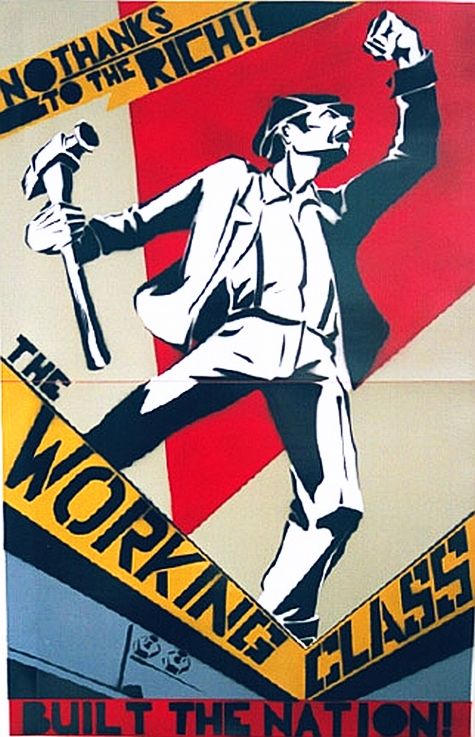
The Art of Labor....
"When you say fiscal responsibility, it seems to me that you really mean rich people keeping their money." — Alice Adams
"Those who want change must be against sacred cows and not only innately irreverent but outwardly, purposefully irreverent in their actions. They must be iconoclastic bulldozers willing to be regarded as profane spoilers of the sacred myths." — Saul Alinsky
"Silence never won rights. They are not handed down from above; they are forced by pressures from below." — Roger Baldwin
All these, and more here.
Thursday, August 28, 2008
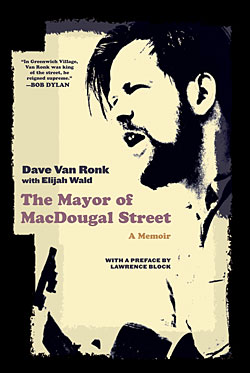
The Mayor of MacDougal Street....
Pekar's book is, in essence, a Classics Comics telling of the history of the student free speech movement and anti-war movement of the late 1960s. It's beauty is in its remarkable succinctness, the direct result of its being a comic (or "graphic novel" if you prefer).
As succinct as Pekar's book is, it is in Van Ronk's memoir that I found the most cogent critique of the anti-war New Left I've ever found. Van Ronk writes:
“[M]ost of these people were not really radicals, just a bunch of very pissed-off liberals. They had no grounding, and indeed no interest, in theory, and their disdain for studying history and learning economics infuriated me. The core problem with the New Left was that it wasn’t an ideology, it was a mood – and if you are susceptible to one mood, you are susceptible to another. They wanted the world to change, but essentially it was a petty bourgeois movement that had no connection with what was really going on. The working class at least has some power – if the working class folds its arms, the machinery stops – and as for the ruling class, its power is obvious. But what power does the middle class have? They have the power to talk: yak, yak, yak. To interpret, reinterpret, and re-reinterpret. And that is the history of the New Left in a nutshell" (emphasis added, p. 200).
Now log onto Amazon and go get your self a copy; I can't recommend a book more.
Labels:
1960s,
Dave Van Ronk,
folk music,
US History,
US Politics
Tuesday, June 10, 2008
Walking the Dogs: History in the Dust Bin & Other Stories
Our bedroom faces the street and the soft blue, red, and yellow pulse of police lights on the wall in the middle of the night does interesting things to your dreams.
Now whoever owns the place has had workers for the past month or so, gutting the inside and remodeling. The main guy is an ex-con, covered with jailhouse tattoos. He likes the dogs and we stop and chat whenever we go by and he’s there. I think one of the problems with prison must be leaving it behind once you don’t live there anymore. Almost every conversation leads to another story about something he doesn’t do anymore that put him in prison before. One morning he was all bruised up and told me he’d been jumped by five Mexicans in the parking lot of an East Side bar a few nights earlier. Something about an argument over how much they were to be paid for some drywall work, he showed me a gash on the side of his head where he was hit with a club.
“But they never got me down; then I got back to my truck and got my knife.” That’s as much information as he gives me and as much as I need.
But, I digress.
This Friday he wasn’t there, the house was closed up, but on the grass by the sidewalk were two trash cans and, as we passed I noticed a pile of photographs inside at the top.
This has happened to me once before. In the late 1980s I was in San Francisco for some academic conference and on a rainy evening walking to a restaurant with friends, I found a big pile of old family photos lying in a gutter. I saved the ones that weren’t ruined by the water, maybe 100-150 in all. They told the story of a guy who’d been in the US Navy and went to the South Pacific in the Second World War and then spent time in Japan where he met and married a Japanese woman and moved back to San Francisco where he worked as a bartender. The photos were all in black & white and included family gatherings, friends, visits to Japan; each photo had torn pits of black paper on the back from where they had been glued in a photo album. Why they were ripped from that album and tossed in the gutter – as opposed to simply throwing the entire album in the trash – remains a mystery.
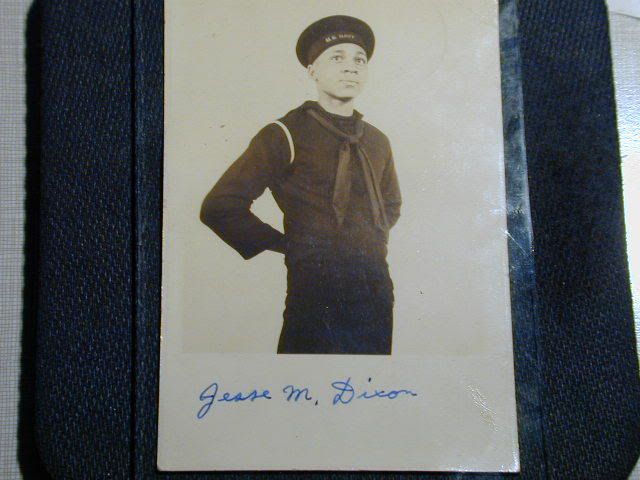
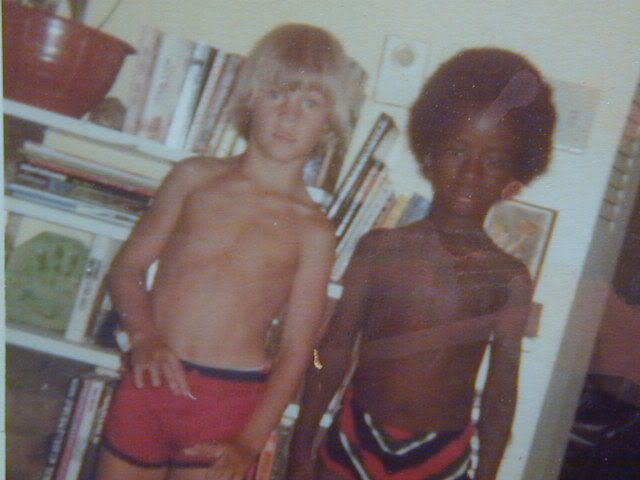
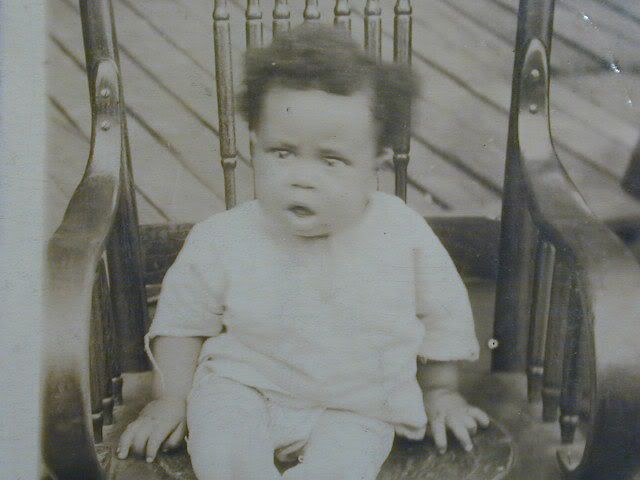
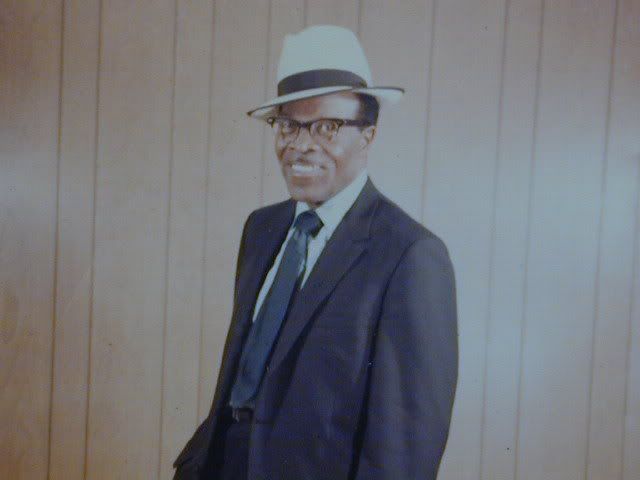
This time it was an African-American family, and the photographs go back to the 1930s or 40s and run up toward the end of the 1980s. There are four photo albums and another hundred or more loose photos as well. They chronicle weddings, births, deaths and funerals. There are pictures of black men in uniform at the end of WWII. The photos seem to represent Indianapolis, Kentucky and Philadelphia as the locations for gatherings and relations.
One friend I emailed the photos to replied that the 1930 census shows no Jesse Dixon in Indiana, but shows six Jesse Dixon's in Kentucky (2 in Jefferson and one each in Boyd, Floyd, Hardin, and Lewis). This is, I imagine, the sort of stuff a journalist might do in a search for survivors.
There’s an official file photo of a fortyish-year old black woman from the Philadelphia Naval Ship Yards in Philadelphia and, near that, is a page of photos of various children and adults taken at different Philadelphia tourist locations.
The photos from the 1970s are great; all the men have enormous afros and look like members of Parliament Funkadelic.
I’ve gone through the photos three times now. The first time I was just overwhelmed by the amount and variety of images. The second time I found myself looking at all the children; baby pictures, five and six year olds playing in yards, and thinking about the roughly 12% of all black men in their 20s in prisons in the US. According to “One in 100: Behind Bars in America 2008,” published by the Pew Center on the States, one in nine Black men between the ages of 20-34 are incarcerated compared to one in 30 other men of the same age. Like the overall adult ratio, one in 100 Black women in their mid-to-late 30s is in prison. I find it impossible to look at these photos and not think of that.
The third time I went through these an interesting thing happened. They turned into my family photos. They became everyone’s family photos; the same odd composition, the same weddings, the same parties, the same vacations. The ones from the late 40s and 50s are the most “posed.” Getting your picture taken was a bigger deal then. Some of the photos are actually post cards, a practice common to the times when you were going to be sending out the photos of a new baby or a cousin or nephew who just finished basic training.
The 1960s were the time for glossy black & white snapshots. Everybody had a camera by now. Photos become more common and plentiful, more casual and less posed. This is the time of the tilted angles, strangely cropped images and odd accidental lighting effects. I love photos from that era. The 1960s were a period of unbridled possibility; the people in these photographs look like they’re at the beginning of a great adventure.
In the 1970s and 1980s the photos shift again to hundreds of Polaroid pictures, rich, saturated colors, softer focus, even more casual. *These photos end in the late 1980s. Our paths, the people in these photos and mine, just missing as I think whoever the person was who lived in that house was gone by 1987, the year we arrived in Indianapolis and a couple years before we bought the house across the street.
One photo in particular seems to be a metaphor for the entire journey of this family through time. There are two young men in naval uniforms, side by side. The photo was either in direct sunlight for a long time or wasn’t fixed properly when it was printed but the image has almost disappeared. The sailors, once proud and full of energy and promise, are now the ghosts of sailors, almost entirely gone from this world.
And the visual history of our lives has been transformed yet again as we move into the new century. Now, instead of boxes of photos and albums bulging with wedding and vacation photos, we have hard drives stuffed with images. Digital photography means that taking 600 photos of your weekend in St. Louis is no big thing. It will be old PCs sitting out for the trash in the days ahead, and nothing to catch the attention of dog walkers in the future.
Everyday in Indianapolis, like every day in every city and town in America, the Sanitation Department comes and picks up the trash and I suspect trashcans stuffed with family histories are not that uncommon and may even collectively represent their own layer in every landfill in the country.
Americans are more nomadic than most other developed nations. I don’t know if it’s far less common for family photos to end up in the dustbin in France or England but my guess is that it would be. The most amazing example of history pulled from the void at the last possible second I have experienced involves a fiery shoebox, Henry Miller and Man Ray, a story that can be found here.
Earlier today a reporter and photographer from The Indianapolis Star and a senior archivist of African-American History from the Indiana Historical Society came over and took the albums and photographs. We sat around for an hour or so looking through all of it; we walked to the empty house and met with the contractor who took us into the basement and garage where even more photos of the black family, and a whole new collection of family pictures of a white family, were discovered. The reporter will try and track down someone from the family who might be stunned to see what just escaped destruction. If no one can be found the photos will be archived at the Historical Society where they will become another set of pieces in an enormous and ever-growing family album.
This would never have happened if we still had cats.
Labels:
African-American history,
family,
photography,
US History
Tuesday, November 27, 2007
Four Freedoms....
My war is the mother-of-all wars, the root cause of pretty much every social ill we face here and abroad.
The War on Poverty is the name for legislation first introduced by Lyndon Johnson during his State of the Union address on January 8, 1964. This legislation was proposed by Johnson in response to the difficult economic conditions associated with a national poverty rate of around nineteen percent.
The War on Poverty speech led the United States Congress to pass the Economic Opportunity Act, a law that established the Office of Economic Opportunity (OEO) to administrate the local application of federal funds targeted against poverty.
And here’s the thing….
The path to the White House in 08, and the greater path back through the ruins of Bush & Co. neo-conservatism and back toward something that resembles the America my father shot at the Germans over is through the restoration of the traditional values of the Democratic Party. It is these very values that ARE the "traditional American family values" the right loves to preach yet fails so miserably to practice.
Twenty-three years earlier, on January 6, 1941, Franklin Roosevelt delivered a State of the Union Address to the 77th United States Congress in which he articulated four fundamental freedoms people "everywhere in the world" ought to enjoy:
Freedom of speech and expression.
Freedom of every person to worship in his own way.
Freedom from want.
Freedom from fear.
His inclusion of the latter two freedoms went beyond the traditional American Constitutional values protected by the First Amendment, and endorsed a right to economic security and an internationalist view of foreign policy that have come to be central tenets of modern American liberalism. Roosevelt’s internationalist view must be understood in the greater historical context of the rise of German and Japanese aggression and the inevitable entry of the US into World War II.
Here’s what he said in that address:
“In the future days, which we seek to make secure, we look forward to a world founded upon four essential human freedoms.
The first is freedom of speech and expression--everywhere in the world.
The second is freedom of every person to worship God in his own way--everywhere in the world.
The third is freedom from want--which, translated into universal terms, means economic understandings which will secure to every nation a healthy peacetime life for its inhabitants-everywhere in the world.
The fourth is freedom from fear--which, translated into world terms, means a world-wide reduction of armaments to such a point and in such a thorough fashion that no nation will be in a position to commit an act of physical aggression against any neighbor--anywhere in the world.
That is no vision of a distant millennium. It is a definite basis for a kind of world attainable in our own time and generation. That kind of world is the very antithesis of the so-called new order of tyranny which the dictators seek to create with the crash of a bomb.”
It is that last bit that reaches out and grabs my attention with both hands; that this vision, “…is no vision of a distant millennium. It is a definite basis for a kind of world attainable in our own time and generation.”
Maybe it’s just me, but doesn’t that sound more inspiring than “Stay the course”?
When I say that the War on Poverty is the mother-of-all-wars I mean that the answer to gun violence isn’t gun control and the answer to the drug problem isn’t a “war on drugs” and the answer to the decline of America’s cities isn’t building more prisons and the answer to illegal immigration isn’t a big-ass fence and the answer to the instability of the Middle East isn’t the invasion of Iran.
If you fight a war on poverty you fight on all these fronts simultaneously. And you fight the only war capable of victories in each of these areas.
Address the mind-numbing hope-destroying dark chasm of poverty here and around the world then this vision of a better tomorrow becomes no vision of a distant millennium. It is a definite basis for a kind of world attainable in our own time and generation.
* Painting by Norman Rockwell, Freedom from Want (1943) The Saturday Evening Post, March 6, 1943 (story illustration). Oil on canvas 45 3/4 x 35 1/2 in. The Norman Rockwell Museum of Stockbridge (Massachusetts)
Labels:
2008 Presidential Race,
FDR,
US History,
US Politics
Friday, October 19, 2007
December 7, 1997 and August 28, 1963
Now, not to dive into the deep end of French literary theory but one favorite distinction gleaned from that work was Roland Barthes' notion of the writerly and readerly texts. Put simply, the meaning in readerly texts is fixed and rigid, but in writerly texts the meaning is more fluid, more open. Barthes said "In readerly texts the signifiers march; in writerly texts, they dance." As artists, the difference between Bob and Chuck seems pretty clear.
In 1997, Dylan and Heston were in the group of five artists honored by President Clinton at The Kennedy Center in Washington, D.C. In 1968, both men were also together in Washington with Dr. Martin Luther King, Jr., and a quarter of a million men and women marching together for social justice.
The March on Washington represented a coalition of several civil rights organizations, all of which generally had different approaches and different agendas. The "Big Six" organizers were James Farmer, of the Congress of Racial Equality (CORE); Martin Luther King, Jr., of the Southern Christian Leadership Conference (SCLC); John Lewis, of the Student Nonviolent Coordinating Committee (SNCC); A. Philip Randolph, of the Brotherhood of Sleeping Car Porters; Roy Wilkins, of the National Association for the Advancement of Colored People (NAACP); and Whitney Young, Jr., of the National Urban League.
Opposition to the march came from a number of quarters. President Kennedy originally discouraged the march, for fear that it might make the legislature vote against civil rights laws in reaction to a perceived threat. Once it became clear that the march would go on, however, he supported it. While various labor unions supported the march, the AFL-CIO remained neutral.
Outright opposition came from two sides. White supremacist groups, including the Ku Klux Klan, were obviously not in favor of any event supporting racial equality. On the other hand, the march was also condemned by some civil rights activists who felt it presented an inaccurate, sanitized pageant of racial harmony; Malcolm X called it the "Farce on Washington," and members of the Nation of Islam who attended the march faced a temporary suspension.
Nobody was sure how many people would turn up for the demonstration in Washington, D.C. Some traveling from the South were harassed and threatened. But on August 28, 1963, an estimated quarter of a million people—about a quarter of whom were white—marched from the Washington Monument to the Lincoln Memorial, in what turned out to be both a protest and a communal celebration. The heavy police presence turned out to be unnecessary, as the march was noted for its civility and peacefulness. The march was extensively covered by the media, with live international television coverage.
The event included musical performances by Marian Anderson; Joan Baez; Bob Dylan; Mahalia Jackson; Peter, Paul, and Mary; and Josh White. Charlton Heston—representing a contingent of artists, including Harry Belafonte, Marlon Brando, Diahann Carroll, Ossie Davis, Sammy Davis Jr., Lena Horne, Paul Newman, and Sidney Poitier–read a speech by James Baldwin.
The two most noteworthy speeches came from John Lewis and Martin Luther King, Jr. Lewis represented the Student Nonviolent Coordinating Committee, a younger, more radical group than King's. The original text to his speech had circulated throughout the day and the march leaders were able to convince him to tone down his rhetoric and remove the most inflammatory portions. What he did deliver was still the most explicitly radical speech of the day. He said, in part:
The revolution is at hand, and we must free ourselves of the chains of political and economic slavery. The nonviolent revolution is saying, "We will not wait for the courts to act, for we have been waiting hundreds of years. We will not wait for the President, nor the Justice Department, nor Congress, but we will take matters into our own hands, and create a great source of power, outside of any national structure that could and would assure us victory." For those who have said, "Be patient and wait!" we must say, "Patience is a dirty and nasty word." We cannot be patient, we do not want to be free gradually, we want our freedom, and we want it now. We cannot depend on any political party, for the Democrats and the Republicans have betrayed the basic principles of the Declaration of Independence.
Dr. King's speech remains one of the most famous speeches in American history. He started with prepared remarks, saying he was there to "cash a check" for "Life, Liberty and the pursuit of Happiness," while warning fellow protesters not to "allow our creative protest to degenerate into physical violence. But then he departed from his script, shifting into the "I have a dream" theme he'd used on prior occasions, drawing on both "the American dream" and religious themes, speaking of an America where his children "will not be judged by the color of their skin but by the content of their character." He followed this with an exhortation to "let freedom ring" across the nation, and concluded with:
And when this happens, when we allow freedom to ring, when we let it ring from every village and every hamlet, from every state and every city, we will be able to speed up that day when all of God's children, black men and white men, Jews and Gentiles, Protestants and Catholics, will be able to join hands and sing in the words of the old Negro spiritual, "Free at last, free at last. Thank God Almighty, we are free at last."
When I talk about the impact of Bob Dylan upon American culture in the last half century I always include the image of the 23 year-old folksinger on the stage in the shadow of the Washington Monument performing as, in effect, the warm up act for Dr. King's "I have a dream" speech.
Dylan sang his greatest protest song, "Only a Pawn in Their Game," about the murder of Medgar Evers on June 12, 1963 by Byron De La Beckwith, a member of the Ku Klux Klan. When he sang this song it was less than three months since that killing. In the film of the scene the camera pans the faces of the crowd and people appear to be listening intently to Dylan's words. The song is unique in the literature of protest music because it does not rally the troops by attacking the killer. Instead, it asks the listener to consider larger questions:
A bullet from the back of a bush took Medgar Evers' blood.
A finger fired the trigger to his name.
A handle hid out in the dark
A hand set the spark
Two eyes took the aim
Behind a man's brain
But he can't be blamed
He's only a pawn in their game.
A South politician preaches to the poor white man,"You got more than the blacks, don't complain.
You're better than them, you been born with white skin," they explain.
And the Negro's name
Is used it is plain
For the politician's gain
As he rises to fame
And the poor white remains
On the caboose of the train
But it ain't him to blame
He's only a pawn in their game.
You can see the rest of the lyrics and hear the melody here; the song is from Dylan's third and most explicitly "protest song" album, The Times They Are A-Changin', which wouldn't be released until the winter of 1963, which means that the crowd in Washington was hearing it for the first time.
But the song and performance that never fails to make all the hair on my neck stand at attention is immediately before that. "When the Ship Comes In" (seen here in a slightly grainy video from the march) uses Biblical imagery to create a sense of justice marching through history, destroying all enemies in its path.
Then the sands will roll
Out a carpet of gold
For your weary toes to be a-touchin'.
And the ship's wise men
Will remind you once again
That the whole wide world is watchin'.
Oh the foes will rise
With the sleep still in their eyes
And they'll jerk from their beds and think they're dreamin'.
But they'll pinch themselves and squeal
And know that it's for real,
The hour when the ship comes in.
Then they'll raise their hands,
Sayin' we'll meet all your demands,
But we'll shout from the bow your days are numbered.
And like Pharaoh's tribe,
They'll be drownded in the tide,
And like Goliath, they'll be conquered.
I suppose it's something to do with age. To paraphrase Bob, "I was so much younger then, I'm older than that now." In 2007 none of the TV networks would cover that march; the audience research says people don't want to see "protests" and we would have instead investigative reports on the breaking scandal of Ellen's dog and Britney's inability to follow the instructions that come with panties.
But "When the Ship Comes In," as powerful as it is, makes no sense today. It is as if it's being sung in a dying language, one with only one or two living speakers. A language that somehow no longer fits the world it once described.
Aw.... I hate to be a buzzkill, but the question does occur to me whether it really makes any difference if Rudy or Hillary is wearing the Captain's costume as the last little bit of the deck rail disappears beneath the frigid waves of the North Atlantic.
* The section above on the March on Washington borrows heavily from the Wikipedia entry.
Labels:
Bob Dylan,
folk music,
Race,
US History,
US Politics
Sunday, August 5, 2007
Eight Haikus for Richard Nixon
Richard Nixon sleeps
The little girl on fire
Visits his dreams
2
Mass murderer, liar
Paranoid war criminal
But he’s not a crook
3
And Richard Nixon
Must have to stand naked
So sang Bob Dylan
4
America ends
Among the flashlights in the
Watergate Hotel
5
Nixon in China
With Kissinger on the ground
Spiro left in charge
6
Chanted in the streets
Vietnam Cambodia
He tried to kill me
7
Nixon waves goodbye
Pat and Tricia try to smile
Nightmare is over
8
Many years later
Yorba Linda, black marble
Dancing on his grave
Subscribe to:
Posts (Atom)