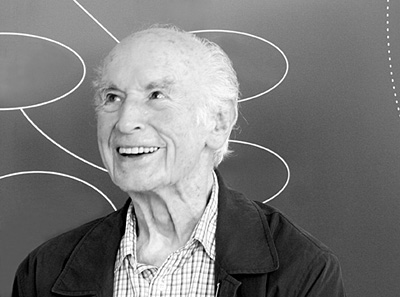
Albert Hofmann was born in Baden, Switzerland, on the elventh of January, 1906, and studied chemistry at the University of Zürich. His main interest was the chemistry of plants and animals, and he later conducted important research regarding the chemical structure of the common animal substance chitin, for which he received his doctorate.
Hofmann joined the pharmaceutical-chemical department of Sandoz Laboratories (now Novartis), located in Basel. He began studying the medicinal plant squill and the fungus ergot as part of a program to purify and synthesize active constituents for use as pharmaceuticals. Over the next few years, he worked his way through the lysergic acid derivatives, eventually synthesizing LSD-25 for the first time in 1938. After minimal testing, LSD-25 was set aside as he continued with other derivatives. Four years later, on April 16, 1943, he re-synthesized LSD-25 because he felt he might have missed something the first time around. That day, he became the first human to experience the effects of LSD after accidentally ingesting a minute amount.
Three days later, on April 19, 1943, he decided to verify his results by intentionally ingesting 250 ug of LSD. This day has become known as "Bicycle Day" as Hofmann experienced an incredible bicycle ride on his way home from the lab.
"Everything I saw was distorted as in a warped mirror," he said, describing his bicycle ride home. "I had the impression I was rooted to the spot. But my assistant told me we were actually going very fast."
Upon reaching home, Hofmann sat down on a divan and began experiencing what he called "wonderful visions."
"What I was thinking appeared in colors and in pictures," he told Swiss television network SF DRS for a program marking his 100th birthday two years ago.
For a time, Sandoz sold LSD 25 under the name Delysid, encouraging doctors to try it themselves. It was one of the strongest drugs in medicine — with just one gram enough to drug an estimated 10,000 to 20,000 people for 12 hours.
Hofmann discovered the drug had a similar chemical structure to psychedelic mushrooms and herbs used in religious ceremonies by Mexican Indians.
In addition to his discovery of LSD, he was also the first to synthesize psilocybin (the active constituent of 'magic mushrooms') in 1958. Albert Hofmann, known as the 'father of LSD', continued to work at Sandoz until 1971 when he retired as Director of Research for the Department of Natural Products. In his retirement, Hofmann served as a member of the Nobel Prize Committee. He continued to write, lecture, and play a leading role as an elder in the psychedelic community until his quick and relatively painless death from a heart attack at the age of 102.
"I think that in human evolution it has never been as necessary to have this substance LSD. It is just a tool to turn us into what we are supposed to be. ” — Albert Hofmann
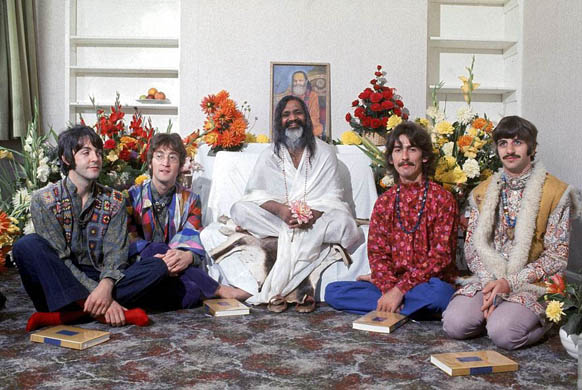
This past November I wrote about growing up in Philadelphia in the 1960s. I was motivated by the recent sale of the house I grew up in, and by a cover photo on a Sunday NY Times Magazine that reminded me of a photo I took in 1968 after seeing the Maharishi Mahesh Yogi when he toured the US with The Beach Boys. While the Beatles love affair with TM was short-lived (years later Paul McCartney confessed in an interview that the supposed sexual indiscretions attributed to the guru were false and that the Maharishi becoming upset by the Beatles drug use at the Himalayan retreat was the actual cause for the rift ), even the momentary intersection was responsible for some interesting things.
Looking back at the era, the arrival of the Maharishi onto the pop culture scene of the late 1960s makes quite a bit of sense. The chain of events included:
* George Harrison taking interest in the Indian musical instruments that appear in some of the scenes in the Beatles’ second feature film, Help! * A friendship between Roger McGuinn of The Byrds and the owner of the World Pacific record label (Ravi Shankar’s US label) led to David Crosby bringing Ravi Shankar to George Harrison’s attention. * John Lennon and George Harrison’s introduction to LSD-25 by way of being dosed by their dentist, Dr. John Riley, at a dinner party in 1965.
Canadian poet and song writer, Leonard Cohen, has spent quite some time in a California Zen monastery and his teacher, an old Japanese Zen master who heads that center, said something once that I think has a whole lot to do with the experience of psychedelic drugs.
“You can’t live in God’s realm too long. There are no restaurants or toilets.”
The Beatles move from LSD to meditation mirrors the experiences of the US Buddhist community as a whole. Tricycle: The Buddhist Review conducted a poll in Autumn of 1996:
"Number of responses: 1,454 (63% from the magazine, 37% from the web). 89% said that they were engaged in Buddhist practice. 83% said that they had taken psychedelics. Over 40% said that their interest in Buddhism was sparked by psychedelics, with percentages considerably higher for boomers than for twenty-somethings. 24% said that they are currently taking psychedelics, with the highest percentage for people over 50 and under 30. 41% said that psychedelics and Buddhism do not mix OR: 59% said that psychedelics and Buddhism do mix. The age group that expressed the most confidence in a healthy mix was under 20. 71% believe that "psychedelics are not a path but they can provide a glimpse of the reality to which Buddhist practice points." 58% said that they would consider taking psychedelics in a sacred context. (In the "under 20" category this percentage was 90 %)."
I remember that, when the Maharishi was in town in 1968, people could go to his hotel and get a private consultation with him for the price of one week’s salary and a bouquet of flowers. That consultation resulted in receiving one’s mantra, a nonsense word that you would repeat during meditation and that would help clear one’s mind. A major reason for my own independent skepticism regarding TM is the whole idea of the “top secret mantra.” Many years later a bunch of people who’d received TM training around the same time suddenly realized that they’d all been given the same mantra.
No wonder it’s a secret.
This is not, however, to dismiss the idea of daily meditation. If you’ve ever spent twenty minutes sitting on the floor or on a pillow trying to empty your mind you will gain an immediate insight to how The Beatles White Album came about.
For a little while in the late 1990s until about early 2002 my office was located directly next door to the Indianapolis Zen Center and I would often join them for their evening meditation. One night there was just myself, the center’s Abbot, and his assistant. After the half-hour of sitting in silence the Abbot’s assistant remarked, “I don’t know what was going on; my mind was a young puppy tonight.”
Perhaps monks who’ve been at it for twenty or so years can actually “empty their minds,” but most of us will find that, when we try, it is as if a damn of the most bizarre images and ideas has burst and floods our minds.
Flooded, I imagine, by characters like Bungalow Bill, Rocky Raccoon, blackbirds, warm guns, savory truffles, and all the little piggies.
So, from a dentist’s tea cup to a Himalayan retreat, from the giggles muffled by the Maharishi’s beard to the greatest double LP in pop music history.
And into deep space.
Polaris, 431 light-years away, is the destination NASA sent The Beatles song "Across the Universe" to commemorate the 50th anniversary of its first space mission. On Monday, February 4th at 7 p.m. Eastern time, the array of huge antennas that were usually tuned to listen for inbound signals from space beamed the best of John Lennon’s Rikikesh compositions to a spot (186,000 x 60 x 60 x 24 x 365 x 431) miles away.
Born sometime between 1911 and 1918, named Mahesh Prasad Varma at birth, the Maharishi Mahesh Yogi died this past February 5th in Holland. In the end I think he is bets remembered as basically a good fellow whose impact on the world was for the good and whose momentary affair with the counterculture of the 1960s influenced some fine music. Without it, there’s a chance that side two of The Beatles’ Sergeant Pepper LP might not start with “Within You Without You,” and that would be a tragedy.
Stan Denski, passed away on May 20, 2025 and lived in Indianapolis, IN, with his wife of 44 years. He plays acoustic and electric 6 & 12-string guitars in various odd tunings (try CGCGCF) and has released four albums under the names Many Bright Things and In The Summer Of The Mushroom Honey and has produced and written liner notes for over 30 others, including all ten volumes of the Love, Peace & Poetry series. As a scholar he has published numerous journal articles, book chapters, and one book. He is comfortable in his own skin and very much happy in his neighborhood and in his life.
On the reason for blogging...
"It does me good to write a letter which is not a response to a demand, a gratuitous letter, so to speak, which has accumulated in me like the waters of a reservoir." - Henry Miller
I live my life in growing orbits which move out over the things of the world perhaps I can never achieve the last but that will be my attempt. I am circling around God, around the ancient tower, and I have been circling for a thousand years and I still don't know if I am a falcon, or a storm, or a great song. ~Rainer Maria Rilke
“The current political situation is very muddled. People tend to confuse the quest for freedom with the embrace of capitalism. It seems doubtful that the joys of capitalism are enough to liberate a people. The bloody failure of socialism is on everybody’s lips, but no one sees capitalist globalization as a failure, in spite of the bloody inequalities that condition the market, and the populations who are excluded from it. The American Revolution failed long before the Soviet Revolution. Revolutionary situations and experiments are engendered by capitalism itself and show no signs of disappearing, unfortunately. Philosophy remains tied to a revolutionary becoming that has nothing to do with the history of revolutions.” - Gilles Deleuze “Two Regimes of Madness”, pg 379
"The point isn't the guitars, or jazz, or even music, but feeling more alive, more capable of compassion, more dedicated to beauty where it lives and love where it needs to go. " - Gary Keenan