Showing posts with label folk music. Show all posts
Monday, November 19, 2012
Promises, promises....
In July 2012 we organized the largest grass roots Woody Guthrie Centennial Celebration in the US, a 9 day festival with 13 events designed to educate and entertain, all in our neighborhood on the East side of Indianapolis, IN, Historic Irvington.
We now plan to make that celebration an annual event, and June 2-8, 2013 will see the Second Annual Irvington Folk Festival (Son of the Woody Guthrie Celebration) in various location in and around Irvington. For more information about the actual schedule of events check out the Facebook page (and go ahead and "like" us if you would).
In the meantime it is my plan to use this blog, which I had tired of somewhat during the political battles of the past few years, to look at the more-complicated-than-you-might-suspect notion of just what "folk music" actually is. So keep checking back to see just what's going on. In the mean time let me leave you with what I think was the brightest moment from last year's festival: Dale Lawrence & The Punkin Holler Boys doing a version of Woody's "This Land Is Your Land" is a quiet and introspective arrangement that drew everybody into the song.
Labels:
Dale Lawrence,
folk music,
Irvington,
Woody Guthrie
Thursday, March 25, 2010
Tim Buckley
My friend Fast Eddie and I saw Tim play once, at The Main Point, a tiny coffeehouse outside of Philadelphia on Lancaster Avenue. It was either in 1973 or 74, he was with a trio of musicians and I mostly remember the feeling of the performance more than any particulars. It was an unaffected melancholy; a genuine world-weariness that pervaded the show.
I have always loved Tim's voice, even though I find the son, Jeff, a second rate parody of the father (to paraphrase Oscar Wilde, "Only someone with a heart of stone can listen to Jeff Buckley sing 'Hallelujah' without laughing."). It is his second, third and fourth LPs, Goodbye and Hello (1967), Happy Sad (1969) and Blue Afternoon (1969) that are my favorites, though I appreciate the later, more experimental, efforts.
What I think of as his best album wasn't released until fifteen years after his death in 1975 at the age of 28. Dream Letter: Live in London 1968 (1990) is a double live LP (yes, it was released on vinyl as well as CD) that manages to capture all his best qualities. It also has my favorite of his songs, "Morning Glory." There is a cover version that is on the very first Blood, Sweat and Tears album, Child Is Father to the Man (1968), their debut (the band founded and led by Al Kooper and not the one featuring vocalist David Clayton Thomas) and another of the "best records by anybody ever."
A wonderful song; this version from Late Night Line Up from the BBC has surfaced on Youtube and is as perfect as perfect gets. Enjoy.
I have always loved Tim's voice, even though I find the son, Jeff, a second rate parody of the father (to paraphrase Oscar Wilde, "Only someone with a heart of stone can listen to Jeff Buckley sing 'Hallelujah' without laughing."). It is his second, third and fourth LPs, Goodbye and Hello (1967), Happy Sad (1969) and Blue Afternoon (1969) that are my favorites, though I appreciate the later, more experimental, efforts.
What I think of as his best album wasn't released until fifteen years after his death in 1975 at the age of 28. Dream Letter: Live in London 1968 (1990) is a double live LP (yes, it was released on vinyl as well as CD) that manages to capture all his best qualities. It also has my favorite of his songs, "Morning Glory." There is a cover version that is on the very first Blood, Sweat and Tears album, Child Is Father to the Man (1968), their debut (the band founded and led by Al Kooper and not the one featuring vocalist David Clayton Thomas) and another of the "best records by anybody ever."
A wonderful song; this version from Late Night Line Up from the BBC has surfaced on Youtube and is as perfect as perfect gets. Enjoy.
Sunday, August 2, 2009
Songs For Political Action....
Songs For Political Action: Folk Music, Topical Songs And The American Left 1926-1953 is a 1996 10 CD box set by the German-based Bear Family label.
Anyone unfamiliar with the Bear Family might want to take a tour of the web site and see some of the most excessive CD box sets anyone has ever imagined. It’s one thing to imagine a collection of early 60’s British skiffle performer, Lonnie Donegan. It’s another thing entirely to imagine it as an 8-CD box set with 60-page book (“More Than Pye in the Sky”).
Or, consider this: Currently in print are four different CD box sets for Dean Martin; an 8-CD & 84-page book set, another 8-CD & 84-page book set, and two different 6-CD plus DVD plus book sets (that’s 28 CDs, 2 DVDs and 4 books of Dino). You’ll also find three 4-CD Tex Ritter box sets, and page after page of multiple multi-CD boxes by Marty Robbins, Petula Clark and countless other artists from every genre and era.
When you look at a Bear Family box set of an artist you’re not particularly interested in there is a tendency to think, “How bizarre.” But, when you find that 12 CD box for one of your favorites that contains every alternate version, demo version, foreign language version, outtake, and a glossy hard cover book with full color photos of every LP, single, E.P., Indonesian flexi-disc, etc., there is a tendency to think, “It’s about time.” The Bear Family is the music collector’s dream label.
Songs For Political Action is a perfect case in point. 296 songs on 10 CDs with a 215-page hard cover coffee-table book makes for a box set that can’t be lifted with just one hand. It also makes for a stunning listening experience.
When compared to most of the developed world, America is still a very young country. It is a characteristic of youth to be disinterested in history, and that historical ambivalence is a defining aspect of the American character. The history of the American Left of the 1930s and 1940s is the history of average Americans struggling to gain the rights and rewards that most of us in 2009 pretty much take for granted.
This description from the Bear Family catalog places the collection in a concise context:
“Maybe it didn’t bring about the social and economic equality that it strove for, but the American Left of the 1930s and 1940s did leave one lasting legacy: the urban folk song revival. The energetic, politically daring music of the Almanac Singers and its predecessors, contemporaries and successors continue to resonate through today’s singer-songwriters. Spanning the years 1926 to 1953, the discs offer a comprehensive overview of this enduring music, from the labor choruses and New York’s socially conscious theatrical scene of the 1930s, to the Almanac Singers´ influential, the postwar idealism of People’s Songs and ends with the disturbing anti-Communist hysteria of the McCarthy era that silenced many of these talented, dedicated performers.”
The discs are organized historically and thematically: #1 - The Leftist Roots of the Folk Revival. #2 – Theatre and Cabaret Performers: 1936-1941. #3 – The Almanac Singers: March 1941-July 1941. #4 – Fighting the Fascists: 1942-1944. #5 – World War II and the Folk Revival. #6 – The People’s Songs Era: 1945-1949. #7 – Pete Seeger: 1946-1948. #8 – Charter Records: 1946-1949. #9 – Campaign Songs: 1944-1949. #10 – An Era Closes: 1949-1953.
Listen to songs like “I’m Going To Organize, Baby Mine” “There Is Mean Things Happening In This Land” “Farmer’s Letter To The President” “Write Me Out My Union Card” “We Shall Not Be Moved” “Bad Housing Blues” “Which Side Are You On?” “Oh, What Congress Done To Me” “Commonwealth of Toil” “Unemployment Compensation Blues” “The U.A.W. Train” “Susan’s in the Union” “Swingin’ On A Scab” “Song Of My Hands” “In Contempt” “Put My Name Down” “Talking Un-American Blues” “Joe McCarthy’s Band” and you’re listening to the history of America; the history of the individual men women who fought and died for simple things like a living wage, voting rights, the right to organize, and the dignity of the average American.
Throughout the collection there is an underlying passion for America, for the ideals and principles that America should extend to every citizen. It is fitting that the last song on the last disc is Woody Guthrie’s “This Land Is Your Land.” This passion for America, and a stubborn refusal to accept nothing less than America’s promise of a fundamental fairness, rests right on the surface of lyrics like:
“Was a high wall there that tried to stop me
A sign was painted said: Private Property,
But on the back side it didn't say nothing --
This land was made for you and me.
One bright sunny morning in the shadow of the steeple
By the Relief Office I saw my people --
As they stood hungry, I stood there wondering if
God blessed America for me.”
Guthrie was a true phenomenon in his time, extraordinarily popular. I’ve always like Grapes of Wrath author, John Steinbeck’s description:
“Woody is just Woody. Thousands of people do not know he has any other name. He is just a voice and a guitar. He sings the songs of a people and I suspect that he is, in a way, that people. Harsh voiced and nasal, his guitar hanging like a tire iron on a rusty rim, there is nothing sweet about Woody, and there is nothing sweet about the songs he sings. But there is something more important for those who will listen. There is the will of the people to endure and fight against oppression. I think we call this the American spirit.”
I think I paid about $250 or so for this box a few years back and it’s been worth that to me. When I was a kid I had an Uncle Joe who always bought me books, every birthday, Christmas, and often whenever he’d come to visit. If I had money, I’d buy a copy for every kid I know as I’m pretty sure this isn’t the history they're getting in schools today, and if anyone ever said a truer thing than “Those who forget history are condemned to repeat it.” I’d sure like to hear it.
Thursday, August 28, 2008
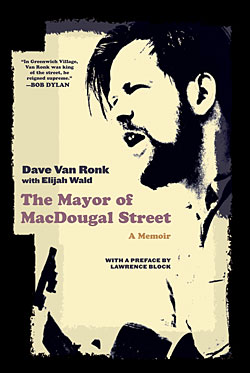
The Mayor of MacDougal Street....
Pekar's book is, in essence, a Classics Comics telling of the history of the student free speech movement and anti-war movement of the late 1960s. It's beauty is in its remarkable succinctness, the direct result of its being a comic (or "graphic novel" if you prefer).
As succinct as Pekar's book is, it is in Van Ronk's memoir that I found the most cogent critique of the anti-war New Left I've ever found. Van Ronk writes:
“[M]ost of these people were not really radicals, just a bunch of very pissed-off liberals. They had no grounding, and indeed no interest, in theory, and their disdain for studying history and learning economics infuriated me. The core problem with the New Left was that it wasn’t an ideology, it was a mood – and if you are susceptible to one mood, you are susceptible to another. They wanted the world to change, but essentially it was a petty bourgeois movement that had no connection with what was really going on. The working class at least has some power – if the working class folds its arms, the machinery stops – and as for the ruling class, its power is obvious. But what power does the middle class have? They have the power to talk: yak, yak, yak. To interpret, reinterpret, and re-reinterpret. And that is the history of the New Left in a nutshell" (emphasis added, p. 200).
Now log onto Amazon and go get your self a copy; I can't recommend a book more.
Labels:
1960s,
Dave Van Ronk,
folk music,
US History,
US Politics
Friday, October 19, 2007
December 7, 1997 and August 28, 1963
Now, not to dive into the deep end of French literary theory but one favorite distinction gleaned from that work was Roland Barthes' notion of the writerly and readerly texts. Put simply, the meaning in readerly texts is fixed and rigid, but in writerly texts the meaning is more fluid, more open. Barthes said "In readerly texts the signifiers march; in writerly texts, they dance." As artists, the difference between Bob and Chuck seems pretty clear.
In 1997, Dylan and Heston were in the group of five artists honored by President Clinton at The Kennedy Center in Washington, D.C. In 1968, both men were also together in Washington with Dr. Martin Luther King, Jr., and a quarter of a million men and women marching together for social justice.
The March on Washington represented a coalition of several civil rights organizations, all of which generally had different approaches and different agendas. The "Big Six" organizers were James Farmer, of the Congress of Racial Equality (CORE); Martin Luther King, Jr., of the Southern Christian Leadership Conference (SCLC); John Lewis, of the Student Nonviolent Coordinating Committee (SNCC); A. Philip Randolph, of the Brotherhood of Sleeping Car Porters; Roy Wilkins, of the National Association for the Advancement of Colored People (NAACP); and Whitney Young, Jr., of the National Urban League.
Opposition to the march came from a number of quarters. President Kennedy originally discouraged the march, for fear that it might make the legislature vote against civil rights laws in reaction to a perceived threat. Once it became clear that the march would go on, however, he supported it. While various labor unions supported the march, the AFL-CIO remained neutral.
Outright opposition came from two sides. White supremacist groups, including the Ku Klux Klan, were obviously not in favor of any event supporting racial equality. On the other hand, the march was also condemned by some civil rights activists who felt it presented an inaccurate, sanitized pageant of racial harmony; Malcolm X called it the "Farce on Washington," and members of the Nation of Islam who attended the march faced a temporary suspension.
Nobody was sure how many people would turn up for the demonstration in Washington, D.C. Some traveling from the South were harassed and threatened. But on August 28, 1963, an estimated quarter of a million people—about a quarter of whom were white—marched from the Washington Monument to the Lincoln Memorial, in what turned out to be both a protest and a communal celebration. The heavy police presence turned out to be unnecessary, as the march was noted for its civility and peacefulness. The march was extensively covered by the media, with live international television coverage.
The event included musical performances by Marian Anderson; Joan Baez; Bob Dylan; Mahalia Jackson; Peter, Paul, and Mary; and Josh White. Charlton Heston—representing a contingent of artists, including Harry Belafonte, Marlon Brando, Diahann Carroll, Ossie Davis, Sammy Davis Jr., Lena Horne, Paul Newman, and Sidney Poitier–read a speech by James Baldwin.
The two most noteworthy speeches came from John Lewis and Martin Luther King, Jr. Lewis represented the Student Nonviolent Coordinating Committee, a younger, more radical group than King's. The original text to his speech had circulated throughout the day and the march leaders were able to convince him to tone down his rhetoric and remove the most inflammatory portions. What he did deliver was still the most explicitly radical speech of the day. He said, in part:
The revolution is at hand, and we must free ourselves of the chains of political and economic slavery. The nonviolent revolution is saying, "We will not wait for the courts to act, for we have been waiting hundreds of years. We will not wait for the President, nor the Justice Department, nor Congress, but we will take matters into our own hands, and create a great source of power, outside of any national structure that could and would assure us victory." For those who have said, "Be patient and wait!" we must say, "Patience is a dirty and nasty word." We cannot be patient, we do not want to be free gradually, we want our freedom, and we want it now. We cannot depend on any political party, for the Democrats and the Republicans have betrayed the basic principles of the Declaration of Independence.
Dr. King's speech remains one of the most famous speeches in American history. He started with prepared remarks, saying he was there to "cash a check" for "Life, Liberty and the pursuit of Happiness," while warning fellow protesters not to "allow our creative protest to degenerate into physical violence. But then he departed from his script, shifting into the "I have a dream" theme he'd used on prior occasions, drawing on both "the American dream" and religious themes, speaking of an America where his children "will not be judged by the color of their skin but by the content of their character." He followed this with an exhortation to "let freedom ring" across the nation, and concluded with:
And when this happens, when we allow freedom to ring, when we let it ring from every village and every hamlet, from every state and every city, we will be able to speed up that day when all of God's children, black men and white men, Jews and Gentiles, Protestants and Catholics, will be able to join hands and sing in the words of the old Negro spiritual, "Free at last, free at last. Thank God Almighty, we are free at last."
When I talk about the impact of Bob Dylan upon American culture in the last half century I always include the image of the 23 year-old folksinger on the stage in the shadow of the Washington Monument performing as, in effect, the warm up act for Dr. King's "I have a dream" speech.
Dylan sang his greatest protest song, "Only a Pawn in Their Game," about the murder of Medgar Evers on June 12, 1963 by Byron De La Beckwith, a member of the Ku Klux Klan. When he sang this song it was less than three months since that killing. In the film of the scene the camera pans the faces of the crowd and people appear to be listening intently to Dylan's words. The song is unique in the literature of protest music because it does not rally the troops by attacking the killer. Instead, it asks the listener to consider larger questions:
A bullet from the back of a bush took Medgar Evers' blood.
A finger fired the trigger to his name.
A handle hid out in the dark
A hand set the spark
Two eyes took the aim
Behind a man's brain
But he can't be blamed
He's only a pawn in their game.
A South politician preaches to the poor white man,"You got more than the blacks, don't complain.
You're better than them, you been born with white skin," they explain.
And the Negro's name
Is used it is plain
For the politician's gain
As he rises to fame
And the poor white remains
On the caboose of the train
But it ain't him to blame
He's only a pawn in their game.
You can see the rest of the lyrics and hear the melody here; the song is from Dylan's third and most explicitly "protest song" album, The Times They Are A-Changin', which wouldn't be released until the winter of 1963, which means that the crowd in Washington was hearing it for the first time.
But the song and performance that never fails to make all the hair on my neck stand at attention is immediately before that. "When the Ship Comes In" (seen here in a slightly grainy video from the march) uses Biblical imagery to create a sense of justice marching through history, destroying all enemies in its path.
Then the sands will roll
Out a carpet of gold
For your weary toes to be a-touchin'.
And the ship's wise men
Will remind you once again
That the whole wide world is watchin'.
Oh the foes will rise
With the sleep still in their eyes
And they'll jerk from their beds and think they're dreamin'.
But they'll pinch themselves and squeal
And know that it's for real,
The hour when the ship comes in.
Then they'll raise their hands,
Sayin' we'll meet all your demands,
But we'll shout from the bow your days are numbered.
And like Pharaoh's tribe,
They'll be drownded in the tide,
And like Goliath, they'll be conquered.
I suppose it's something to do with age. To paraphrase Bob, "I was so much younger then, I'm older than that now." In 2007 none of the TV networks would cover that march; the audience research says people don't want to see "protests" and we would have instead investigative reports on the breaking scandal of Ellen's dog and Britney's inability to follow the instructions that come with panties.
But "When the Ship Comes In," as powerful as it is, makes no sense today. It is as if it's being sung in a dying language, one with only one or two living speakers. A language that somehow no longer fits the world it once described.
Aw.... I hate to be a buzzkill, but the question does occur to me whether it really makes any difference if Rudy or Hillary is wearing the Captain's costume as the last little bit of the deck rail disappears beneath the frigid waves of the North Atlantic.
* The section above on the March on Washington borrows heavily from the Wikipedia entry.
Labels:
Bob Dylan,
folk music,
Race,
US History,
US Politics
Saturday, April 7, 2007
The Tao of Music
"We could say that meditation doesn't have a reason or doesn't have a purpose. In this respect it's unlike almost all other things we do except perhaps making music and dancing.
When we make music we don't do it in order to reach a certain point, such as the end of the composition. If that were the purpose of music then obviously the fastest players would be the best.
Also, when we are dancing we are not aiming to arrive at a particular place on the floor as in a journey. When we dance, the journey itself is the point, as when we play music the playing itself is the point.
And exactly the same thing is true in meditation. Meditation is the discovery that the point of life is always arrived at in the immediate moment.” - Alan Watts
When we make music we don't do it in order to reach a certain point, such as the end of the composition. If that were the purpose of music then obviously the fastest players would be the best.
Also, when we are dancing we are not aiming to arrive at a particular place on the floor as in a journey. When we dance, the journey itself is the point, as when we play music the playing itself is the point.
And exactly the same thing is true in meditation. Meditation is the discovery that the point of life is always arrived at in the immediate moment.” - Alan Watts
Wednesday, April 4, 2007
Don't We All Want To Be Freewheelin'?
If there is one principle true for all great art it is that repeat visits are rewarded with new insights. This is true for the greatest paintings as it is true for the greatest films and it is true for the greatest pop records. I just relistened to this album. I’ve heard this, I can’t begin to estimate how many times in the past 4 decades or so and it offers its rewards each and every time. In Dylan’s expansive catalog I’m hard-pressed to name another record that’s actually better than this one.
Dylan's sophomore album, Freewheelin' was the follow-up to his eponymous 1962 debut, an album that sold so poorly that Dylan was nick-named "Hammond's Folly" inside Columbia Records. But where his debut presented Dylan in full Woody Guthrie mode, still making wild claims about a mythical childhood in the Southwest and being raised by wolves in the Black Hills of the Dakotas, it's on Freewheelin' that Bob Dylan finds his voice. It's here that he puts the finishing touches on his persona, adding touches of James Dean and Brando to Woody Guthrie and Ramblin' Jack.
Just like "true" Beatles fans identify themselves by denigrating Sgt. Pepper, so too is there a tendency among "true" Dylan fans to dismiss “Blowin’ in the Wind” as "overrated." But "true" fans are, when you get down to it, more often clueless idiots than not, and obsessive devotion to Bob Dylan minutia will most likely blind you to the BIG truths. That "Blowin' in the Wind" is among the greatest American songs of the 20th Century is one of those truths. I imagine it gets the short shrift now because it sounds like one of those songs, like “Amazing Grace” or "We Shall Overcome," a song that can’t possibly have an author (or a song that simply dwarfs its authorship, rendering it irrelevant). On an album of various major and minor masterpieces this really does remain the jewel in the crown.
Like many early Bob songs, “Girl of the North Country” is based on an older folk song (George Harrison based “My Sweet Lord” on “He’s So Fine” and look where it got him). It’s a timeless melody, made near-perfect by this set of lyrics; the album performance is simply sublime.
"Masters of War" has always seemed like a bit of a sore thumb here. It's Dylan's "protest songs" that are the most dated of his catalog (and the follow-up to this album, The Times They Are A-Changing, is his only dated-sounding LP from his early work). But Greil Marcus has made a strong case that the value of the song is in its emotional excess, not in its literal interpretation as “protest” song.
“Down the Highway” is Dylan playing in a classic country blues style. Not the best song here, it adds spice and variety to the record as a whole. The first album was Dylan-as-folksinger, this album is Dylan-as-Dylan and every song here is a piece in that portrait.
"Bob Dylan’s Blues" plays the essential role here of releasing some air from the profundity balloon. It also reminds me that one of the real casualties of Dylan’s post-1964 career was how his phenomenal comic abilities got lost. In 2007 it's almost impossible to imagine Dylan as a comic, but I also imagine that, in his later years, it was just as difficult to look at Chaplin and still see the Little Tramp. Remember, things change.
“A Hard Rain…” Yes, it’s based on an old Scottish ballad, but it stands there, with one foot in the 17th Century and the other in the 20th. It encompasses Kerouac, Ginsberg and the Beats and who knows how many other references I’m not well-read enough to pick up on. Dylan’s denial that the “rain” is atomic fallout shines a light on the whole problem with authorial intentionality. The songs exists apart from Bob and, set in the cold war and Cuban missile crisis, clearly includes nuclear rain at the top of its list of signifiers. It’s hard to imagine today what hearing this song in the early 60s was like. Hard as it is for a 2007 Dylan audience to imagine, people actually stopped going out for more beer and screaming “WATCHTOWER BOBBY!!!! WOOOO!” during it. People sat, dumbfounded, just stunned by it, like they must have reacted to hearing Charlie Parker for the first time, or Bill Monroe, or anything actually, genuinely NEW.
"A Hard Rain" is also the BIG BANG of what would become the singer/songwriter movement; it is the moment that redefined folk authenticity and made writing and singing original songs a requirement rather than grounds for banishment.
“Don’t Think Twice…” is AS good a song as anything else on here. It’s like a perfect miniature portrait. The album version is that rare flawless thing. It's also the sort of underhanded sly misogyny that would define Dylan's romantic relationships for the rest of his life.
“Bob Dylan’s Dream” is one of my 5 or 6 favorite Dylan songs. I like to sing it a cappella in my car (and LOUD) when I’m on the highway coming back from or on the way to a visit with my oldest and best friends. “I wish, I wish, I wish in vain. That we could sit simply in that room again. Ten thousand dollars at the drop of a hat, I’d give it all gladly, if our lives could be like that.” Jesus. Who wouldn't?
“Oxford Town” is the conjoined twin to “Masters of War” but not as good (it would need to call for the death of everyone in Oxford to be as good), not as excessive. The earlier “Emmett Till” is very much a superior song. The performance is lacking too. Richie Havens covers it on a very early record and it’s way stronger. The tell-tale sign of a lesser Dylan song is when someone else does it better ("All Along the Watchtower" excepted).
“Talkin’ WWIII.…” More great satire stuffed with brilliant one-liners. You get the impression that this guy would sound interesting putting in a breakfast order. Can you imagine the 2007 Bob Dylan doing something like this? I know. I can't either.
I wonder if the sequencing of these last three tracks, which result in the record closing slightly less impressively than it opens, has something to do with the last-minute juggling of tracks when 4 songs that were slated to be on the album got pulled and replaced. Those songs, good ones too, were more Bob-as-Woody and already too dated to make the 2nd LP – an indication of his off-the-scale growth rate at the time.
“Corrina, Corrina” was a revelation because no one knew or suspected that little Bobby was a rocker at heart. His piano-playing-kicked-off-the-HS-talent-show shenanigans wouldn’t come to light for decades yet. The 45 track “Mixed Up Confusion” never got air play or got around and sank from sight once he took the Folk King crown. Great song and a great version.
“Honey, Just Allow Me…” and “”I Shall Be Free” both give the suggestion of being wine-fueled studio improvs, though I have no idea how true or false that is. They’re outrageous and funny and help deflect a one-dimensional self-importance that would not have benefited the record over time.
Finally, there's the cover.
The amazing cover.
A simple photo of Bob and girlfriend walking down a winter street in the Village, it somehow manages to encompass the vague and uncertain concept of "freewheelin'" and the result is that an entire generation would long to be "freewheelin'."
To be freewheelin' seemed to have something to do with your relationship to the future. If the defining characteristic of what is now called "THE SIXTIES" was an ability to imagine a future as something other than the simple extension of the present then the sixties start here, in those boots, those jeans, that jacket.
Dylan's sophomore album, Freewheelin' was the follow-up to his eponymous 1962 debut, an album that sold so poorly that Dylan was nick-named "Hammond's Folly" inside Columbia Records. But where his debut presented Dylan in full Woody Guthrie mode, still making wild claims about a mythical childhood in the Southwest and being raised by wolves in the Black Hills of the Dakotas, it's on Freewheelin' that Bob Dylan finds his voice. It's here that he puts the finishing touches on his persona, adding touches of James Dean and Brando to Woody Guthrie and Ramblin' Jack.
Just like "true" Beatles fans identify themselves by denigrating Sgt. Pepper, so too is there a tendency among "true" Dylan fans to dismiss “Blowin’ in the Wind” as "overrated." But "true" fans are, when you get down to it, more often clueless idiots than not, and obsessive devotion to Bob Dylan minutia will most likely blind you to the BIG truths. That "Blowin' in the Wind" is among the greatest American songs of the 20th Century is one of those truths. I imagine it gets the short shrift now because it sounds like one of those songs, like “Amazing Grace” or "We Shall Overcome," a song that can’t possibly have an author (or a song that simply dwarfs its authorship, rendering it irrelevant). On an album of various major and minor masterpieces this really does remain the jewel in the crown.
Like many early Bob songs, “Girl of the North Country” is based on an older folk song (George Harrison based “My Sweet Lord” on “He’s So Fine” and look where it got him). It’s a timeless melody, made near-perfect by this set of lyrics; the album performance is simply sublime.
"Masters of War" has always seemed like a bit of a sore thumb here. It's Dylan's "protest songs" that are the most dated of his catalog (and the follow-up to this album, The Times They Are A-Changing, is his only dated-sounding LP from his early work). But Greil Marcus has made a strong case that the value of the song is in its emotional excess, not in its literal interpretation as “protest” song.
“Down the Highway” is Dylan playing in a classic country blues style. Not the best song here, it adds spice and variety to the record as a whole. The first album was Dylan-as-folksinger, this album is Dylan-as-Dylan and every song here is a piece in that portrait.
"Bob Dylan’s Blues" plays the essential role here of releasing some air from the profundity balloon. It also reminds me that one of the real casualties of Dylan’s post-1964 career was how his phenomenal comic abilities got lost. In 2007 it's almost impossible to imagine Dylan as a comic, but I also imagine that, in his later years, it was just as difficult to look at Chaplin and still see the Little Tramp. Remember, things change.
“A Hard Rain…” Yes, it’s based on an old Scottish ballad, but it stands there, with one foot in the 17th Century and the other in the 20th. It encompasses Kerouac, Ginsberg and the Beats and who knows how many other references I’m not well-read enough to pick up on. Dylan’s denial that the “rain” is atomic fallout shines a light on the whole problem with authorial intentionality. The songs exists apart from Bob and, set in the cold war and Cuban missile crisis, clearly includes nuclear rain at the top of its list of signifiers. It’s hard to imagine today what hearing this song in the early 60s was like. Hard as it is for a 2007 Dylan audience to imagine, people actually stopped going out for more beer and screaming “WATCHTOWER BOBBY!!!! WOOOO!” during it. People sat, dumbfounded, just stunned by it, like they must have reacted to hearing Charlie Parker for the first time, or Bill Monroe, or anything actually, genuinely NEW.
"A Hard Rain" is also the BIG BANG of what would become the singer/songwriter movement; it is the moment that redefined folk authenticity and made writing and singing original songs a requirement rather than grounds for banishment.
“Don’t Think Twice…” is AS good a song as anything else on here. It’s like a perfect miniature portrait. The album version is that rare flawless thing. It's also the sort of underhanded sly misogyny that would define Dylan's romantic relationships for the rest of his life.
“Bob Dylan’s Dream” is one of my 5 or 6 favorite Dylan songs. I like to sing it a cappella in my car (and LOUD) when I’m on the highway coming back from or on the way to a visit with my oldest and best friends. “I wish, I wish, I wish in vain. That we could sit simply in that room again. Ten thousand dollars at the drop of a hat, I’d give it all gladly, if our lives could be like that.” Jesus. Who wouldn't?
“Oxford Town” is the conjoined twin to “Masters of War” but not as good (it would need to call for the death of everyone in Oxford to be as good), not as excessive. The earlier “Emmett Till” is very much a superior song. The performance is lacking too. Richie Havens covers it on a very early record and it’s way stronger. The tell-tale sign of a lesser Dylan song is when someone else does it better ("All Along the Watchtower" excepted).
“Talkin’ WWIII.…” More great satire stuffed with brilliant one-liners. You get the impression that this guy would sound interesting putting in a breakfast order. Can you imagine the 2007 Bob Dylan doing something like this? I know. I can't either.
I wonder if the sequencing of these last three tracks, which result in the record closing slightly less impressively than it opens, has something to do with the last-minute juggling of tracks when 4 songs that were slated to be on the album got pulled and replaced. Those songs, good ones too, were more Bob-as-Woody and already too dated to make the 2nd LP – an indication of his off-the-scale growth rate at the time.
“Corrina, Corrina” was a revelation because no one knew or suspected that little Bobby was a rocker at heart. His piano-playing-kicked-off-the-HS-talent-show shenanigans wouldn’t come to light for decades yet. The 45 track “Mixed Up Confusion” never got air play or got around and sank from sight once he took the Folk King crown. Great song and a great version.
“Honey, Just Allow Me…” and “”I Shall Be Free” both give the suggestion of being wine-fueled studio improvs, though I have no idea how true or false that is. They’re outrageous and funny and help deflect a one-dimensional self-importance that would not have benefited the record over time.
Finally, there's the cover.
The amazing cover.
A simple photo of Bob and girlfriend walking down a winter street in the Village, it somehow manages to encompass the vague and uncertain concept of "freewheelin'" and the result is that an entire generation would long to be "freewheelin'."
To be freewheelin' seemed to have something to do with your relationship to the future. If the defining characteristic of what is now called "THE SIXTIES" was an ability to imagine a future as something other than the simple extension of the present then the sixties start here, in those boots, those jeans, that jacket.
Subscribe to:
Posts (Atom)