Showing posts with label space. Show all posts

Saturday, July 25, 2009

The Exploration of Space and the Consciousness of Cathedrals

Man stands on the Moon, July 1969

Ignore for the moment that conservative Republicans mostly believe the moon landing was a hoax ("If it's real then why aren't there dinosaurs in the photo? Well? Answer that, smart guy!") and take a moment to reflect on the 40th anniversary of the Moon landing and contemplate the reasons why that seemed to represent the swan song for America's program of space exploration.

In a neighborhood coffee shop the other day I watched a twenty-something guy get frustrated to the point of apoplexy with his laptop computer because it took over twenty seconds to load a Youtube video. This, to me, represents the current consciousness we bring with us when we regard time.

Now consider that the nearest star to our solar system is Proxima Centauri, part of a triple star system called Alpha Centauri; Proxima is 4.22 light years from Earth. Considered to be science fiction only a few decades ago, the technology of ion drive propulsion has increased the speed of a potential inter stellar vehicle well beyond anything we've known in the past. Using ion drive propulsion, a vessel from Earth would take 81,000 years to make the one-way journey. In human terms, that is 2,700 generations of people, living and dying along the way. Or, imagine the launch of the spaceship in late 2010, and then imagine the parade celebrating it's arrival in 83015 (allowing the additional 4.22 years for the radio message "We made it!" to arrive).

Now imagine another quantum leap forward in propulsion technology allowing the ship to maintain the top speed attainable through gravitational assist, and you can cut a large amount of time off that figure. Now the travel time is reduced to 19,000 years (600 generations). You've cut 62,000 years off your travel time, not too shabby.

Nuclear pulse propulsion is a theoretically possible form of fast space travel. Very early on in the development of the development of the atomic bomb, nuclear pulse propulsion was proposed in 1947 and Project Orion was born in 1958 to investigate interplanetary space travel.

The Partial Test Ban Treaty of 1963 is largely attributed to the cancellation of Project Orion (due to the obvious design flaw that huge amounts of radioactive waste would be pumped into space), but what kind of velocities could a nuclear pulse propulsion spaceship attain? Some estimates suggest a ballpark figure of 5% the speed of light (or 5.4×10⁷ km/hr). So assuming a spacecraft could travel at these speeds, it would take a Project Orion-type craft approximately 85 years to travel from the Earth to Proxima Centauri.

Now we're talking. We've managed to slice 80,915 years off our original estimate (ignoring the nuclear pollution of the galaxy for a moment). But even 85 years in Youtube minutes is impossibly long. Such a monumental expenditure of time and money, it's difficult to imagine a Presidential administration putting energy behind a journey that would not see a "Welcome back!" parade until forty-two and a half administrations later.

If we consider what happens when inter stellar travel time consciousness collides full on with Youtube download time consciousness... you can see what the problem is. One solution might be if North Korea or Iran were to announce that they are putting resources into a space program for the purpose of inter stellar exploration. That might do it.

Within 48 hours every Republican with a hideous fake tan would be converging on Fox News demanding action be taken (just so long as poor people don't somehow benefit).

But I digress....


In 1160, Bishop Maurice de Sully had a vision in which he saw a new cathedral in the place where the current Parisian cathedral, St Stephen's (built in the 4th century) stood. Shortly after he assumed the title of Bishop of Paris, de Sully had the old cathedral demolished. Three years later, in 1163, the cornerstone for the new cathedral was lain. In 1196 de Sully died just as the nave (the central approach to the high altar in Gothic church architecture) was completed.

In 1345 the Cathedral of Notre Dame was completed and opened to the people of Paris.

Human history is nothing if not a story linked by similar multi-generational projects.

And this brings me back to one of my favorite quotations. About 15 years ago now I ducked my head inside a luncheon that was going on as part of a Women Studies conference and listened to a speaker who quoted someone who said,

"The trick is that we have to be willing to work for a future that, all along, we know we will never live to see."


There are certain things we know, now, even if reality hasn't yet caught up. One day same sex unions will be no big deal. One day people won't be thrown into prison for smoking the leaves and flowers of a weed that grows wild in all 50 states. One day there will be universal health care. One day cars will get over 50 miles to a gallon. One day humanity will spread out into the galaxy and consciousness will begin its slow spread out into the universe.

Some of these things could be achieved with a stroke of a pen; but others take time.

More precisely, they require a 12th Century temporal consciousness that allows for multi-generational projects. Who knows? Perhaps the Islamic clerics will prevail and will return the world to a 12th Century Islamic state and, in so doing, allow the work to begin. Nobody can predict the future.

Thursday, February 7, 2008

Across the Universe

Tags: Maharishi, Beatles, meditation, LSD, aliens

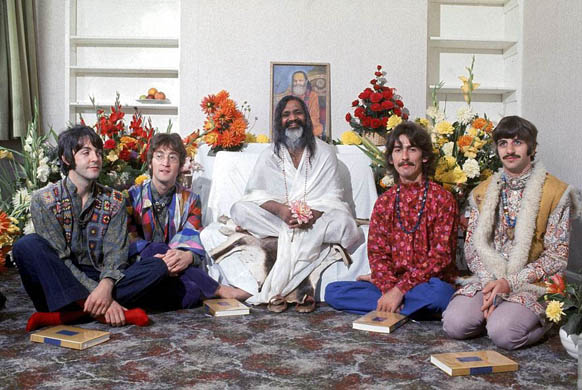
This past November I wrote about growing up in Philadelphia in the 1960s. I was motivated by the recent sale of the house I grew up in, and by a cover photo on a Sunday NY Times Magazine that reminded me of a photo I took in 1968 after seeing the Maharishi Mahesh Yogi when he toured the US with The Beach Boys. While the Beatles love affair with TM was short-lived (years later Paul McCartney confessed in an interview that the supposed sexual indiscretions attributed to the guru were false and that the Maharishi becoming upset by the Beatles drug use at the Himalayan retreat was the actual cause for the rift ), even the momentary intersection was responsible for some interesting things.

Looking back at the era, the arrival of the Maharishi onto the pop culture scene of the late 1960s makes quite a bit of sense. The chain of events included:

* George Harrison taking interest in the Indian musical instruments that appear in some of the scenes in the Beatles’ second feature film, Help!
* A friendship between Roger McGuinn of The Byrds and the owner of the World Pacific record label (Ravi Shankar’s US label) led to David Crosby bringing Ravi Shankar to George Harrison’s attention.
* John Lennon and George Harrison’s introduction to LSD-25 by way of being dosed by their dentist, Dr. John Riley, at a dinner party in 1965.

Canadian poet and song writer, Leonard Cohen, has spent quite some time in a California Zen monastery and his teacher, an old Japanese Zen master who heads that center, said something once that I think has a whole lot to do with the experience of psychedelic drugs.

“You can’t live in God’s realm too long. There are no restaurants or toilets.”

The Beatles move from LSD to meditation mirrors the experiences of the US Buddhist community as a whole. Tricycle: The Buddhist Review conducted a poll in Autumn of 1996:

"Number of responses: 1,454 (63% from the magazine, 37% from the web). 89% said that they were engaged in Buddhist practice. 83% said that they had taken psychedelics. Over 40% said that their interest in Buddhism was sparked by psychedelics, with percentages considerably higher for boomers than for twenty-somethings. 24% said that they are currently taking psychedelics, with the highest percentage for people over 50 and under 30. 41% said that psychedelics and Buddhism do not mix OR: 59% said that psychedelics and Buddhism do mix. The age group that expressed the most confidence in a healthy mix was under 20. 71% believe that "psychedelics are not a path but they can provide a glimpse of the reality to which Buddhist practice points." 58% said that they would consider taking psychedelics in a sacred context. (In the "under 20" category this percentage was 90 %)."

I remember that, when the Maharishi was in town in 1968, people could go to his hotel and get a private consultation with him for the price of one week’s salary and a bouquet of flowers. That consultation resulted in receiving one’s mantra, a nonsense word that you would repeat during meditation and that would help clear one’s mind. A major reason for my own independent skepticism regarding TM is the whole idea of the “top secret mantra.” Many years later a bunch of people who’d received TM training around the same time suddenly realized that they’d all been given the same mantra.

No wonder it’s a secret.

This is not, however, to dismiss the idea of daily meditation. If you’ve ever spent twenty minutes sitting on the floor or on a pillow trying to empty your mind you will gain an immediate insight to how The Beatles White Album came about.

For a little while in the late 1990s until about early 2002 my office was located directly next door to the Indianapolis Zen Center and I would often join them for their evening meditation. One night there was just myself, the center’s Abbot, and his assistant. After the half-hour of sitting in silence the Abbot’s assistant remarked, “I don’t know what was going on; my mind was a young puppy tonight.”

Perhaps monks who’ve been at it for twenty or so years can actually “empty their minds,” but most of us will find that, when we try, it is as if a damn of the most bizarre images and ideas has burst and floods our minds.

Flooded, I imagine, by characters like Bungalow Bill, Rocky Raccoon, blackbirds, warm guns, savory truffles, and all the little piggies.

So, from a dentist’s tea cup to a Himalayan retreat, from the giggles muffled by the Maharishi’s beard to the greatest double LP in pop music history.

And into deep space.

Polaris, 431 light-years away, is the destination NASA sent The Beatles song "Across the Universe" to commemorate the 50th anniversary of its first space mission. On Monday, February 4th at 7 p.m. Eastern time, the array of huge antennas that were usually tuned to listen for inbound signals from space beamed the best of John Lennon’s Rikikesh compositions to a spot (186,000 x 60 x 60 x 24 x 365 x 431) miles away.

Born sometime between 1911 and 1918, named Mahesh Prasad Varma at birth, the Maharishi Mahesh Yogi died this past February 5th in Holland. In the end I think he is bets remembered as basically a good fellow whose impact on the world was for the good and whose momentary affair with the counterculture of the 1960s influenced some fine music. Without it, there’s a chance that side two of The Beatles’ Sergeant Pepper LP might not start with “Within You Without You,” and that would be a tragedy.