Showing posts with label Kurt Vonnegut. Show all posts

Monday, July 16, 2007

More Kurt....


Rereading Slaughterhouse Five sent me back to the stacks for something I had not read previously and that led me to Timequake, a 1997 novel. It is filled with many delightful moments even if the overall feeling is one of a very old man gradually slowing down. Two passages in particular are worth sharing here:

"I remember labor history, too, because the first effective strikes by American working people for better pay, and more respect, and safer working conditions, were called against the railroads. And then against the owners of coal mines and steel mills and textile mills, and on and on. Much blood was shed in what appeared to most members of my generation of American writers to be battles as worth fighting as any against a foreign enemy.

The optimism that infused so much of our writing was based on our belief that after the Magna Carta, and then the Declaration of Independence, and then the Bill of Rights, and then the Emancipation Proclamation, and then Article XIX of the Constitution, which in 1920 entitled women to vote, some scheme for economic justice could also be devised. That was the next logical step.

And even in 1996, I in speeches propose the following amendments to the Constitution:

Article XXVIII: Every newborn shall be sincerely welcomed and cared for until maturity.

Article XXIX: Every adult who needs it shall be given meaningful work to do, at a living wage.

What we have created instead, as customers and employees and investors, is mountains of paper wealth so enormous that a handful of people in charge of them can take millions and billions for themselves without hurting anyone. Apparently.

Many members of my generation are disappointed." (pp. 151-152)

In the other the real Vonnegut volunteers to go stand beside his fictional alter-ego, the science ficton writer Kilgore Trout to help with a demonstration.

Trout asks him to look into the night sky and select two twinkling stars. Trout explains that "the universe has expanded so enormously that light is no longer fast enough to make any trips worth taking even in the most unreasonable lengths of time. Once the fastest thing possible, they say, light now belongs in the graveyard of history, like the Pony Express."

Explaining that light traveling between the two stars that Vonnegut has selected would take millions of years to make the trip he instructs his volunteer to "look precisely at one, and then precisely at the other."

This done, Trout continues:

"It took a second, do you think?" he said.

"No more," I said.

"Even if you'd taken an hour," he said, "something would have passed between where those two heavenly bodies used to be, at, conservatively speaking, a million times the speed of light."

"What was it?" I said.

"Your awareness," he said. "That is a new quality in the Universe, which exists only because there are human beings. Physicists must from now on, when pondering secrets of the Cosmos, factor in not only energy and matter and time, but something very new and beautiful, which is human awareness. . . . I have thought of a better word than awareness," he said. "Let us call it soul." (pp. 213-214)

So it goes.

Monday, June 4, 2007

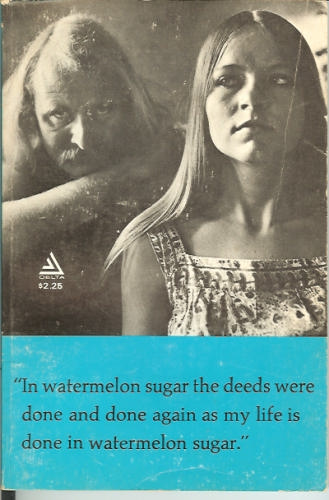
In Watermelon Sugar the deeds were done....

"In Watermelon Sugar the deeds were done and done again as my life is done in watermelon sugar. I'll tell you about it because I am here and you are distant.

Wherever you are, we must do the best we can. It is so far to travel, and we have nothing here to travel, except watermelon sugar. I hope this works out.

I live in a shack near iDEATH. I can see iDEATH out the window. It is beautiful. I can also see it with my eyes closed and touch it. Right now it is cold and turns like something in the hand of a child. I do not know what that thing could be.

There is a delicate balance in iDEATH. It suits us.

The shack is small but pleasing and comfortable as my life and made from pine, watermelon sugar and stones as just about everything here is.

Our lives we have carefully constructed from watermelon sugar and then travelled to the length of our dreams, along roads lined with pines and stones.

I have a bed, a chair, a table and a large chest that I keep my things in. I have a lantern that burns watermelontrout oil at night.

That is something else. I'll tell you about it later. I have a gentle life.

I go to the window and look out again. The sun is shining at the long edge of a cloud. It is Tuesday and the sun is golden.

I can see piney woods and the rivers that flow from those piney woods. The rivers are cold and clear and there are trout in the rivers.

Some of the rivers are only a few inches wide.

I know a river that is half-an-inch wide. I know because I measured it and sat beside it for a whole day. It started raining in the middle of the afternoon. We call everything a river here. We're that kind of people.

I can see fields of watermelons and the rivers that flow through them. There are many bridges in the piney woods and in the fields of watermelons. There is a bridge in front of this shack.

Some of the bridges are made of wood, old and stained silver like rain, and some of the bridges are made of stone gathered from a great distance and built in the order of that distance, and some of the bridges are made of watermelon sugar. I like those bridges best.

We make a great many things out of watermelon sugar here -- I'll tell you about it -- including this book being written near iDEATH.

All this will be gone into, travelled in watermelon sugar."

Richard Brautigan, 1968.

That's the first chapter in Richard's third novel, also my favorite of his books.

I cannot explain what it is about this book. I do think that it is the most psychedelic novel I've ever read, and that's a part of what I love about it.

There is a quality of Brautigan's writing that some people find lazy and unfocused. Some people don't. I'm one of those who doesn't.

The original printing was a paperback by Dell with the cover shown here. The current edition has a completely different cover that, in my opinion, does the book no favors.

I wonder why publishers will change the cover art of a classic novel while record companies never (or rarely) change the covers of classic LPs. The 40th Anniversary of The Beatles Sgt. Pepper album was a few days ago and I can't help but think that, had it been a novel, the anniversary would have been celebrated with a new edition in a brand new sleeve.

I was already pretty happy that it wasn't a novel but now, even more.

Reading Vonnegut's A Man Without A Country last week, and re-reading Slaughterhouse Five at the moment, made me think of Richard Brautigan, and thinking of Richard always makes me pull out a copy of In Watermelon Sugar.

Friday, June 1, 2007

I Miss Him Already....

Kurt Vonnegut had a way with words.

In his last book, written after he claimed there would be no more books, there was one passage I found so perfect an expression of what it was I loved about Vonnegut's writing that I want to share it here. The book is called A Man Without a Country and this link will take you to Amazon where I hope you will buy a copy (or head off to the library if you're like me and just don't need any more stuff).

"Persuasive guessing has been at the core of leadership for so long, for all of human experience so far, that it is wholly unsurprising that most of the leaders of this planet, in spite of all the information that is suddenly ours, want the guessing to go on. It is now their turn to guess and guess and be listened to. Some of the loudest, most proudly ignorant guessing in the world is going on in Washington today. Our leaders are sick of all the solid information that has been dumped on humanity by research and scholarship and investigative reporting. They think that the whole country is sick of it, and they could be right. It isn't the gold standard that they want to put us back on. They want something more basic. They want to put us back on the snake-oil standard.

Loaded pistols are good for everyone except inmates in prison or lunatic asylums.

That's correct.

Millions spent on public health are inflationary.

That's correct.

Billions spent on weapons will bring inflation down.

That's correct.

Dictatorships to the right are much closer to American ideals than dictatorships to the left.

That's correct.

The more hydrogen bomb warheads we have, all set to go off on a moment's notice, the safer humanity is and the better off the world will be that our grandchildren inherit.

That's correct.

Industrial wastes, and especially those that are radioactive, hardly ever hurt anybody, so everybody should shut up about them.

That's correct.

Industries should be allowed to do whatever they want to do: Bribe, wreck the environment just a little, fix prices, screw dumb customers, put a stop to competition, and raid the Treasury when they go broke.

That's correct.

That's free enterprise.

And that's correct.

The poor have done something very wrong or they wouldn't be poor, so their children should pay the consequences.

That's correct.

The United States of America cannot be expected to look after its own people.

That's correct.

The free market will do that.

That's correct.

The free market is an automatic system of justice.

That's correct.

I'm kidding."

I miss him.