Thursday, June 7, 2007

Room to move....

This coming November, UK blues artist John Mayall will turn seventy-four and I think we’ll have a party for him. Clearly, if we started playing his catalog of albums on Friday afternoon, the party could last well into the following week.

One comparison I’ve seen repeatedly throughout Mayall’s career is to jazz legend, Miles Davis. The Miles comparison is in recognition of the parade of musicians who apprenticed in one of Mayall’s bands before moving onto their own bands and careers. And that comparison is an apt one. As Richie Unterberger notes in Mayall’s biographical entry at the All Music Guide web site, "Throughout the '60s, his band, the Bluesbreakers, acted as a finishing school for the leading British blues-rock musicians of the era. Guitarists Eric Clapton, Peter Green, and Mick Taylor joined his band in a remarkable succession in the mid-'60s, honing their chops with Mayall before going on to join Cream, Fleetwood Mac, and the Rolling Stones, respectively. John McVie and Mick Fleetwood, Jack Bruce, Aynsley Dunbar, Dick Heckstall-Smith, Andy Fraser (of Free), John Almond, and Jon Mark also played and recorded with Mayall for varying lengths of times in the '60s.”

But comparisons to Miles, who, along with Louis Armstrong and Duke Ellington, represents one third of the 20th Century’s holy trinity of American music, must always be made with some awareness of their limitations. Mayall’s contributions were early with his trio of 1966-1967 LPs, Bluesbreakers With Eric Clapton, A Hard Road (with Peter Green), and Crusade (with Mick Taylor). By the end of the 60s his band rarely featured players whose later reputations would eclipse his own.

Nor was Mayall’s instrumental prowess on guitar, harp or keyboards comparable in any sense to Miles’ contributions to jazz trumpet.

Still, Miles comparisons aside, Mayall deserves his elder statesman status as richly as anyone. I almost said “as any of his peers” but caught myself. I don’t know that Mayall has any peers. He is a good ten years older than any other UK musician who occupies a similar place in music history. On one of his LPs it’s actually rather shocking to see a 1960’s rock figure in his British military uniform during his service in the Korean war.

There are two Mayall records that I would find it hard to live without. The first is, of course, his 1966 Bluesbreakers With Eric Clapton. Returning to Miles comparisons, the effect of this record on the rock music that followed was not dissimilar to the impact of either Kind Of Blue (1959) or In A Silent Way (1969) on jazz. There is a new “Deluxe Edition” on Decca, a 2 CD set that has the entire original LP in both mono and stereo mixes on the first disc and stuffs the second disc with 19 bonus tracks including a variety of BBC Saturday Club sessions and a number of rare Immediate label 45s (including “I’m Your Witchdoctor”). It’s one of those “Christmas and your birthday” kind of records.

The other Mayall LP I have burned into my brain’s hard drive is his 1969 album The Turning Point. In the context of its release it was almost as impressive a rock record as In A Silent Way was a jazz LP. 1969 was a time of supergroups, screaming electric guitars and twenty-minute drum solos. In the midst of this Mayall appeared in a quartet setting following Mick Taylor’s departure to The Stones. In any setting, but particularly in the musical climate of 1969, this is a stunningly quiet record. Mayall eliminates drums entirely, and replaces the electric guitar with not just an acoustic, but a nylon string acoustic played fingerstyle by Jon Mark joined by the flute and tenor and alto sax of John Almond (whose later Mark-Almond albums would try, with questionable results, to duplicate this sound). The result was to introduce a shocking quiet in the middle of all the loud. The 1969 Fillmore appearance was recorded and released as The Turning Point and became one of Mayall’s most successful albums. The fact that it was one of the 2 or 3 greatest records to smoke pot to late into the evening didn't hurt either.

Mayall’s longevity is also proof that Keith Richards was right when he answered a question about whether it would be silly to still be a rocker at 70 by saying that his role models were Muddy Waters and other blues greats who played until they had to be carried off the stage. At 65, Bob Dylan seems to be following similar advice. Come this November “Room To Move” “California” and “The Laws Must Change” will be on heavy rotation.

Monday, June 4, 2007

In Watermelon Sugar the deeds were done....

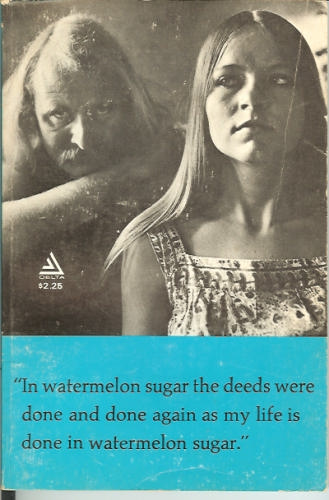
"In Watermelon Sugar the deeds were done and done again as my life is done in watermelon sugar. I'll tell you about it because I am here and you are distant.

Wherever you are, we must do the best we can. It is so far to travel, and we have nothing here to travel, except watermelon sugar. I hope this works out.

I live in a shack near iDEATH. I can see iDEATH out the window. It is beautiful. I can also see it with my eyes closed and touch it. Right now it is cold and turns like something in the hand of a child. I do not know what that thing could be.

There is a delicate balance in iDEATH. It suits us.

The shack is small but pleasing and comfortable as my life and made from pine, watermelon sugar and stones as just about everything here is.

Our lives we have carefully constructed from watermelon sugar and then travelled to the length of our dreams, along roads lined with pines and stones.

I have a bed, a chair, a table and a large chest that I keep my things in. I have a lantern that burns watermelontrout oil at night.

That is something else. I'll tell you about it later. I have a gentle life.

I go to the window and look out again. The sun is shining at the long edge of a cloud. It is Tuesday and the sun is golden.

I can see piney woods and the rivers that flow from those piney woods. The rivers are cold and clear and there are trout in the rivers.

Some of the rivers are only a few inches wide.

I know a river that is half-an-inch wide. I know because I measured it and sat beside it for a whole day. It started raining in the middle of the afternoon. We call everything a river here. We're that kind of people.

I can see fields of watermelons and the rivers that flow through them. There are many bridges in the piney woods and in the fields of watermelons. There is a bridge in front of this shack.

Some of the bridges are made of wood, old and stained silver like rain, and some of the bridges are made of stone gathered from a great distance and built in the order of that distance, and some of the bridges are made of watermelon sugar. I like those bridges best.

We make a great many things out of watermelon sugar here -- I'll tell you about it -- including this book being written near iDEATH.

All this will be gone into, travelled in watermelon sugar."

Richard Brautigan, 1968.

That's the first chapter in Richard's third novel, also my favorite of his books.

I cannot explain what it is about this book. I do think that it is the most psychedelic novel I've ever read, and that's a part of what I love about it.

There is a quality of Brautigan's writing that some people find lazy and unfocused. Some people don't. I'm one of those who doesn't.

The original printing was a paperback by Dell with the cover shown here. The current edition has a completely different cover that, in my opinion, does the book no favors.

I wonder why publishers will change the cover art of a classic novel while record companies never (or rarely) change the covers of classic LPs. The 40th Anniversary of The Beatles Sgt. Pepper album was a few days ago and I can't help but think that, had it been a novel, the anniversary would have been celebrated with a new edition in a brand new sleeve.

I was already pretty happy that it wasn't a novel but now, even more.

Reading Vonnegut's A Man Without A Country last week, and re-reading Slaughterhouse Five at the moment, made me think of Richard Brautigan, and thinking of Richard always makes me pull out a copy of In Watermelon Sugar.

Friday, June 1, 2007

I Miss Him Already....

Kurt Vonnegut had a way with words.

In his last book, written after he claimed there would be no more books, there was one passage I found so perfect an expression of what it was I loved about Vonnegut's writing that I want to share it here. The book is called A Man Without a Country and this link will take you to Amazon where I hope you will buy a copy (or head off to the library if you're like me and just don't need any more stuff).

"Persuasive guessing has been at the core of leadership for so long, for all of human experience so far, that it is wholly unsurprising that most of the leaders of this planet, in spite of all the information that is suddenly ours, want the guessing to go on. It is now their turn to guess and guess and be listened to. Some of the loudest, most proudly ignorant guessing in the world is going on in Washington today. Our leaders are sick of all the solid information that has been dumped on humanity by research and scholarship and investigative reporting. They think that the whole country is sick of it, and they could be right. It isn't the gold standard that they want to put us back on. They want something more basic. They want to put us back on the snake-oil standard.

Loaded pistols are good for everyone except inmates in prison or lunatic asylums.

That's correct.

Millions spent on public health are inflationary.

That's correct.

Billions spent on weapons will bring inflation down.

That's correct.

Dictatorships to the right are much closer to American ideals than dictatorships to the left.

That's correct.

The more hydrogen bomb warheads we have, all set to go off on a moment's notice, the safer humanity is and the better off the world will be that our grandchildren inherit.

That's correct.

Industrial wastes, and especially those that are radioactive, hardly ever hurt anybody, so everybody should shut up about them.

That's correct.

Industries should be allowed to do whatever they want to do: Bribe, wreck the environment just a little, fix prices, screw dumb customers, put a stop to competition, and raid the Treasury when they go broke.

That's correct.

That's free enterprise.

And that's correct.

The poor have done something very wrong or they wouldn't be poor, so their children should pay the consequences.

That's correct.

The United States of America cannot be expected to look after its own people.

That's correct.

The free market will do that.

That's correct.

The free market is an automatic system of justice.

That's correct.

I'm kidding."

I miss him.

Sunday, May 27, 2007

History and Mythology and Methamphetamine

Back in the 70s I had a friend who was heavy into speed. He had a tiny little house on a back alley and there were many nights when I’d be bored or coming down from some drugs of my own and I’d drop in. He worked at a little desk with a little lamp and stacks of books and he was always writing in this perfect handwriting smaller than anyone’s I’d ever seen. He was working on some grand theory of everything, tying together ancient civilizations and contemporary cultural theory in way I don’t think anyone but he understood.

What he was doing then, long before personal computers and the internet, is what I think we would all do today if we had a high-speed internet connection, a blog, and some crystal meth. I can remember how those little lines of fine white powder just burnt like hell, very different from the coke we’d sometime share that would numb the back of your throat and make everything glow a wee little bit as it made everything slightly more interesting.

For a lot of people I think drugs are all about the pleasure. But for some, for the curious, it’s all about how they make the world more… interesting.

Anyway… I don’t do those things anymore, my body can’t survive the strains it could shake off thirty years ago. But I was playing on line a while ago and had a kind of metaphorical flashback to 4 or 5 in the morning, in that little house on the alley as I started to write something about the ancient Greeks and the British invasion.

So, you need to understand that Euhemerus was a Greek mythographer (4th Century BC) at the court of Cassander, the king of Macedonia. He is chiefly known for a rationalizing method of interpretation, known as Euhemerism, that treats mythological accounts as a reflection of actual historical events shaped by retelling and traditional mores.

The writer Robert Graves said of Greek myth: "True myth may be defined as the reduction to narrative shorthand of ritual mime performed on public festivals, and in many cases recorded pictorially." (The Greek Myths, Introduction). Graves was deeply influenced by Sir James George Frazer's mythography The Golden Bough, and he would have agreed that myths are generated by many cultural needs.

Myths authorize the cultural institutions of a tribe, a city, or a nation by connecting them with universal truths. Myths justify the current occupation of a territory by a people, for instance. All cultures have developed over time their own myths, consisting of narratives of their history, their religions, and their heroes. The great power of the symbolic meaning of these stories for the culture is a major reason why they survive as long as they do.

Myths that are based on a historical events over time become imbued with symbolic meaning, transformed, shifted in time or place, or even reversed. One way of conceptualizing this process is to view 'myths' as lying at the far end of a continuum ranging from a 'dispassionate account' to 'legendary occurrence' to 'mythical status'. As an event progresses towards the mythical end of this continuum, what people think, feel and say about the event takes on progressively greater historical significance while the facts become less important. By the time one reaches the mythical end of the spectrum the story has taken on a life of its own and the facts of the original event have become almost irrelevant.

This method or technique of interpreting myths as accounts of actual events, euhemerist exegesis, dates from antiquity and can be traced back (from Spencer) to Evhémère's Histoire sacrée (300 BCE) which describes the inhabitants of the island of Panchaia in the Indian Ocean as normal people deified by popular naivety.

As Roland Barthes affirms, "Myth is a word chosen by history. It could not come from the nature of things.”

Roland Barthes (1915 – 1980) was a French literary critic, literary and social theorist, philosopher, and semiotician. Barthes's work extended over many fields and he influenced the development of schools of theory including structuralism, semiology, existentialism, Marxism and post-structuralism.

Barthes' 1957 book Mythologies was a collection of interrogations of pieces of cultural materia conducted to expose how bourgeois society used them to assert its values upon others. For instance, portrayal of wine in French society as a robust and healthy habit would be a bourgeois ideal perception contradicted by certain realities (i.e. that wine can be unhealthy and inebriating). He found semiology, the study of signs, useful in these interrogations. Barthes explained that these bourgeois cultural myths were second-order signs, or significations. A picture of a full, dark bottle is a signifier relating to a signified: a fermented, alcoholic beverage - wine. However, the bourgeois take this signified and apply their own emphasis to it, making ‘wine’ a new signifier, this time relating to a new signified: the idea of healthy, robust, relaxing wine. Motivations for such manipulations vary from a desire to sell products to a simple desire to maintain the status quo. These insights brought Barthes very much in line with similar Marxist theory.

Now, the thing that I want to take from all of this is this notion of “mythology” not as some imaginary realm of dragons and elves, but as the end of a process that involves the removal of actual events from their concrete historical moorings.

And so we fast forward to early 1964 and the beginning of what we all now call the “British invasion.”

I started thinking about the British invasion as an example of cultural mythology when I read the article “Before the Beatles: International Influences on American Popular Recordings, 1940-63” by William L. Schurk, B. Lee Cooper and Julie A. Cooper in the May 2007 issue of the journal Popular Music and Society. It is an academic journal and, as such, most often stuffed full of the self-evident nit-picked into absurdity. I published a couple times in the journal, presented papers at their conferences over the years and, because of my odd mix of academic and music business credentials, I am a member of their advisory board (which is to say, I don't pay for the journal).

But I digress….

In their introduction the authors write that, “This discographic compilation is designed to debunk the myth of 1964 as the foreign influence watershed year in American recorded music. . . . The misconception being examined is that, until the arrival of The Beatles, Dave Clark Five, Herman’s Hermits, Hollies, Kinks, Zombies, and others in 1964, American recording charts were largely devoid of foreign-born performers.”

In 40 pages chock full of charts and tables these scholars present a very well-reasoned argument that there was a significant non-US presence in the pop charts well before the supposed invasion, and that US-artists fared far better during the invasion than is generally believed. But I would extend this conclusion a bit farther.

The mythology of the British invasion is tied to a much larger mythology of America in the 1960s, and an even larger mythology of the 1960s itself. The exit of Eisenhower, the arrival of JFK, Kennedy’s subsequent assassination, the baby boom, Vietnam, rise of drug use, etc., all neatly places the 1950s in a conservative pin-striped box and the 1970s into a polyester disco shirt box, the 80s into a Reagan-Gordon Gekko-shaped box and so on.

If there is anything the culture needs to get over more than the myth of the 1960s I don’t know what that might be.

The essence of that myth is that we had our chance, the planets were aligned, we could have had a utopia, but we blew it. Now the planets won’t align for another 9,000 years so, really, what’s the point? This is a horrible, self-centered, banal, and destructive mythology, more destructive than any Reagan-based mythos the Republicans can muster.

I still like paisley, I long for the return of ruffled cuffs and collarless jackets, and I kind of miss the beads. But perhaps it’s time to see the 1960s as the superficial paper-thin bourgeois “revolution” that it was (and take another look at the 1950s while we’re at it) and try walking forward one more time before the light fades entirely.

Tuesday, May 15, 2007

Bob Dylan and Lonesome Rhodes....

Sean Wilentz at BobDylan.com has written a piece called The Roving Gambler at Scenic Newport which is one of the more worthwhile things I've read on Dylan in quite some time. I am a big fan of anything that makes me go "Oh yeah! Why didn't I see that? It's so... so... clear." I've pasted an excerpt below, but you should go here and read the whole thing.

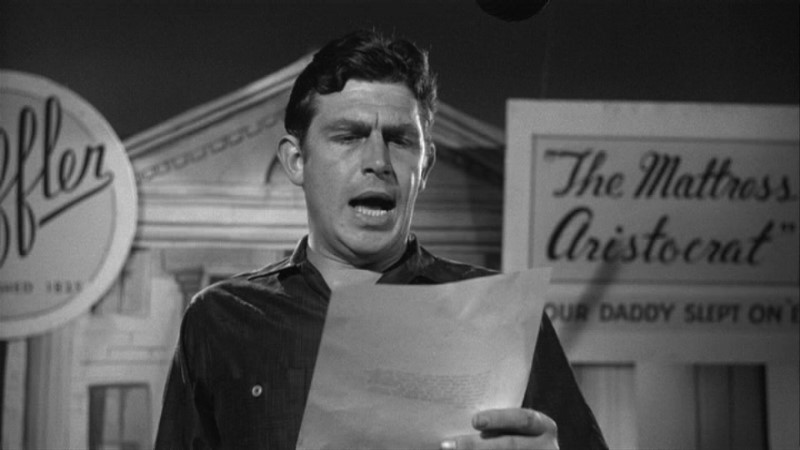
"In 1957, Andy Griffith starred in the Budd Schulberg-Elia Kazan film A Face in the Crowd, playing Lonesome Rhodes, a convicted hobo and country singer who, thanks to a shrewd producer (played by Patricia Neal) becomes a nationwide T.V. celebrity and reactionary demagogue -- a forerunner of Rush Limbaugh and Bob Roberts. Bob Dylan saw A Face In The Crowd, and, reportedly, was more shaken by it than by any film he'd seen since Rebel Without a Cause. At a crucial moment in the film, Griffith's character realizes he's going to make a fortune and starts singing an exuberant and menacing version of 'The Roving Gambler.'

On August 24, 1997, Bob Dylan -- who had cheated death weeks earlier and was now on the verge of releasing an album, Time Out Of Mind, that would reclaim his career -- played a concert in Vienna, Virginia. The songs included 'The Roving Gambler,' which Dylan and his new band had added to their set list a few months earlier. (They would eventually alternate it with 'Duncan and Brady.') Three songs later, after 'Blind Willie McTell,' Dylan introduced his band and acknowledged the presence in the audience of one of the men 'who unlocked the secrets of this kind of music,' Alan Lomax. (At Newport, in 1965, Lomax along with Pete Seeger led the old guard that objected to the blasts of white-boy electricity, including Dylan's. Now all seemed forgiven.) Then, with a mischievous audible chuckle, Dylan and the band kicked into a roaring 'Highway 61 Revisited,' a consummate Dylan rocker of the kind that had so enraged Lomax in 1965. 'This kind of music,' indeed - except that except that 'Highway 61' includes the following verse, with ominous undertones of both ancient folk music and A Face in the Crowd:

Now the rovin' gambler he was very bored
He was tryin' to create a next world war
He found a promoter who nearly fell off the floor
He said I never engaged in this kind of thing before
But yes I think it can be very easily done
We'll just put some bleachers out in the sun
And have it on Highway 61.

On July 19, 2002, two weeks before what the New York Times would soon be hyping as Bob Dylan's triumphant return to Newport, Alan Lomax died. But something of his spirit, and that of the recently dead Dave Van Ronk, and also those of Tennessee Ernie Ford, Don and Phil Everly, Robert Mitchum, Lonesome Rhodes, and Tony Glover, hit the stage running when Dylan, in a cowboy hat, a fake beard, and a wig that made it seem, from five rows back, as if he'd sprouted enormous flowing orthodox Jewish ear locks, opened his set with the Brothers Four's arrangement of 'The Roving Gambler.'"

Go read the Wilentz piece now, and if you've never seen Kazan's A Face in the Crowd you really need to go find a copy as soon as possible. About a third of the way through you'll be reaching for the box, checking the date and wondering how this documentary on the rise of George Bush the First could have been made so long before anyone had heard of him.

Wednesday, May 9, 2007

The Late Great Clarence White

I was lucky enough to see the late Clarence White play twice, both times with The Byrds and within a few days of each other at a couple small college auditoriums circa 1971-72. I went with a guitar player friend of mine, a guy who owned an early 1950s Fender Esquire that the previous owner had covered in faux-fur; I get a little sad just thinking about it even today.

Clarence and Byrds-drummer, Gene Parsons, had invented the Parsons-White B-Bender, a device that could be installed on a Fender Telecaster guitar by routing out a significant amount of wood in the back and placing a pulley system connected to the B-string and the strap button. By pulling down on the strap when you played you could raise the B-string a whole step and, used properly, it allowed a guitarist to play licks that are only possible on a pedal steel guitar. During Clarence’s solo in “Lover of the Bayou” I remember by friend turning to me with an amazed look, saying “You can’t DO that!”

Clarence invented lead bluegrass guitar playing. In 2003 Sierra Records issued the CD 33 Acoustic Guitar Instrumentals which collects solo acoustic flatpicking home recordings Clarence made in 1962, two years before the Kentucky Colonels released their Appalachian Swing album.

Jerry Garcia said of Clarence, “He brought a kind of swing – a rhythmic openness – to bluegrass, and a unique syncopation. His feel has been incorporated by a lot of other players, but nobody has ever quite gotten the open quality of his rhythm. In the bluegrass world; the instruments characteristically are on top of or slightly in front of the beat. Bluegrass is a kind of forward-leaning music. Clarence’s playing was way in the back of the beat, and so added an openness that was really breathtaking.”

His work with The Kentucky Colonels lasted until 1968 when he joined Nashville West (which also featured Gib Guilbeau, Wayne Moore and Gene Parsons) whose album, The Legendary Nashville West Album, finally saw the light of day in 2003. Clarence’s Telecaster is all over that record and any fan of country rock guitar playing who hasn’t worn out a copy is missing a huge piece of the larger musical puzzle. Clarence does an instrumental version of Bobbie Gentry’s “Ode To Billy Joe” which, after playing the record the other day, is my current “best thing I ever heard.”

Clarence joined the reformed Byrds in 1968 playing with them until 1973 around which time he joined up with Peter Rowan (guitar and vocals), Bill Keith (banjo), Richard Green (fiddle), David Grisman (mandolin), and John Kahn (bass), to form the band Muleskinner.

What’s interesting to me is the flow of musicians from traditional bluegrass (both Rowan and Green had been in Bill Monroe’s group and it doesn’t get more traditional than that) into experimental rock (Seatrain, Earth Opera, The Byrds) back into the, albeit slightly progressive, bluegrass of Muleskinner.

Muleskinner was released in 1974 on Warner Brothers and sold poorly and was deleted pretty quickly. In the 80s the album was reissued on LP in another sleeve on a small bluegrass label, Ridgerunner. In 1994 Gene Parsons’ Sierra label issued it on CD. The song “Runways of the Moon” may be the single finest example of the meeting of Grateful Dead-inspired psychedelia and authentic Americana music ever.

Clarence died in 1973 in Palmdale, California; loading equipment into a truck after a gig, he was killed by a drunk who lost control of her car in the alley behind the club.

Anyway… I was taken by surprise by how great these three records are and thought I’d mention them in case anyone is looking for something new to explore. Seriously, you can't go wrong.

Wednesday, May 2, 2007

Of Rodney, Zelig and Al....

Some months back I read four or five things in quick succession in which some writer referred to Al Kooper as the “Zelig of rock’n’roll.” What had happened seemed pretty clear; some clever fellow coined the phrase in an article somewhere and someone else picked up on it, repeated it, and, well, Bob’s your uncle.

But it is, I think, a genuinely wrongheaded metaphor, misdirected and wholly inaccurate. It is a lazy comparison as well. I’m trying to think of a similar erroneous comparison; perhaps to call Devandra Barnhart the “Jimi Hendrix of Nu Folk” because Barnhart plays guitar and, um, Jimi played guitar. Other than that, the comparison would be silly; much like... oh, comparing Al Kooper to Zelig.

Zelig, used as a noun as in “a Zelig,” comes from the character of Leonard Zelig created by Woody Allen in his 1983 fictitious biography of the same name. In that film, comprised of newsreel footage from the 1920s and 1930s into which Allen inserted himself (as Leonard Zelig) into various memorable historical moments, a new history of pre-WWII emerges into which Leonard Zelig is a constant bystander. Robert Zemeckis used similar elements in his 1994 film Forrest Gump in which the title character interacts with JFK, John Lennon and others.

Writing for the All Music Guide, Bruce Eder describes Al Kooper this way:

Al Kooper, by rights, should be regarded as one of the giants of '60s rock, not far behind the likes of Bob Dylan and Paul Simon in importance. In addition to co-writing one classic mid-'60s pop-rock song, "This Diamond Ring" (though it was written as an R&B number), he was a very audible session player on some of the most important records of mid-decade, including Bob Dylan's "Like a Rolling Stone." Kooper also joined and led, and then lost two major groups, the Blues Project and Blood, Sweat & Tears. He played on two classic blues-rock albums in conjunction with his friend Mike Bloomfield. As a producer at Columbia, he signed the British invasion act the Zombies just in time for them to complete the best LP in their entire history; and still later, Kooper discovered Lynyrd Skynyrd and produced their best work. Instead, in terms of public recognition, Kooper has been relegated to second-rank status, somewhere midway between John Mayall and Steve Winwood. Apart from the fact that he's made, and continues to make great music, it's the public's loss that he's not better respected outside the ranks of his fellow musicians.

The story of Kooper showing up at Dylan’s sessions for “Like A Rolling Stone” with his guitar in hopes of playing – hopes that were abandoned shortly after Michael Bloomfield arrived and plugged in; then to bluff his way onto the organ when no one was looking and Dylan’s response when he listened to the playback, “Turn up the organ” – is a thing of rock legend.

That Hammond organ sound that Kooper used on that track became the most copied sound in all pop for the next year or so, while Al was busy reintroducing horns into post-psychedelia via Blood, Sweat and Tears, and recording a throw-away LP of studio jams that he added some horn charts to and became one of the biggest selling records for Columbia up to that time (Supersession). For the Zelig metaphor to hold Zelig would need to do way more than just show up and make it into the photograph.

No. Not only is Al not Zelig, I know who actually is the “Zelig of rock’n’roll.”

In 2004 George Hickenlooper directed the documentary The Mayor of Sunset Strip, chronicling the life of one Rodney Bingenheimer (tell me that doesn’t sound like the name of a folk duo circa 1961, “Ladies and gentlemen, Gerde’s Folk City is proud to present the folk music stylings of Hickenlooper and Bingenheimer”).

Beginning with the early California surf-pop-garage band scene, the unassuming and diminutive Bingenheimer has helped advance every adventurous rock mutation--California pop, glam, punk, goth, new wave, alternative.

In the middle of the film there is a montage of file footage of every major and many minor bands of the 1960s – Byrds, Beatles, Stones, Sonny and Cher, etc. – and after a second or so an arrow appears on screen pointing at Rodney, standing by a speaker, standing off to one side, standing just off stage, always with his page boy haircut and always smiling.

I borrowed the DVD from a friend and watched it with my wife and in the middle of that sequence she turned to me and said, “Hey! He’s like the Zelig of rock and roll.” And so he was.

Al Kooper was never a bystander. Zelig didn’t play the organ part that defined the sound of Dylan’s greatest song. Zelig would have been in the back of the control room, off to one side, passively observing, not a participant. And Rodney never traded licks with Michael Bloomfield onstage at both Fillmores.

After I saw that “Zelig” reference in a short piece in an issue of the UK magazine MOJO I wrote a letter to the magazine and looked up Al Kooper on line and found his web site. I emailed him my outrage over the whole Zelig thing and, a few days later, I got an email from Al. “Don’t sweat it,” he wrote. “So long as they’re writing about me I don’t care.”

I kept it in my email “in” box for months and would drop it into conversations, “Say, whadda ya know; an email from Al Kooper. You know, the guy who plays organ on ‘Like a Rolling Stone.’”

The definitive Al Kopper records are Projections (1966) by The Blues Project, Child Is Father to the Man (1968) by Blood, Sweat and Tears (the pre-David Clayton-Thomas version), I Stand Alone (1968) and Supersession (1968) with Michael Bloomfield and Steven Stills (actually, just for the Bloomfield side).

Bruce Eder’s bio entry for Al Kooper at the AMG site ends by neatly placing Kooper in a solid historical location:

Anyone counting the records on which Al Kooper has played a key role — as songwriter, singer, keyboardman, guitarist, or producer — would come up with tens of millions of albums and singles sold, and a lot of radio airtime. His career recalls that of Steve Winwood in some respects, though he's never had a solo hit. Even in the '90s, however, Kooper remains a formidable performing talent, and one of the most inspired and intelligent people in rock music.