Monday, November 12, 2007

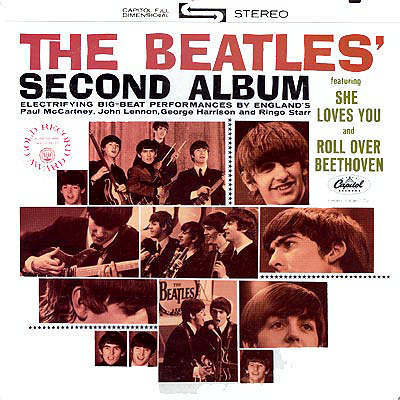
The Beatles' Second Album

My first memory of hearing the name “The Beatles” is an odd one. I was sitting in a classroom in Saint Matthews, the local Catholic boy’s school. I think I was in the 5th grade at the time. Occasionally the tiny public address speaker in the front of the room would crackle in anticipation of an announcement from the disembodied voice of Mother Superior, a figure not that unlike the character of Death in Bergman’s The Seventh Seal or the character of the Emperor in Star Wars. But above even Mother Superior in the pantheon of my childhood authority was the voice of the parish priest. It was the voice we would expect to hear shortly before the incoming Soviet ICBM’s struck the high priority target of the naval shipyards five or six miles from where we sat. It was as close as you could get in 1963 in Northeast Philadelphia to the voice of God.

“Boys…” the voice said. I think I grasped the edge of my desk expecting to hear “This is not a drill” followed by instructions containing the words “duck” and “cover.”

Believe it or not, but in 1963 children were regularly shown films of the effects of nuclear explosions – the shock wave obliterating the farmhouse, mannequins disintegrating at the table, the car engulfed in flames and spinning wildly through the air – and then instructed to dive beneath our small wooden desks for safety in the event of this nuclear fire. I don’t know if anyone has ever really charted the effects of this on the so-called “baby boom” generation. The corresponding rise in popularity of the “Theatre of the Absurd” may not be a coincidence.

But I digress….

The voice of the priest continued.

“I want to make it very clear that under no condition will beetle haircuts be permitted in this school.”

We sat, silent, uncomprehending, still behind the curve of new cultural trends. But while it was true that not a single kid in the room had any idea what the priest was talking about, it was also true that every kid in the room wanted one.

There are many different definitions of “THE SIXTIES.” Some put the decade in literal terms from 1960 to 1969. Some use the death of JFK in 1963 through the resignation of Nixon in 1974. Some trace it from the birth of The Beatles on Ed Sullivan to the death of Meredith Hunter at Altamont. A new academic journal on the era uses a “long sixties” of 1955-1975. Those of us who were around during those times each have a personal sixties; mine starts with that announcement.

All of this is documented in a million other places: The Beatles were signed to EMI in England which, even though it owned Capitol Records in the US, could not get Capitol to release the early Beatles recordings. The ones that were released appeared on small regional labels like Tollie, Swan, and Vee-Jay and registered no impact on Top 40 radio. Finally in late 1963, early 1964 Capitol could no longer ignore the success the band was experiencing across Europe and released the first US LP, Meet the Beatles.

Actually 1964 was a pretty good year for Beatles albums. In addition to Meet The Beatles, Capitol also released The Beatles’ Second Album, Something New, Beatles ’65 and a double LP, The Beatles Story, that collected news stories, interviews and snippets of live recordings. United Artists also released the soundtrack to A Hard Day’s Night, and Vee-Jay records released Introducing The Beatles compiling all the early tracks they still had the license for.

During the week of April 4, 1964 The Beatles occupied the first five slots of the Billboard Hot 100, #1 - "Can't Buy Me Love," #2 - "Twist and Shout," #3 - "She Loves You," #4 - "I Want to Hold Your Hand" and #5 - "Please Please Me," the only group in rock and roll history to achieve this feat. That same week they also had another seven charting records in the Hot 100: "I Saw Her Standing There," 31; "From Me to You," 41; "Do You Want to Know a Secret?" 46; "All My Loving," 58; "You Can't Do That," 65; "Roll Over Beethoven," 68. The Beatles had twelve songs on the charts that week, a feat never matched before or since.

In 1964, the Beatles had the never-matched total of 15 American million-selling records (9 singles and 6 LPs), representing US sales of over 25 million in 1964 alone.

In other words, 1964 was a very good year for the Fabs.

But it is The Beatles’ Second Album that fascinates me because it is this, and not “Revolution” that stands as the most political statement they ever made. It also rocks harder than any of their other records as it manages to avoid any of the pop ballads favored by Paul McCartney that usually slowed down the group's other early albums.

As Bruce Eder writing for the All Music Guide notes:

The Beatles' Second Album stands as probably best pure rock & roll album ever issued of the group's music. In the process of pulling songs from various British and American EPs, singles (including "She Loves You") and B-sides, as well as tracks left over from the editing of With the Beatles for American release, the compilers somehow No other long-player by the group featured them doing more covers of songs by black American artists or songwriters, including Little Richard ("Long Tall Sally"), Chuck Berry ("Roll Over Beethoven"), Smokey Robinson ("You Really Got a Hold on Me"), Barrett Strong ("Money"), and others, and just to show how rich a vein this all was at the time of its release, the version of "Roll Over Beethoven" here actually charted briefly as a single.

In his new book, The Beatles’ Second Album, Dave Marsh writes:

"The Beatles showed their allegiance to the principles of the civil rights movement when they refused to play any racially segregated shows on their 1964 concert tour. It was an unusual statement. The Beatles never again took a political stand as a group, and very few performers made such demands when they worked in the South. Making that choice did not endear them to many white American adults, Southern or Northern....

....I don't know what was in that teacher's conscious mind; I do know that everything he tried to teach us smacked of the message I got at home, which was that white was right and black needed to be kept back, or, since it was advancing, north and south, into territory that had been "ours," pushed back. That stuff about the Beatles being revolutionary is more than just talk. There was a war going on, and we were asked to take sides."


The racial history of US pop music up until The Beatles is Pat Boone covering Fats Domino and Little Richard, sanitizing the music, bleaching the color from it, neutering any hint of sexuality. But The Beatles covered these songs as triumphant celebrations of the original artists and every copy of the album that sold was an engraved invitation to an army of middle class white kids to go to the record stores and track down the albums of black America.

The White Southern Christian Citizens Brigades that were formed (along with some Northern ones) in the mid-1950s to fight the threat of race-mixing inherent in the records of Elvis, Chuck Berry, Jerry Lee Louis and Little Richard had been successful. Elvis was in the army, Berry was in prison, Jerry Lee in exile and Little Richard had found Jesus. Pat Boone and the legion of the one-named teen idol pop crooners (Frankie, Dion, Fabian, etc.) had fought back the Visigoths of pop culture.

But in 1964 the Visigoths were back at the gates and this time they had WMDs.

Monday, November 5, 2007

Masked and Anonymous....

Every so often I get into an argument over this 2003 film by Larry Charles. Since I am a fan of Bob Dylan I am accused of having my judgement clouded. I am accused of not being able to distinguish between a film that I "like" and a film that is "good." As I have been known to spend hours explaining why I think Pootie Tang is infinitely superior to American Beauty I recognize that this is a self-inflicted wound.

But this is not the case here. I will often explain how my wife, who is not a fan of Dylan in particular, has become a major fan of this film. When people she doesn't know come to visit she often shows them the film and, if they react like a typical movie critic (who until a week ago was reviewing restaurants) that's the last we'll see of her that evening. And, while I have never called this film a "masterpiece," I do believe it is better by far than the vast majority of the films that are lavashied with awards at what has come to represent the dark side of the force in independent film - Sundance.

Whenever I have to mount a defense of the film I am always sent back to the internet and a Google search for what I think is the most cogently argued defense I've ever read. Written by David Vest in the 20 September 2003 issue of CounterPunch, "Masked and Anonymous: Dylan's Elegy for Lost America" says everything that I could hope to say about the film. Rather than have to go look for it everytime I need it I've decided to archive it here. if you haven't seen the film check your library's database immediately. Here's the trailer to tide you over.

Bob Dylan's Elegy for a Lost America
By David Vest

Bob Dylan's new film, "Masked and Anonymous," has met with almost universal condemnation (or worse, condescension) from critics in the corporate media. According to most reviewers, in lieu of a plot the film offers "rambling incoherence" and "incomprehensible dialogue." It is "an exercise in self-indulgence." Several reviewers have actually worried in print that Dylan made the movie in order to have some kind of joke at their expense. Dylan's character, Jack Fate, has little or nothing to say, we are repeatedly told, and more or less just "sits there like a toad," in the words of Roger Ebert, who should be the last person to accuse anyone of that.

Could the movie really be this bad? It wouldn't matter if it were equal to "The Tempest" or "Julius Caesar," it has already been pronounced D.O.A.

Anytime the nation's media are this unanimous about anything, one would do well to be suspicious. After all, President Bush's decision to invade Iraq in search of "weapons of mass destruction" was met not with skepticism but with near-unanimous cheerleading and boosterizing in the corporate media.

Reviewers had already effectively killed Dylan's film by the time it arrived in Portland, Oregon for a perfunctory one-week run. Although attendance grew steadily during the week, it started sparse and grew toward respectable.

Not ten minutes after the opening credits I could see why the film had been marked for assassination by big newspaper media critics. They are the villains of the piece! "Masked and Anonymous" portrays the reporters who wrote the bad reviews as people who have to wear ankle monitors. Editors hold the keys that control them. Who owns the editors is pretty clear, too. The sight of superstar critic and Sixties specialist "Tom Friend" (Jeff Bridges) being beaten to death with Blind Lemon Jefferson's guitar must have been too much for them.

"Friend," obsessed with his own memories of the Sixties but oblivious to what is going on outside the window, never seems to notice that Fate, his quarry, answers none of his questions.

Officials of the "network" televising the "benefit" on which Fate is to appear see him as self-indulgent, too. They want him to sing "Jailhouse Rock," "Jumping Jack Flash" and "Revolution - the slow version."

He gives them "Dixie."

The infamous "rambling and incomprehensible" plot is in fact rather well-constructed and makes abundant sense. Although the project could have used some tighter editing and more attention to minor issues of continuity, anyone who couldn't follow this movie probably couldn't be trusted with a comic book. The storyline is no more "obscure" or "disjointed" than "A Hard Day's Night."

But it hits a great deal harder. When the camera pans slowly down a desolate L.A. avenue, and Dylan is heard singing "Seen the arrow on the doorpost, saying This Land is Condemned, all the way from New Orleans to Jerusalem," try to keep tears from welling. (Or sit there like a toad eating popcorn and stuff the feeling, it's your call.)

Whereas the concert finale of "A Hard Day's Night" is witnessed by screaming teenagers and an adoring TV audience, the concert performed by Fate in "Masked and Anonymous" is seen by no one except stage hands and extras because it is pre-empted by a presidential speech and interrupted by guns and bayonets.

In spite of what you may have read, the film is not "set in some imaginary third-world country at some point in the future," anymore than King Lear is about prehistoric England. Failure to recognize the true setting should immediately disqualify any reviewer. "Masked and Anonymous" is a spot-on accurate portrayal of what is going on RIGHT NOW, seen through the eyes of someone with vision and not just eyesight, someone who has looked through the eyes not only of Charley Patton and Elizabeth Cotton but also of Emmett Miller and even Daniel Decatur Emmett.

All America's chicken-hawk foreign wars have come home to roost. The horrors once visited upon El Salvador, Nicaragua, Vietnam, Somalia and Iraq are now rolling through the streets of California. All the electoral disgrace of recent campaigns has been compressed into one presidential speech. As for the major media as portrayed in this film, it is impossible not to think of Christiane Amanpour's recent admission that CNN "was intimidated" by the Bush administration and operated in a "climate of fear and self-censorship" during the invasion of Iraq.

When the new president (Mickey Roarke) concludes his "war-is-peace" oration at the end of the film with the sarcastic words "May God help you all," it is merely what anyone with a perceptive imagination can hear Bush or Cheney saying when they conclude their speeches with the formulaic "God Bless America." Certainly the administration portrayed in "Masked and Anonymous" is no more thuggish than the one currently rooting at the trough in Washington.

Or, as Uncle Sweetheart (John Goodman) puts it, "It's the dark princes, the democratic republicans, working for a barbarian who can scarcely spell his own name."

When a soldier (Giovanni Ribisi) tells Fate of fighting first with the rebels, then with the counter-insurgents, then with the Government, then with the rebels again, only to discover that some of the rebels are in fact funded by the very Government they're supposed to be opposing, how strange does that seem to anyone familiar with the betrayals and capitulations of contemporary politics, especially movement politics? It's like finding out who sponsors "Earth Day."

My favorite exchange: "I'm trying to be on your side, Jack," says Uncle Sweetheart, the promoter who is, naturally, "only trying to help."

"You have to be born on my side, Sweetheart," says Fate.

To be on the side of workers, of animals, of oppressed people, of love, of the truth is to court destruction. Before singing his final song and meeting his own fate, Jack Fate experiences a visitation by his ghostly forerunner, Oscar Vogel (Ed Harris), a banjo-playing entertainer who worked in blackface and who disappeared after raising his voice against the times. When Fate looks back to catch a last glimpse of Vogel, the vaudevillian has been replaced by a young Black man who could be a janitor, a Reggae artist or a rising Hip-Hop truth teller, next in the line of destiny, or line of fire.

This film isn't perfect. I have read the original screenplay and far too much has been cut out of it to try to make it acceptable to people who would have had none of it under any circumstances. But it is the only motion picture I have seen so far in this millennium that seems to have a clue about what is going on in America. Moviegoers will get it or they won't. Great pains have been taken to ensure that they won't even see it.

It is a tale of almost unbearable sadness and loss. When Dylan sings "I'll Remember You," as electrifying a performance as has ever been caught on camera (all the songs are performed live, there's no lip-synching in this movie) you feel that he may well be singing not merely about a person but also about that "lost America of love" that Ginsberg mourned in "A Supermarket in California," a work that in its visionary aspect and intensity "Masked and Anonymous" resembles. (Its ultimate antecedents are of course Shakespeare's history plays.)

When Dylan's character, Fate, is reunited with his lost/doomed love (Angela Bassett, magnificent in the role), she endeavors with great tenderness to console him for his losses, and without a word Dylan manages to convey that Fate's grief is inconsolable. It is a scene of considerable beauty and delicacy.

Dylan's performance has been called "inscrutable." But who else could have played this role? There are people who find his songs inscrutable as well, and I suppose arguing with them would be as pointless as trying to answer "Tom Friend's" interview questions. (These days, anything an idiot can't or won't bother to understand is "incomprehensible" and "inscrutable.")

The most daring (and intriguing) line in the film slips by almost unnoticed: moments after Jack Fate is arrested for a sudden act of violence committed by his sidekick Bobby Cupid (Luke Wilson), he thinks to himself, "Sometimes it's not enough to know the meaning of things. Sometimes we have to know what things don't mean as well. Like, what does it mean to not know what the person you love is capable of?"

Unlike D. A. Pennebaker's "Don't Look Back," which showed a young Dylan eating dumb but presumptuous critics alive, "Masked and Anonymous" depicts an aging Jack Fate with nothing whatever to say to them. "I was always a singer and maybe no more than that," he says.

So much for "self-indulgence."

Sunday, November 4, 2007

Johnny Rotten Just Doesn't Get It....


The article below comes from the 15 October issue of The Daily Mail and is written by Billy Bragg. When I read it I remembered the scene in the recent Stephen Frears film, The Queen, in which Michael Sheen, in the part of Tony Blair in a room of his supporters following his election to Prime Minister, explodes in anger at a cruel joke told at the Queen's expense.

After the photo above appeared there was an outcry not that different from the one following the debut of Bob Dylan's recent Cadillac Escalade commercial. Many on the left in Britain apparantly wanted Bragg to snub the Queen in a show of socialist solidarity. Without descending into a deep chasm of Marxist cultural theory, such reactions are best understood as the operation of cultural hegemony in late capitalism. Think of it this way.... In less advanced societies if an artist whose work takes a politically oppositional stance begins to rise in popularity, the powers that be send men in masks in the dark of night and the body of the artist is never found. But in advanced capitalist societies like the UK and US, when an artist whose works offers politically oppositional ideas becomes popular, men in suits come with TV news crews in the bright light of the afternoon and with them they bring steamer trunks stuffed with thousand dollar bills and solid gold record albums to lay at the feet of the artist who now has two choices.

He can refuse the money and fame claiming a desire to remain "one of the people" in which case the actual people will mostly see him as insane. "What kind of idiot turns down stacks of money?" In David Mamet's Heist, Danny DeVito's character asks "Why do you think they call it money?" (I can't think of a better example of a nonsensical question that makes sense to everybody who hears it.) Recast now as either crazy or eccentric, the legs are taken out from under whatever oppositional potential the art may have held.

Or, the artist can take the money, and be recast as "selling out" whatever principles he might have previously held.

I'm amazed by that particular phenomenon because what it really means is that money & wealth have a toxiticty to them that only right wing Republicans can survive.

But I digress.

Here's Billy Bragg's explanation:

"She was a small, grey-haired woman, smartly dressed in light colours to stand out against all the suits, and with a neat little handbag on her arm.

She worked her way down the line of dignitaries, nodding politely as they said their bit. It did make me laugh that both my neighbours in the line-up whispered to me as we stood together: 'Of course, you know I'm not a monarchist' - before dropping into a curtsey as the Queen came into view.

As I watched her approach, I couldn't help thinking that this is what it must be like to play for England, lining up to shake hands with the Queen before the big match.

My mind was drifting back to 1966 when suddenly there she was, offering me her hand with a look that seemed to say: 'Well, well. I didn't expect to see you here, Braggy.'

I found myself explaining how I'd written the new lyrics to Ode To Joy, and how fantastic it had been to hear Beethoven accompanied by my words. Earlier, I had noticed her in the Royal Box, following the lyrics in her programme. I had to smile.

I joked that I'd wanted to become the new Bob Dylan and had become the new Friedrich Schiller, the original 18th-century author of the Ode lyrics, instead. She laughed.

When she had gone, I spent some time speaking with members of the choir. They had done a great job with my lyrics, and I welcomed this chance to tell them so.

Later, I heard that the Queen's private secretary had asked if it would be possible to get a copy of the score - signed by me. That just about topped the evening off.

So I guess I have a bit of explaining to do. How could I - a life-long socialist who believes that God Save The Queen should be replaced as England's national anthem by Blake's Jerusalem - find myself shaking hands with Her Majesty?

After all, as a punk rocker during the Queen's Jubilee year back in 1977, I bought my copy of the Sex Pistols' anarchic God Save The Queen like all my mates.

Indeed, I woke up the morning after the performance to find columnists in the Mail wondering how a 'dyed-in-the-wool republican' like me could shake hands with the Queen.

The simple truth is that although I am a Left-winger, I have never described myself as a republican. I've always felt that campaigning against the monarchy distracts us from addressing the issue of where the power really lies in this country.

Back in the Eighties when I fronted the Labour-supporting movement Red Wedge, I had a spat with the band The Housemartins over this very issue.

They refused to join Red Wedge because we would not come out in favour of abolition of the monarchy.

I hit back with an article in Well Red, our house magazine, in which I argued that it would make a much greater contribution to altering the balance of power in this country if we abolished the House of Lords and replaced it with a democratically elected upper chamber - a view I still hold.

Ultimately, I'd like to see the monarchy removed from the political process. It's not just the charade of the Queen's Speech that I object to.

The Prime Minister has, in the form of the royal prerogatives, the power to declare war, sign treaties and appoint peers without recourse to Parliament. Such issues ought to be a matter for our elected representatives.

I believe the people should be sovereign in Parliament, not the Crown.

That magnificent gold throne in the House of Lords would look lovely in a museum.

Once that happens, I don't have a problem with having a monarchy that is symbolic. After all, the Queen already plays that role, especially for the generation who lived through World War II. They do seem to revere her more than the rest of us.

So I believe that while there are still those among us whose loved ones fought and died for king and country in that conflict, then we owe them a debt of respect, not only for the sacrifices they made during the war, but for the legacy of the Welfare State, which they created and handed down to us. By respecting the Queen, we respect them.

However, I don't think the respect that people have for Elizabeth II will automatically be extended to Charles - I know from experience that even ardent monarchists have trouble with the notion of Queen Camilla. And I just can't see the Aussies wanting to put King Charles III on their banknotes.

On the night of the performance, I certainly wouldn't have stuck around to shake hands with any other member of The Firm - and let's not even get started on the Queen's grandchildren, falling out of nightclubs with their braying Sloaney friends.

In contrast, just look at how our Queen comports herself. She does her job pretty well, playing the role of our national figurehead with diligence and decorum, giving us a sense of continuity in a world where change seems to be getting faster. My respect for our monarch is entirely personal - it is not vested in her office.

The Queen is going to be a very hard act to follow, if only because her place in our national life is unprecedented. After all, she is the only head of state most of us have ever known.

I sometimes feel very old, because I can remember having small change in my pocket which bore the austere profile of Queen Victoria.

But anyone under 40 will have known only one face adorning coins and stamps. When she dies, the monarchy as we know it will die with her. The institution itself may not survive her passing.

Up close, the Queen really isn't majestic, more like a grandmother in twin- set and pearls, but the dignity that she brings to the role of head of state utterly transcends the need for the flummery of majesty.

Ask yourself who else could have opened the new National War Memorial in Staffordshire last week? Would a politician have made a better connection with the veterans? They stood in line to meet the woman who embodies to them the very things that they were fighting for.

Could anyone else signify to the families of the fallen how important we believe their sacrifice to be? Hers is a fame beyond the transitory celebrity which has become the debased currency of modern life. Posh and Becks fade into insignificance alongside her ubiquity and place in modern British history.

That's why the BBC found themselves in such trouble over the 'Crowngate' affair (in which film of the Queen for a trailer for a documentary was shown out of sequence).

It's pretty much standard practice for reality TV programmes to stitch up their subjects by editing the footage to create a sense of tension and conflict. The independent production company who supplied the show reel were just doing their 'job'.

What they didn't realise is that what might seem permissible when done to the poor souls who put themselves at the mercy of reality TV is just not acceptable where the Queen is concerned. Whether we like it or not, she is a special case, a national icon who has to be treated with respect. It's just a shame that we don't treat all our 81-year-olds that way.

I know I'll get lots of stick for shaking her hand - one of my fan websites, the Braggtopia, is offering a prize for the best photo caption for my royal moment.

My tour manager has even asked if we are going to have the full coat of arms on the side of our tour bus with the words 'By appointment, songwriter to Her Majesty Queen Elizabeth II'. And I'll probably get struck off Morrissey's Christmas card list.

Of course, some argue that the monarchy makes us all subjects, but take a look at your passport - mine says I am a citizen, of Great Britain and of the European Union. Clearly, being a subject is a state of mind.

There are those who will doubtless seek to portray my actions as some kind of a betrayal, but that sort tend to be narrow-minded people from both sides of the political spectrum who would prefer me to be a stereotypical Leftie. I guess they'd find that easier to deal with.

The fact is, you won't see me standing outside Buck House waving a flag at the Trooping the Colour any time soon; nor will you find me accepting any honours that might be dangled my way.

However, that doesn't mean I can't show some respect for a woman who clearly means a great deal to many of my fellow citizens. Surely that's what living in our multicultural society entails, isn't it - showing due respect for beliefs that you don't necessarily adhere to?

I could have been sniffy, I suppose, and refused to shake her hand, but she was good enough to come to my gig and follow my lyrics while they were sung. She even asked for my autograph.

Last Tuesday night was very special. I sat with my mother, my missus and my son while we listened to a great orchestra and a massive choir passionately sing my words to one of the greatest pieces of music ever written.

And afterwards, I got to shake hands with the woman who gave the World Cup to Bobby Moore. For a boy from Barking, it just doesn't get much better than that.

What can I say? The Queen charmed the pants off me."

• Billy Bragg's fee for this article has been donated to Jail Guitar Doors, http://www.jailguitardoors.org.uk/

Friday, October 19, 2007

December 7, 1997 and August 28, 1963

I'm sure there are other reasons these dates are significant, but I find them interesting because on both days Bob Dylan hung out a bit with Charlton Heston.

Now, not to dive into the deep end of French literary theory but one favorite distinction gleaned from that work was Roland Barthes' notion of the writerly and readerly texts. Put simply, the meaning in readerly texts is fixed and rigid, but in writerly texts the meaning is more fluid, more open. Barthes said "In readerly texts the signifiers march; in writerly texts, they dance." As artists, the difference between Bob and Chuck seems pretty clear.

In 1997, Dylan and Heston were in the group of five artists honored by President Clinton at The Kennedy Center in Washington, D.C. In 1968, both men were also together in Washington with Dr. Martin Luther King, Jr., and a quarter of a million men and women marching together for social justice.

The March on Washington represented a coalition of several civil rights organizations, all of which generally had different approaches and different agendas. The "Big Six" organizers were James Farmer, of the Congress of Racial Equality (CORE); Martin Luther King, Jr., of the Southern Christian Leadership Conference (SCLC); John Lewis, of the Student Nonviolent Coordinating Committee (SNCC); A. Philip Randolph, of the Brotherhood of Sleeping Car Porters; Roy Wilkins, of the National Association for the Advancement of Colored People (NAACP); and Whitney Young, Jr., of the National Urban League.

Opposition to the march came from a number of quarters. President Kennedy originally discouraged the march, for fear that it might make the legislature vote against civil rights laws in reaction to a perceived threat. Once it became clear that the march would go on, however, he supported it. While various labor unions supported the march, the AFL-CIO remained neutral.

Outright opposition came from two sides. White supremacist groups, including the Ku Klux Klan, were obviously not in favor of any event supporting racial equality. On the other hand, the march was also condemned by some civil rights activists who felt it presented an inaccurate, sanitized pageant of racial harmony; Malcolm X called it the "Farce on Washington," and members of the Nation of Islam who attended the march faced a temporary suspension.

Nobody was sure how many people would turn up for the demonstration in Washington, D.C. Some traveling from the South were harassed and threatened. But on August 28, 1963, an estimated quarter of a million people—about a quarter of whom were white—marched from the Washington Monument to the Lincoln Memorial, in what turned out to be both a protest and a communal celebration. The heavy police presence turned out to be unnecessary, as the march was noted for its civility and peacefulness. The march was extensively covered by the media, with live international television coverage.

The event included musical performances by Marian Anderson; Joan Baez; Bob Dylan; Mahalia Jackson; Peter, Paul, and Mary; and Josh White. Charlton Heston—representing a contingent of artists, including Harry Belafonte, Marlon Brando, Diahann Carroll, Ossie Davis, Sammy Davis Jr., Lena Horne, Paul Newman, and Sidney Poitier–read a speech by James Baldwin.

The two most noteworthy speeches came from John Lewis and Martin Luther King, Jr. Lewis represented the Student Nonviolent Coordinating Committee, a younger, more radical group than King's. The original text to his speech had circulated throughout the day and the march leaders were able to convince him to tone down his rhetoric and remove the most inflammatory portions. What he did deliver was still the most explicitly radical speech of the day. He said, in part:

The revolution is at hand, and we must free ourselves of the chains of political and economic slavery. The nonviolent revolution is saying, "We will not wait for the courts to act, for we have been waiting hundreds of years. We will not wait for the President, nor the Justice Department, nor Congress, but we will take matters into our own hands, and create a great source of power, outside of any national structure that could and would assure us victory." For those who have said, "Be patient and wait!" we must say, "Patience is a dirty and nasty word." We cannot be patient, we do not want to be free gradually, we want our freedom, and we want it now. We cannot depend on any political party, for the Democrats and the Republicans have betrayed the basic principles of the Declaration of Independence.

Dr. King's speech remains one of the most famous speeches in American history. He started with prepared remarks, saying he was there to "cash a check" for "Life, Liberty and the pursuit of Happiness," while warning fellow protesters not to "allow our creative protest to degenerate into physical violence. But then he departed from his script, shifting into the "I have a dream" theme he'd used on prior occasions, drawing on both "the American dream" and religious themes, speaking of an America where his children "will not be judged by the color of their skin but by the content of their character." He followed this with an exhortation to "let freedom ring" across the nation, and concluded with:

And when this happens, when we allow freedom to ring, when we let it ring from every village and every hamlet, from every state and every city, we will be able to speed up that day when all of God's children, black men and white men, Jews and Gentiles, Protestants and Catholics, will be able to join hands and sing in the words of the old Negro spiritual, "Free at last, free at last. Thank God Almighty, we are free at last."

When I talk about the impact of Bob Dylan upon American culture in the last half century I always include the image of the 23 year-old folksinger on the stage in the shadow of the Washington Monument performing as, in effect, the warm up act for Dr. King's "I have a dream" speech.

Dylan sang his greatest protest song, "Only a Pawn in Their Game," about the murder of Medgar Evers on June 12, 1963 by Byron De La Beckwith, a member of the Ku Klux Klan. When he sang this song it was less than three months since that killing. In the film of the scene the camera pans the faces of the crowd and people appear to be listening intently to Dylan's words. The song is unique in the literature of protest music because it does not rally the troops by attacking the killer. Instead, it asks the listener to consider larger questions:

A bullet from the back of a bush took Medgar Evers' blood.
A finger fired the trigger to his name.
A handle hid out in the dark
A hand set the spark
Two eyes took the aim
Behind a man's brain
But he can't be blamed
He's only a pawn in their game.

A South politician preaches to the poor white man,"You got more than the blacks, don't complain.
You're better than them, you been born with white skin," they explain.
And the Negro's name
Is used it is plain
For the politician's gain
As he rises to fame
And the poor white remains
On the caboose of the train
But it ain't him to blame
He's only a pawn in their game.

You can see the rest of the lyrics and hear the melody here; the song is from Dylan's third and most explicitly "protest song" album, The Times They Are A-Changin', which wouldn't be released until the winter of 1963, which means that the crowd in Washington was hearing it for the first time.

But the song and performance that never fails to make all the hair on my neck stand at attention is immediately before that. "When the Ship Comes In" (seen here in a slightly grainy video from the march) uses Biblical imagery to create a sense of justice marching through history, destroying all enemies in its path.

Then the sands will roll
Out a carpet of gold
For your weary toes to be a-touchin'.
And the ship's wise men
Will remind you once again
That the whole wide world is watchin'.

Oh the foes will rise
With the sleep still in their eyes
And they'll jerk from their beds and think they're dreamin'.
But they'll pinch themselves and squeal
And know that it's for real,
The hour when the ship comes in.

Then they'll raise their hands,
Sayin' we'll meet all your demands,
But we'll shout from the bow your days are numbered.
And like Pharaoh's tribe,
They'll be drownded in the tide,
And like Goliath, they'll be conquered.

I suppose it's something to do with age. To paraphrase Bob, "I was so much younger then, I'm older than that now." In 2007 none of the TV networks would cover that march; the audience research says people don't want to see "protests" and we would have instead investigative reports on the breaking scandal of Ellen's dog and Britney's inability to follow the instructions that come with panties.

But "When the Ship Comes In," as powerful as it is, makes no sense today. It is as if it's being sung in a dying language, one with only one or two living speakers. A language that somehow no longer fits the world it once described.

Aw.... I hate to be a buzzkill, but the question does occur to me whether it really makes any difference if Rudy or Hillary is wearing the Captain's costume as the last little bit of the deck rail disappears beneath the frigid waves of the North Atlantic.


* The section above on the March on Washington borrows heavily from the Wikipedia entry.

Friday, October 5, 2007

Live Music and the Novelty Effect

“The concert is a polite form of self induced torture.” - Henry Miller

For the longest time one of the attractions of seeing Bob Dylan in concert has been the opportunity to hear him stretch his most recognizable songs into new, and sometimes nearly unrecognizable, arrangements. Unlike most of his peers, Dylan’s refusal to treat his songs as if they were sacred texts, for which radical reinterpretation would border on blasphemy, began as something commendable. In his lengthy career as a live performer, however, these reinterpretations have gradually turned to parody.

Dylan’s early performing career was as a solo acoustic “folk” performer. His first four albums (Bob Dylan, The Freewheelin’ Bob Dylan, The Times They Are A-Changin’, and Another Side of Bob Dylan) are, with the exception of Freewheelin’s “Corrina, Corrina,” entirely solo acoustic. His live performances during the same period were made up of mostly straight readings of the album songs. At times you can hear some of the more “protest” (read: self-righteous) oriented songs, “The Lonesome Death of Hattie Carroll” for example, begin to take on sacred song characteristics.

1965 of course marks the single most famous insertion of a plug into an electrical outlet in pop music history and triggered the burst of creativity that produced three brilliant albums Bringing it All Back Home, Highway 61 Revisited, and Blonde On Blonde (a run of creative energy that remained unequaled until the 1998-2007 arrival of Time Out Of Mind, Love and Theft and Modern Times).

Almost immediately Dylan began to use the massive influx of energy the new rock 'n' roll arrangements afforded him to open up and, in some cases, explode the meaning of his acoustic material (listen to 1966 live recordings of “Baby, Let Me Follow You Down” in particular). In these performances Dylan, it seems to me, plays with the ecstasy of electric music, the excess of volume, the simple joys of noise.

But 1966 is the end of the second Dylan, the “electric Dylan” (who followed the debut “Woody” Dylan) and the beginning of the “Recluse” Dylan. Following a (1) serious or (2) trivial motorcycle accident, Dylan retreats and, with the exception of the odd sighting (Isle of Wight, Concert for Bangladesh, Johnny Cash TV Show) Dylan withdrew from live performance, choosing to make unusual and unexpected music (The Basement Tapes, Self Portrait) designed to rip down the “Voice of His Generation” banner by frustrating every expectation.

When Dylan took the stage again in 1974 with The Band on a record-breaking cross country tour he once again returned to altering the arrangements of his material. This time, however, was a bit different. I saw that tour in Philadelphia and I remember that there was an opening set by Dylan and The Band, a set by The Band, a solo acoustic set by Dylan, and a closing set by Dylan and The Band. Oddly, I also remember a small line of protestors outside The Spectrum (where 3 shows had sold out) picketing the concert because ticket prices had been raised. I had my ticket stub for years after that show and I remember the ticket was $7.50.

But I digress….

This time it wasn’t his acoustic material being reshaped by an electric band (like it had been in 1965 and 1966). This time the material from his electric albums was redone. In part, the new arrangements were designed to take advantage of his backing band, but some of the revisions resulted in a radical alteration of the song’s meaning; the most explicit example is the 1974 live version “Lay, Lady, Lay.”

The original version is on the 1969 album, Nashville Skyline, Dylan’s sudden turn to country music, which was at that time, competing with Big Band and Show Tunes for “most unhip” music, ever. In hindsight, Nashville Skyline was an extension of the brilliant John Wesley Harding, but both albums were decidedly ahead of the learning curve of the late 1960s. While there is clearly an ongoing and important conversation regarding just what it means, Nashville Skyline (and JWH especially when read as Dylan’s answer record to Sgt. Pepper) was a clear return to “traditional American family values.” A short time later the rest of us would wake up after the acid had worn off, at ten in the nmorning the day-glo paisley wouldn’t look as good on the mailbox, and somebody still had to do the laundry and the dishes and change the litter box. Maybe the best explanation is the one offered by Leonard Cohen’s Zen teacher (whose name escapes me at the moment) who said, “You can’t live in God’s world too long; there are no restaurants or toilets.”

But I digress….

On Nashville Skyline “Lay, Lady, Lay” had seemed a very tender song, almost as if the singer were saying “You look tired. Here, lay across my big brass bed for a bit. It’s comfy; you take a nap and, when you wake up, I’ll make us some tea.” Backed by Robbie Robertson’s biting guitar fills the song was suddenly eroticized. “Get on the bed; here, slip these handcuffs on….”

The following year Dylan cobbled together his Rolling Thunder Review and took to the road for big chunks of 1975 and 1976. The traveling gypsy caravan character of the tour made the loud and, at times, almost unrecognizable arrangements of his classic material seem natural; like just what a traveling gypsy caravan might do. On You Tube you can find performances for songs like his duet with Joan Baez on “I Pity the Poor Immigrant” or his reworking of “Idiot Wind” or “Shelter From the Storm” off 1975’s Blood On the Tracks that seem to both wipe away whatever meaning the songs had, but have so much fun doing it that it isn’t immediately noticeable.

Not so for 1978.

If you look in the links section and click on Expecting Rain and then click on “Discussions” and then click on “Rare Recordings” you’ll find an indexed archive of a huge array of downloadable live Dylan ranging from the very early 1960s right on through to last week. If you’re interested in hearing any of the performances referenced in this blog you will almost certainly find them there. Border Beneath the Sun is a 2 disc set from a 1978 performance in Paris that most people think is superior to the official live album, Bob Dylan at Budokan, recorded at the start of the tour in Japan. For the first time Dylan puts together a full show band, complete with horns and female backup singers and presents a “Greatest Hits” program in which all the songs are reworked into what has always struck me as a Neil Diamond-meets-Elton-John-at-Graceland form. Here’s one example from Nashville in December 1978 of “Changing of the Guard” and some samples from a number of songs from London in June 1978.

From this point on the story takes some strange turns and most of those are easy to watch for yourself thanks to the miracle that is You Tube. Just search under “Dylan 1982” “Dylan 1983” and so on. Here’s what you’ll find.

Dylan’s reworking of songs is no longer offering a new arrangement as much as it is simply a rather thudding blues-based chanting of lyrics in an idiosyncratic-for-idiosyncrasy’s sake manner that renders the original song on the terms of little more than novelty.

I wish pianist Glenn Gould were still alive and I could arrange a meeting between him and Dylan to talk about live performance. At the height of his popularity Gould walked away from live performing. In one recorded interview, Gould tells a very interesting story about a particular piece of music he had developed an affection for on a European tour. He played it at almost ever concert, if not part of the program then as an encore. At the end of the tour he went into the studio and recorded the piece. When he played it back he was shocked. “It was perhaps the single worst thing I had ever played.” he said. The piece, in the interaction between the artist and audience, had become a caricature of itself; it had been rendered at best a novelty, at worst, grotesque.

In case you were wondering, my attitude toward Dylan is not a matter of being trapped in the past. I think his last two albums have been equal to the best of his entire career. But I find I agree more and more with Gould who said, “A record is a concert without halls and a museum whose curator is the owner.”

Tuesday, August 14, 2007

The Left What's Left....

I’ve gotten into the habit of checking the obituaries of a small town newspaper in Western, Pennsylvania, because it is a small town and because I lived there for quite some time in the 1970s and 1980s and I sometimes recognize a name. I rarely look at the obituaries in larger papers, but one did catch my eye this past Sunday in the NY Times.

"Moe Fishman, who as a 21-year-old from Astoria, Queens, fought Fascists in Spain with the Abraham Lincoln Brigade and was severely wounded, then led veterans of that unit in fighting efforts to brand them as Communist subversives, died on Aug. 6 in Manhattan. He was 92."

The photo caught my eye. I have one friend who wears a beret; it is a very hard look to pull off. It helps if you’re playing “Flambee Montalbanaise” on an accordion. But exceptions can be made, and a 92 year old Spanish Civil War veteran on the streets of Astoria can wear a Viking helmet if he likes. I wouldn’t complain.

One discovery I made when I started writing a blog was that every post seems to send me off into odd corners of the internet and I always seem to return with unexpected little bits of information I found just sort of floating out there, drawn to me as if by gravity as I wander about.

I knew that George Orwell had gone to Spain to fight the fascists. I remember a journal entry he’d made during that time, something to the effect that “I’ve been here for two weeks and haven’t killed my first fascist yet. . . . If we could each shoot one fascist they would quickly become extinct.” I found that a year or so ago when I was writing a piece about Woody Guthrie, and how the phrase “This machine kills fascists” that he’d written around the border of his guitar was not entirely meant to be taken figuratively.

What I did not know, however, was that George Orwell was born Eric Arthur Blair. The son of a British civil servant, he was born in eastern India in 1903 and joined the Indian Imperial Police in Burma, then a British colony. He resigned in 1927 when he began to think of himself as a writer. He took the name “Orwell” just before the publication of his book Down and Out in Paris and London in 1933.

I’ve thought, like I suppose most people have at one time or another, of changing my name, adopting a new one or adapting an old one. When I moved to West Virginia in 1977 I’d planned to tell everyone my name was Mike. My confirmation name was Michael so I thought I had some claim to it, and I have always liked the name. I’ve met a whole slew of Mikes in my life and, with one notable exception, always seemed to like them right off.

My family name was originally “Dzieniszewski” and I may yet use the name “S. Dzieniszewski” if I ever finish the novel I started in 1970 (the working title of which is Everything, which may point in the direction of the problem).

Late in 1936, Orwell traveled to Spain to fight for the Republicans against Franco's Nationalists. He was later forced to flee in fear of his life from Soviet-backed communists who were suppressing revolutionary socialist dissenters. The experience turned him into a lifelong anti-Stalinist. Orwell died of tuberculosis on 21 January 1950, not yet 47 years old. Moe Fishman, however, veteran of the Spanish Civil War, managed to live to the fine old age of 92.

As my generation ages there are continual attempts to redefine the various signposts as they approach. “Fifty is the new thirty” is one example. I definitely remember 30 feeling a whole lot different that 50. “Sixty isn’t old” is another that is quickly making the transition from catch phrase to mantra. So far however, no one has tried to make 92 anything but what it is. Which is why I don’t write this to mourn Moe. I am sorry I never knew him. I bet he was a fine man and I bet he was great fun to sit with on a sunny afternoon with some tea and stories.

As of today about 40 of about 3,000 American veterans of the Spanish Civil War volunteers are living. The Abraham Lincoln Brigade Archives keep records for these men. It was Moe Fishman who kept the group going during the long, ultimately successful legal battle to remove the group’s subversive label. Mr. Fishman put out a newsletter, kept scrupulous books, ran the office daily and spoke widely. In 1937, Mr. Fishman was a high-school dropout working in a laundry and driving a truck. He was also a member of the Young Communist League, having joined partly to meet like-minded young women at dances the organization sponsored.

In 1968 I joined the Young Peoples Socialist League because they had blood red membership cards and a girl from south Philadelphia I’d gone out with a couple times thought it looked cool and was impressed at how angry it made her father.

Moe joined because he liked how the Communists responded when a family behind on the rent was evicted and thrown on the streets with its furniture. He saw party members use an ax or hammer to break the lock on the door and put the family back in. Many believe that at least half of the volunteers for the Lincoln Brigade were Communists.

Moe Fishman’s reasons for going were more complex. In 1969 he told The Times, “Why did I go? That’s hard to say. That’s a key question. I was active in trade union work. I wanted to travel. I belonged to the 92nd Street Y.M.H.A., and we were very anti-Fascist, much opposed to Hitler, Franco.”

The Spanish Civil War began in 1936 after Gen. Francisco Franco set out to overthrow the newly elected leftist government. Americans soon volunteered to fight Franco in what came to be called the Lincoln Brigade. It was actually a battalion. Officially, Americans joined it or the Washington Battalion. The two American battalions, which informally have come to be known as the Lincoln Brigade, joined with four other battalions of volunteers from other countries to form the XV International Brigade. On July 5, 1937, during the Brunete offensive west of Madrid, a sniper hit Mr. Fishman’s thigh, leaving 32 pieces of bone and metal. He spent a year in Spanish hospitals, and a pin was put into his leg. He was in and out of hospitals in the United States for two years.

He was born Moses Fishman on Sept. 28, 1915, and grew up in Astoria. He’s gone now and we are, I think, a little bit worse off without his voice.

Sunday, August 5, 2007

Eight Haikus for Richard Nixon

1
Richard Nixon sleeps
The little girl on fire
Visits his dreams

2
Mass murderer, liar
Paranoid war criminal
But he’s not a crook

3
And Richard Nixon
Must have to stand naked
So sang Bob Dylan

4
America ends
Among the flashlights in the
Watergate Hotel

5
Nixon in China
With Kissinger on the ground
Spiro left in charge

6
Chanted in the streets
Vietnam Cambodia
He tried to kill me

7
Nixon waves goodbye
Pat and Tricia try to smile
Nightmare is over

8
Many years later
Yorba Linda, black marble
Dancing on his grave