Thursday, January 3, 2008
Glad All Over
I can remember all sorts of specifics from my youth. I think as I get older my memory of things back in the mid-1960s actually improves (while my memory of this morning gets fuzzy). But, while I can remember watching band after band take the stage on The Ed Sullivan Show, I can’t remember what it was like to actually have a serious discussion over who was better – the Dave Clark Five or The Beatles, even if I do remember the question coming up.
There was a brief window in 1964, maybe even into early 1965 when The DC5 were riding high in the charts and showing up all over TV. Pretty soon however, you realized that Lennon & McCartney were actually growing as writers, turning out song after song and stretching the boundaries of what pop music could be, while Dave Clark & Company had pretty much done what they were going to do, never really producing a complete “album” as opposed to a steady flow of LPs with one hit single and tons of in-one-ear-and-gone-tomorrow filler.
But Dave Clark, the mastermind behind the band, understood the pop music business as well as any of the era’s impresarios and stretched the band’s talents to include eight top ten records and 15 albums in the United States between 1964 and 1967. In those three short years they made more appearances on the Ed Sullivan show than any other band, eighteen in all.
Dave Clark was born on December 15, 1939. With a reputation as a daredevil, he worked as a stuntman in over 40 films. When his soccer team needed money in 1960, he decided to form a band. He bought a set of drums and learned how to play them. The band started out life as a backing group for Stan Saxon, a North London singer. They signed a recording contract with Ember/Pye in 1962, and became more and more popular in England. Their first single in the UK was “Do You Love Me.”
Shortly after Liverpool gave the world Mersey Beat, the DC5 began to promote themselves as the vanguard of the “Tottenham Sound.” The band’s peak came early when in January 1964 they knocked the Beatles "I Want To Hold Your Hand" off the top of the UK Singles Chart (the position it had held for 6 weeks) with "Glad All Over." Toppling the Beatles brought some major press for the group and they took advantage of this with the release of their next single, "Bits and Pieces" which reached number 2 on the British Charts.
The Dave Clark Five took the U.S. by storm with 6 sold out tours and 15 Top 20 hits in three years. One of their tours included an amazing 12 sold out shows at Carnegie Hall in 3 days. Five more records from the group were released in 1964 that reached the top fifteen in the U.S., including the top ten songs, "Can't You See That She's Mine" (#4) and "Because" (#3). Their hot streak continued the following year with "I Like It Like That" (#7), "Catch Us If You Can" (#4) and their sole U.S. #1, "Over and Over", which had been released earlier by Bobby Day as the flip side of his hit, "Rockin' Robin".
All told, The Dave Clark Five placed 17 records in Billboard's Top 40 to go with 12 Top 40 United Kingdom hits between 1964 and 1967. Their song "Over And Over" went to number one in the U.S. on the Billboard Charts Hot 100 at the end of December 1965.
The band was also distinctive on three ways. In a design uncommon for a pop group of that (or any) era, the leader was the drummer. Dave Clark would play and sing with his drums positioned at the front of the stage, with the guitarists and keyboard to his rear and sides. The group was also unique in the British Invasion because it featured a saxophone, a sort of hold over from the early rock bands of the 1950s (and an element that would not resurface in a rock band for another decade when Clarence Clemmons took center stage with The E-Street Band).
The real genius of Dave Clark, and what set him apart from all of his contemporaries, was a business sense that was decades ahead of its time. Right from the beginning, he held ownership of all the DC5 masters and continued receiving royalties for years. Even more, he retained all the rights of the group’s numerous TV appearances, which is why you so rarely see them included in the growing stream of British Invasion TV specials. In the DVD series that’s been released collecting old Ed Sullivan highlights there are multiple disc releases of the British Invasion era that feature The Beatles, Rolling Stones, Animals, Herman’s Hermits, Freddy & The Dreamers and others, but there isn’t a single DC5 clip included.
Perhaps it was Clark’s background in cinema that was responsible for the band’s most individual accomplishment.
After the success of the Beatles movie A Hard Day's Night in 1964, the DC5 released their own film Catch Us If You Can (released in the United States as Having a Wild Weekend) in 1965. Directed by first time director John Boorman whose next film would be the film that gets my vote for Best US Crime Film Ever, Point Blank (1967), and Deliverance four years after that (and Boorman got closer than Kubrick to directing The Lord of the Rings in 1970, producing a screenplay that’s a very interesting single film adaptation), the film is immediately interesting for the way in which it deviates from the Richard Lester Hard Day’s Night pop-group-in-a-movie-formula. The Wikipedia entry has a nice summary:
“Far from being a conventional pop vehicle, this serious, thought-provoking film concerns itself with the frailty of personal relationships, the flimsiness of dreams, and the difficulty of maintaining spontaneity and integrity in a stage-managed ‘society of the spectacle.’ (That such a message is articulated through one of the very mass media that have created this society is just one of several ironies.) Boorman, an established documentary filmmaker and veteran of TV commercials, already displays great technical skill in this early film. This debut offering is particularly compelling (it drew favorable notices from Pauline Kael and Dilys Powell), not least because of the enormous cultural energy of the time (mid-1960s) in which the film was made.”
By 1967 pop music was awash in the bright colors and paisley of psychedelia which proved a difficult fit for the band. One of the strangest moments in pop music came with their last single, a cover of Neil Young's "Southern Man." The best description was a comment made by my friend, Indianapolis musician John Sheets after I played the single for him. There was a long pause, and John looked at me and said in the most serious tone I've ever heard him use, "Everything about that was wrong."
Below, however, is the "psychedelic" DC5 covering The Youngbloods in the early 1970s and doing a rather nice job of it.
When the group split, Clark attended drama school. Mike Smith continued in the music business, writing commercial jingles and producing other artists. Lenny Davidson became a guitar teacher in Hertfordshire and ran a business that services church organs. Rick Huxley went to work for the Vox musical instrument company before opening Musical Equipment Ltd in Camberwell, and then turned to electrical wholesaling. Dennis Payton went in to the real estate business and continued to play music part time until his death in December 2006.
In March of 2008 The Dave Clark Five will be inducted into the Rock & Roll Hall of Fame.
Sunday, December 16, 2007
Action Gender Studies
I like Bruce Willis. I like how he “gets” what his action-movie-star counterparts don’t seem to get, that once you’ve been paid $20 million dollars four or five times for movies in which pretty much everything you don’t actually shoot still explodes, the pressure is off. You can do community theatre if you want. You can take odd little roles in odd little movies for the minimum salary just because it looks like it, too, might be fun. Consider what Lamberto Maggiorani was paid for Ladri di Biciclette in1948 and get over any notion that connects salary to quality.
The original Die Hard movie is a classic. Well-written and very well-made, it defied the convention that required all “action heroes” be muscle-bound masters of martial arts, i.e., super heroes. Instead, it introduced the action hero as everyman. Willis’ John McClane is not a man of extraordinary skills and abilities. He is a NYC cop on vacation that gets caught up in circumstances beyond his control. In every film in the franchise, the character gradually has the hell beat out of him to be left at the end of the film, bullet-riddled, cut to pieces, bloody, but the last man standing.
Nineteen years after the original film hit the theatres and twelve years after the last and weakest installment in the series (Die Hard with a Vengeance) Willis decided to bring John McClane back in a fourth film, Live Free or Die Hard.
The story is about an attack on the country’s infrastructure by cyber-terrorists who hijack control of transportation, communication and power systems by typing really, really fast.
Who knew, growing up, that in the future battles between good and evil would be represented by a clash of the typists?
In one scene in his basement “command center” Kevin Smith, a “digital Jedi” named “Warlock” has a keyboard on his lap and his fingers dance across it in a manner that makes you ask “What could he possibly be typing?” Most of what the characters actually DO with their computers are things that would mostly involve mouse clicks. Lots of mouse clicks. I have to think that the dilemma must be that, no matter what you do, it’s just impossible to infuse dramatic tension into a mouse click.
Typing then becomes the visual “action” associated with computers.
In science fiction films (e.g., Minority Report) one of the first things to happen is that keyboards disappear and people find new physical ways to interact with computers. In contemporary settings the best we can do is come up with cooler keyboards like the one used in many action sequences here, a full size keyboard that rolls up into the size of a Cuban cigar. In the 21st Century size still matters, but smaller seems to signify better.
And Willis plays McClane as a man out of time. The film’s theme song – CCR’s “Fortunate Son” – is an interesting pick. Fogerty wrote the song in response to Richard Nixon’s attempt on his life (ala the draft and Vietnam). Willis’ John McClane “ain’t no senator’s son, no.” No.
The film’s politics are rather odd. In the current political climate one might expect the villain here to be a crazed jihadist with a computer science degree. But the enemy, though clearly constructed as the “bad guy” by the number of people killed without hesitation for simple convenience sake, is domestic; an insider, self-described patriot determined to demonstrate the country’s vulnerability to this kind of attack.
In the Roderick Thorp novel Nothing Lasts Forever, the basis for the original Die Hard film, the hero was trying to save his daughter (rather than his ex-wife) and the addition here of Mary Elizabeth Winstead as Lucy Gennero is a kind of slight nod to the book.
John McClane was introduced to feminism the same way that most of the blue-collar men of his generation were, by way of their daughters. We first see Lucy in the front seat of a car necking with a young man determined to get to first base. As Lucy peels his hand from her breast a second time the car door opens and the kid is yanked from the car by John McClane whose first spoken line in the film is: “No means no, jerk-off.”
But McClane hasn’t missed the point of those “Take Back the Night!” marches he was probably assigned crowd control duties at in the late 70s, and his daughter has her father’s left hook. The film never takes Lucy to the magnificent heights of Bridgette Wilson’s Whitney Slater, Jack Slater’s daughter in the misunderstood and brilliant Last Action Hero (1993), but she definitely establishes herself as something more formidable than helpless movie victim girl throughout the film.
One of the best lines is an exchange between Lucy and good-guy hacker Matt Farrell when she tells him “Maybe you’re just gonna have to reach way down and find some bigger balls” to which he replies, “Wow… I know that tone. I’m just not used to it coming from someone with, you know, hair.”
The other major female role here is that of the head bad guy's lover-henchwoman, Mai Lihn (Maggie Q), a mixed racial martial artist who engages McClane in the longest fight scene of the film in which they both beat each other senseless repeatedly until her demise in an exploding SUV at the bottom of an elevator shaft (you have to see it).
A pre-feminist McClane would have had serious reservations about “hitting a girl.” The post-feminist McClane, not so much. I was explaining to a friend just the other day that one of the triumphs of feminism is that my opposition to Senator Hillary Clinton’s candidacy can have absolutely nothing to do with gender.
The film, set during a 4th of July Independence Day holiday in Washington, D.C., engages in so little manipulation of post 9/11 iconography that it might actually be the first example of a post-post-9/11 action movie.
We can only hope.
By the way, I watched both the “theatrical” and “unrated” versions and oddly I would strongly recommend the “theatrical” version. There aren’t many differences other than a few lines of dialogue that are better in the theatrical version and a very odd increase in a specific kind of violence. In the theatrical version when McClane shoots a bad guy he shoots 3 or 4 times. In the unrated version he shoots 11 or 12 times, which just seems both unnecessary and ill-advised for a cop with limited ammunition.
Saturday, December 8, 2007
I'm Not There....
Restored to bright and vibrant color, The Beatles second film, Help!, has just been reissued on DVD. I bought a copy a week or two before I saw the new Todd Haynes Bob Dylan anti-biopic I’m Not There. I mention the two films together because I remembered that among the ideas kicked around for the third Beatles film was one that called for the four Beatles to play four different aspects of one character. At one point the Italian director Michelangelo Antonioni was supposedly connected to the idea – most likely apocryphal given that Blow Up is the most critical film even made about “the sixties” generation – but nothing ever came of it.
Without question however, the most bizarre third Beatles film that never happened involved a plan to have Stanley Kubrick direct the four Beatles in a film version of Tolkien’s Lord of the Rings with George as Gandalf, Paul as Frodo, Ringo as Sam, and John as Gollum.
Dennis O’Dell, the head of Apple Films had worked with Kubrick on the production of Doctor Strangelove. In The Beatles film Magical Mystery Tour (which I think represents a home movie more than a follow-up to Help!) there is a sequence for the lone Beatles’ instrumental “Flying” in which O’Dell took some aerial footage shot for Doctor Strangelove but never used, and colorized it, giving it a sufficiently psychedelic look. Amazingly, when the film debuted on British TV on Boxing Day 1967, Kubrick watched it at home, recognized his pilfered footage and called O’Dell.
Around the same time someone gave John Lennon a set of the Tolkien books which he read during those moments when the acid wore off long enough for the letters to stop swirling around the page. Needless to say, John was hooked. O’Dell took the idea of a Beatles’ Lord of the Rings to United Artists who said they were interested, but because of what would be a sizable budget, required that a “name” director be part of the deal.
You can see where this is going.
O’Dell met with Kubrick who said he was interested but that he’d never read the Tolkien books. Stanley had booked passage on a ship back to the US and said he would read them on the trip. When he returned he called O’Dell and announced that the books were quite good but completely unfilmable and bowed out of the discussion. By that time Lennon’s attention had already moved on to the next batch of shiny bright things and the idea was quietly abandoned.
I love this story because it reminds me of something I can easily forget when I listen to The Beatles. By the time the band was reduced to nothing more than a room full of lawyers in 1970-71 not a single Beatle had yet turned thirty years old. The idea of the four of them tripping their way across Middle Earth is the perfect LSD-fueled fantasy of twenty-something young men.
But I digress….
Before I tell you what I think about I’m Not There, let me say that I think you should see it. Unlike most films playing as I write this, it’s worth your time.
I don’t believe you have to be a "fan" of Bob Dylan to see this film.
Dylan occupies a place in the culture comparable to the one occupied by The Beatles. A person who owns no Beatles albums, who would fail a “name that tune” round of Beatles songs, who might not even be able to successfully match “John “Paul” George” “Ringo” to the four photos that came with The White Album, would still have absorbed enough information about The Beatles through his skin in the process of walking through the world by this point to watch a documentary on The Beatles and make sense of it.
The idea here was to not make the standard biopic in which the actor playing the “young Bob” would have some conversation with his mother in their Hibbing, Minnesota kitchen over oatmeal about following one’s dream before a slow dissolve turned him into the actor playing the “older” Bob walking up the steps of the Brooklyn State Hospital on his way to meet Woody Guthrie.
If that sounds like a film you’d like to watch, well, WHAT THE HELL IS YOUR PROBLEM?!?!?
Sorry. I just hate “biopics.”
And where I’m Not There develops problems is in the degree to which it actually fails to escape the gravitational pull of the standard biopic for all it’s cleverness in casting six actors to play Bob Dylan.
Among the most interesting portrayals is one by the young 11 year-old African-American actor, Marcus Carl Franklin, as “Woody Guthrie.”
Before single-handedly forcing a redefinition of “authenticity” in folk music by the sheer power of his will and talent, Bob Dylan entered the stream of the folk revival understanding (1) that there were “authentic” lives and (2) that his wasn’t one of them. What an odd notion, that authentic people could never be Jews from Minnesota whose fathers owned appliance stores.
Bob Dylan would have never survived in the media culture of 2007.
Having developed a reputation as an engaging performer with albeit limited appeal, he’d lucked out and gotten a good review in the NY Times that brought him to the attention of John Hammond, Sr. who signed him to Columbia and produced a debut LP that sold fewer copies than any record in Columbia’s history. It was when he began to write that he began to attract an audience.
Befriended by the reigning Queen of Folk Music, Joan Baez, Dylan wrote “Blowing in the Wind” a song that, totally unlike the rest of his massive catalog, resembles “Amazing Grace” and “We Shall Overcome,” songs that sound as if they have no authorship, as if they were delivered on stone tablets or first heard rising from a burning bush.
But Robert Allen Zimmerman from Hibbing, Minnesota, had crafted a fictitious biography for himself. His parents were dead, or had been carnival folk, or both. He was raised in a traveling carnival that roamed across the southwest, or by wolves in South Dakota. He learned songs first hand at the knee of Blind Snake Oil Roberts and Old Sorrowful and Lightning Hopkins and Blind Boy Fuller.
One of the best bootleg recordings of early Bob Dylan is a radio program called “Folksinger’s Choice” hosted by Cynthia Gooding which aired in New York sometime in 1962 (I have seen both November and March dates listed). Dylan performs fourteen songs, a mix of early originals, traditional songs, and songs by Hank Williams, Bukka White, Howlin’ Wolf and Woody Guthrie. The performance is incredible, but the interview, also extensive, is amazing. If Gooding had asked Dylan his belt size, the date or the time I am certain he’d have lied about those too!
CG: When I first heard Bob Dylan it was, I think, about three years ago in Minneapolis, and at that time you were thinking of being a rock and roll singer weren't you?
BD: Well at that time I was just sort of doin' nothin'. I was there.
CG: Well, you were studying.
BD: I was working, I guess. l was making pretend I was going to school out there. I'd just come there from South Dakota. That was about three years ago?
CG: Yeah.?
BD: Yeah, I'd come there from Sioux Falls. That was only about the place you didn't have to go too far to find the Mississippi River. It runs right through the town you know. (laughs).
When I say that Dylan wouldn’t have survived the media climate of 2007 I mean that the story that broke sometime in, I think, 1964 in which a reporter tracked down Dylan’s (still living) parents and his High School year book photo played out fairly quickly. Dylan mostly refused to comment on it and the world moved on. A world that didn’t have 300 24-hour cable news channels looking for “stories.” In today’s world, Dylan could have easily been tarred as the Vanilla Ice of the folk revival.
I suspect that after the interview Dylan went home with Gooding, stayed for a couple weeks, ate all her food, stole her record collection and moved on.
I’m not joking about the record collection either. The young Bob Dylan was one of the original “turn table artists.” Until Dylan’s generation, musicians learned their craft at the feet of other musicians who came before them. Ramblin’ Jack Elliot (a Jew from Brooklyn born one Elliott Charles Adnopoz in 1931) really did run away from home and join a rodeo and learn his first guitar chords from a rodeo clown. Jack heard Woody Guthrie, tracked him down and traveled with him throughout the western US for years learning his craft.
But Dylan, like almost everyone who followed him, would learn his craft on the edge of a bed sitting by a turntable playing records, sometimes slowing them down to figure out guitar parts. Among the stories told about Dylan’s early days in New York is one about his theft of a stack of records from someone who’d been nice enough to offer his couch and the friends of that guy who showed up one night intent on retrieving the records and putting a beating on the voice of their generation.
One of the purloined records was the Rosetta Stone of the folk revival, Harry Smith’s Anthology of American Folk Music. A compilation of recordings of American folk and country music commercially released as 78 rpm records between 1927 and 1932, the anthology was released in 1952 on Folkways Records as three two-LP sets. This was the document that brought the works of Blind Lemon Jefferson, Mississippi John Hurt, Dick Justice, The Carter Family and Clarence Ashley to the attention of this new generation of performers. In the liner notes to the 1997 reissue, the late Dave van Ronk wrote that "we all knew every word of every song on it, including the ones we hated.”
As early as 1927, Carl Sandburg understood that “A song is a role. The singer acts a part . . . all good artists study a song and live with it before performing it . . . . There is something authentic about any person’s way of giving a song which has been known, lived with and loved, for many years, by the singer.”
Robert Cantwell, in his book When We Were Good: The Folk Revival, writes that by 1965 “the folksinger’s persona had evolved into a loosely conventional form, that of the casually road-weary traveler in jeans and boots or peasant frocks, clothes rumpled as parents would allow, erratic hair, one who speaks a pidgin idiom neither south nor west but vaguely regional and proletarian, that non-regional dialect of the Shangri-La West that Bob Dylan and Jack Elliot hailed from, that mythical nowhere where all men talk like Woody Guthrie and are recorded by Moses Asch.” (pp. 328-329)
“Whoever Bob Dylan was, Columbia’s high-fidelity micro-grooves brought his callow voice, wretchedly overwrought, his stagey panhandle dialect, his untutored guitar and harmonica – all of his gallant fraudulence – into dormitory rooms with shocking immediacy. And when, in the spoken preface to his shattering ‘Baby Let Me Follow You Down,’ he waggishly reported that he had learned the song from one Rick Von Schmidt, a blues guitar player from Cambridge, whom he had ‘met one day in the green pastures of. . .ah. . .Harvard University,’ the folk revival had met one of its own.” (p. 345)
“The folk revival, then, is really a moment of transformation in which an unprecedented convergence of postwar economics and demographic forces carried a culture of personal rebellion across normally impermeable social and cultural barriers under the influence of authority of folk music, at once democratic and esoteric, already obscurely imbued with a spirit of protest. This passage across social lines, again, transformed it, endowing it with new expressive forms, and with a legitimacy both wonderful and terrible – terrible because the massively politicizing issue of the Vietnam War, beginning in 1965, would swell it to a tidal wave of protest that swept destructively over the cultural landscape, leaving behind it deep racial, class, gender, and other moraines.” (p. 346)
By 1965 Dylan’s emerging persona became the source of a self-contained “authentic” self. The more other songwriters scrambled to write “Bob Dylan” songs, the more authentic Bob Dylan became in contrast.
But, I digress….
Pretty much everything above lies in the subtext of Marcus Carl Franklin performance as “Woody.” Later in the film, in the odd and disjointed old western town of “Riddle,” Franklin reappears dressed as Charlie Chaplin with Chaplin moustache and cap and cane, only for a moment before disappearing back into, well, the “Riddle.”
Haynes says there was a seventh Dylan in the original screenplay, a Chaplin character created to represent the Dylan of the folk coffeehouse scene in New York whose performances were – and people just coming to Dylan today will find this incomprehensible – funny. But the character was cut for length, and length is the other problem I think the film suffers from. Just as Chaplin Dylan was reduced to a cameo, I think dropping the lion's share of Ben Whishaw’s Arthur Rimbaud Dylan could have helped the problem of the film’s length.
In a traditional narrative, there is a feeling you get as a story proceeds; a sense of where you are – beginning, middle or end – at any point. When a film that really tells no story is long, the feeling that this may never end is not a particularly pleasant one. Cutting most of the Rimbaud Dylan and trimming the Woody Dylan – what’s up with the big whale in the river anyway? – would have been a good step in cutting some length.
Walking out of the theatre, I wasn't sure what to make of Christian Bale’s performance as both the Protest Dylan and Gospel Dylan. After a few days of letting them resonate, I think he does a superb job of playing a man who is more uncomfortable in his own skin than anyone I think I’ve ever seen.
It’s here where a mini tsunami of Dylan iconography is unleashed in the form of famous photos, still images that spring to life, concert posters, and a spot-on perfect performance by Julianne Moore as Joan Baez. I’m not sure it’s even possible to explain how impressive her performance is to someone unfamiliar with the various stages of Baez. The Bale/Jack Rollins/Protest Dylan is, at times, uncomfortable to watch which is, I think, the point.
Bale’s later transition into the Gospel Dylan is extraordinary as well. Here again we get the underlying shift in the Dylan persona, done in a way that side-steps the standard biopic very well. This Rollins/Dylan is an ordained minister. Unlike the “real” Dylan, this Dylan never came back from his conversion, and in the end is reduced to preaching a dire “last days” message to a room of maybe 8 people. The fact that he even plays music seems inconsequential.
The film has a point of view - it doesn't like this apocalyptic evangelical variant of Christianity. It is very clear on this point.
What Haynes has done with Heath Ledger’s Robbie the Actor Dylan – who we first see as he becomes famous for his portrayal of the Jack Rollins/Protest Dylan in a “biopic” is, along with the idea of the Woody Dylan, to create the most successful attempt to fracture, shatter, and generally screw with traditional biopic conventions.
Of all the Dylans here, Ledger’s looks more like the Woodstock-Self Portrait-era Bob than even Blanchett does the 65-66 Bob. And Ledger performance is aided enormously by Charlotte Gainsbourg playing a character assembled from biographical bits of Suze Rotolo and Sarah Lowndes-Dylan made into a French painter. In offering this next-to-impossible-to-sort-out jumble of truth and fiction Haynes simultaneously gives us the “real” (i.e., unreal) “Bob Dylan” and shines a light on new directions in the biopic. For me, these are the peak performances in the film.
I’ve read one criticism of the push for a “Best Actress” Oscar for Cate Blanchett that argues that she only merits “Best Supporting Actress” because she plays the same part played by five other actors in the same film. This sounds like it was written by someone who read a synopsis but hasn’t actually seen the film; Blanchett’s “Jude Quinn” (I don’t know either, maybe some weird weld of “Hey Jude” and “Quinn the Eskimo”) totally dominates the movie. She has more screen time and the combination of her skills – she is the “best actor” here – and the unavoidable novelty of casting – like Travolta in Hairspray ratcheted up by the power of ten – allow her to, at times, disappear into the part.
But it is in these sequences, shot in black & white so as to resemble D.A. Pennebaker’s Don’t Look Back, that I’m Not There downshifts into an almost conventional biopic mode. We get great performances by David Cross as Alan Ginsberg and Peter Friedman as Albert Grossman/Morris Bernstein and Bruce Greenwood as the journalist-cum-inquisitor/Mister Jones/Pat Garrett. We even get the Bobby Neuwirth-Bob Dylan-Edie Sedgwick (“Co-Co Rivington”) love triangle. The Jude Dylan sequence comes closest to the “dumping the notebook” phenomenon in which Haynes finds so many period factoids so interesting that he seems to squeeze one in at every opportunity.
The scene that almost saves this sequence is the meeting by the river where Dylan arrives with The Beatles in an explosion of the visual comedic style of A Hard Day’s Night as they tumble and roll on the grass. The four exit through the gate to the rear, first herded to the left by a bowler hat-wearing Brian Epstein, to remerge in the background a moment later running to the right chased by a small crowd of screaming fans. As Jude Dylan enters he is immediately waylaid by Max Walker playing a perfect collection of tics that comprise every fact-obsessed Bob Dylan “fan.” This was the one moment I laughed out loud in the theatre.
Haynes' intent seems most obscure in the film's last sequence with Richard Gere as a Billy the Kid Dylan living quietly in the old western town of Riddle. The Charlie Chaplin Dylan makes his brief appearance here, a band plays "Goin' To Acapulco" and the visual style of the cover of The Basement Tapes album is heavily referenced in the various characters and still life's on display. Modernity is about to destroy the old ways of the town; when Billy Dylan protests, an ancient Pat Garrett imprisons him. He escapes and hops a freight train heading out of town where he finds Woody's guitar, dusts it off and strums as he watches his dog run after the train but not quite make it.
That last bit, Dylan abandoning the dog rather than jumping off, getting the dog, and catching the next train I read as Haynes' quiet little reference to what a self-centered jerk the "real" Bob Dylan is, cutting off friends and lovers and never looking back. One person I discussed the film with saw it more as a reference to sacrifice, but it seems more like the dog's sacrifice than Bob's so I'm not sure what that means.
The whole Pat Garrett and Billy the Kid period is a minor footnote in Dylan's biography and I'm not really sure why it's elevated to play the role it does here. Nor am I clear on why Dylan, who played a character named "Alias" in the Peckinpah film, is recast now as one of the leads. The entire Billy the Kid Dylan sequence has this other narrative imposed upon it with its own characters and its own drama, but the drama is more dream-like than anything else. The sort of dream you have that makes perfect sense until you slowly wake up, your rational mind kicks in, and all the "sense" your dream made blows away like so much smoke.
The "sense" to be found in Dylan's best work is more like that dream sense; a kind of non-rational connect-the-dots of imagery and the play of language across the surface of the texts (think "Visions of Johanna" "Desolation Row"). So it is with most of this film; and that may well point to a fundamental structuring device here as one of a series of dreams.
In the end, it is the longest sequence, the only black & white sequence, the one that everyone who will write about this film will write about - as if the casting of Cate Blanchett to play the androgynous Dylan of 65-66 is somehow more novel than casting an 11 year-old black actor to play the 20 year-old Dylan - is the one that comes most dangerously close to the very film Haynes set out not to make.
Real Lives
I hate malls. My hatred of malls probably has a clynical name I would know were I to seek help and a proper diagnosis. After two or three minutes at most I find it difficult to breathe, I start sweating and, if I can't immediately start for an exit, things could get ugly. But, rather than seek treatment, I simply stay away from malls. Look Ma, no Prozac.
The plastic world that drove the young Benjamin Braddock to the deep end of the pool and into the arms of Ann Bancroft is upon us and, except for Aimesville, Ohio, and some remote parts of Pakistan, there's not much getting away from it.
The greatest danger we face is that a justifiable cynicism (the final refuge of the true romantic) might generate a noise loud enough to drown out the sound of our own compassion.
The news media flocks to events like the Nebraska mall shootings like so many carrion birds to fresh road kill, and with a similar degree of thoughtfulness. In the furor and frenzy of the coverage I have been able to find some actual information that helps create some sense of the real lives of the eight people who were murdered by the gunman (who was sufficiently self-aware to understand that he was about to become "famous").
Ten years ago around this time I was sitting in a train that was about to pull out of the station at Oxford and head to London. The platform was full of people and I remember a remarkable moment when I looked out at the crowd and it exploded in my mind and every single individual seemed to tunnel backwards into a line of their ancestors and forward into a possible future and sideways into the lives of the people they knew, around each of whom similar tunnels appeared.
It's impossible to describe, it was like what suddenly being able to perceive the fourth dimension might be like. It was over quickly, with the first movement of the train, but it left the impression that it had lasted forever.
But I digress....
The material below is taken from Associated Press reports that appeared in the Washington Post and on the CNN web site.
Gary Scharf was on his way home to Lincoln after a business trip in Iowa when he stopped at the Von Maur store.
"I'm sure he got in front of other people" and took a bullet that might have hit someone else, said his ex-wife, Kim Scharf. "There's no doubt in my mind, I promise you. That's who he is, to a fault."
Scharf, 48, sold agricultural products and was devoted to helping people, she said. Recently he helped a single mom get her car started, then got her address and delivered a package of groceries and blankets to her doorstep, she said.
"I called him my Dudley-do-right," Kim Scharf said. "I'm not kidding. You'd never meet a more honorable and loyal man."
Raised in a small Nebraska town, Gary Scharf graduated from the University of Nebraska-Lincoln.
Kim Scharf said the couple divorced about three years ago, but "he followed me out of divorce court and said we'd remarry in six months." They saw each other every day and were planning to get married.
Beverly Flynn, a gift wrapper at the Von Maur, also had been a real estate agent for NP Dodge Co. since last year.
Whenever she closed a deal, the 47-year-old Omaha woman planted a rose bush in the yard of the new homeowners as a move-in gift, company spokeswoman Susan Young said.
"That was her way to put her style on the whole transaction," Young said. "She was a very warm individual."
Shot in the chest, Flynn was taken to Creighton University Medical Center, where attempts to resuscitate her failed.
"All we know is that a fine human being has been taken from us prematurely, and that she and the other victims will be greatly missed," said Sandy Dodge, president of NP Dodge, in a letter to employees.
Angie Schuster had planned to teach elementary school after graduating from college, but when she couldn't find a job in the field, she started working in retail, said her older sister, Donna Kenkel.
Schuster, 36, of Omaha, was a manager in the girls' department at Von Maur, where she had worked for nearly 10 years, Kenkel said. The department is near the third-floor elevator, which Kenkel said meant "she probably didn't have any chance, any warning" against the gunman.
"They said he got off the elevator, and she would have been right there in his way," she said.
The sisters were born 11 months apart and lived about a mile from each other. They last saw each other Sunday, at a child's birthday party at the Omaha zoo.
"She was in a very happy place in her life. She met a man," Kenkel said. "They were so happy."
Dianne Trent, a store employee, spent warm evenings tending to the flowers on her porch, drinking tea and chatting with her neighbor, Errol Schlenker.
"A very incredibly sweet person," Schlenker said. "She was a middle-of-the-road American, a dedicated worker. She was just a decent person who lived a good life here." Divorced many years ago and with no children, Trent, 53, lived in a northwest Omaha town house with a small dog and two cats, Schlenker said.
"She called me a couple times when she was afraid of something, when she heard noises outside," he said. "I know she was always concerned about her safety as far as the way things were going in society and being a single woman."
Janet Jorgensen, a longtime employee in Von Maur's gift department, was popular with co-workers and customers alike, her daughter-in-law said.
Almost everyone who shopped there seemed to know the 66-year-old Omaha woman because of her friendly, outgoing personality, said the daughter-in-law, who didn't want her name used.
Jorgensen, who worked at the store since it opened about a dozen years ago, is survived by a husband, three children and eight grandchildren.
John McDonald, 65, and his wife, Kathy, of nearby Council Bluffs, Iowa, were getting Christmas gifts wrapped when the shooting broke out, AP reported. He was fatally wounded as they tried to hide behind a chair.
"He was one of the greatest people anyone could hope to meet," Kathy McDonald told AP. "He had a fantastic sense of humor. He was so accepting of people."
John McDonald's brother P.J. is the chaplain for the Clive, Iowa, police and fire departments.
"People enjoying their Christmas shopping on a pleasant afternoon, and then to have nine lives lost -- one of them my brother. It's a terrible thing," P.J. McDonald told CNN affiliate KCCI in Des Moines, Iowa.
"My brother was a gentle soul. If there was one thing that would be a characteristic of his, it was the fact that he did not like violence."
Despite his training, McDonald said he can't minister to himself.
"I can be a chaplain for other people, but on my own behalf, I am useless. I am devastated by this horrible turn of events," he told KCCI. "When I heard it, I had no response. I sat there and cried. That's all I could do." McDonald said he hopes the Omaha tragedy will make people everywhere stop to look at their own lives.
"I again invite people observing this to take some time and think about where we are with some of our violent acts that we no longer need to entertain, and just softening of the heart."
Gary Joy's mother, Inez Joy, told KETV her son visited her often at her retirement community. She said he loved to write stories and poetry and was pursuing a degree in literature at Bellevue University.
She said her son's decision to donate his organs was typical of the way he always helped others.
"I've been through tragedy before," his mother said. "You hurt. There's not a thing you can do about it."
Joy, 56, was a Von Maur employee who had homes in Omaha and in Denver, Colorado, AP reported.
Maggie Webb, the youngest victim at 24, came to the Omaha Von Maur store this year from one in Chicago, according to AP.
The Moline, Illinois, native had a degree in business administration, according to AP."One of my staff commented to me about Maggie, saying, 'She was one of the good ones.' They paused, and said, 'No, one of the great ones," ' Moline High School Principal Bill Burrus told the Quad City Times, according to AP.
Tuesday, November 27, 2007
Four Freedoms....
My war is the mother-of-all wars, the root cause of pretty much every social ill we face here and abroad.
The War on Poverty is the name for legislation first introduced by Lyndon Johnson during his State of the Union address on January 8, 1964. This legislation was proposed by Johnson in response to the difficult economic conditions associated with a national poverty rate of around nineteen percent.
The War on Poverty speech led the United States Congress to pass the Economic Opportunity Act, a law that established the Office of Economic Opportunity (OEO) to administrate the local application of federal funds targeted against poverty.
And here’s the thing….
The path to the White House in 08, and the greater path back through the ruins of Bush & Co. neo-conservatism and back toward something that resembles the America my father shot at the Germans over is through the restoration of the traditional values of the Democratic Party. It is these very values that ARE the "traditional American family values" the right loves to preach yet fails so miserably to practice.
Twenty-three years earlier, on January 6, 1941, Franklin Roosevelt delivered a State of the Union Address to the 77th United States Congress in which he articulated four fundamental freedoms people "everywhere in the world" ought to enjoy:
Freedom of speech and expression.
Freedom of every person to worship in his own way.
Freedom from want.
Freedom from fear.
His inclusion of the latter two freedoms went beyond the traditional American Constitutional values protected by the First Amendment, and endorsed a right to economic security and an internationalist view of foreign policy that have come to be central tenets of modern American liberalism. Roosevelt’s internationalist view must be understood in the greater historical context of the rise of German and Japanese aggression and the inevitable entry of the US into World War II.
Here’s what he said in that address:
“In the future days, which we seek to make secure, we look forward to a world founded upon four essential human freedoms.
The first is freedom of speech and expression--everywhere in the world.
The second is freedom of every person to worship God in his own way--everywhere in the world.
The third is freedom from want--which, translated into universal terms, means economic understandings which will secure to every nation a healthy peacetime life for its inhabitants-everywhere in the world.
The fourth is freedom from fear--which, translated into world terms, means a world-wide reduction of armaments to such a point and in such a thorough fashion that no nation will be in a position to commit an act of physical aggression against any neighbor--anywhere in the world.
That is no vision of a distant millennium. It is a definite basis for a kind of world attainable in our own time and generation. That kind of world is the very antithesis of the so-called new order of tyranny which the dictators seek to create with the crash of a bomb.”
It is that last bit that reaches out and grabs my attention with both hands; that this vision, “…is no vision of a distant millennium. It is a definite basis for a kind of world attainable in our own time and generation.”
Maybe it’s just me, but doesn’t that sound more inspiring than “Stay the course”?
When I say that the War on Poverty is the mother-of-all-wars I mean that the answer to gun violence isn’t gun control and the answer to the drug problem isn’t a “war on drugs” and the answer to the decline of America’s cities isn’t building more prisons and the answer to illegal immigration isn’t a big-ass fence and the answer to the instability of the Middle East isn’t the invasion of Iran.
If you fight a war on poverty you fight on all these fronts simultaneously. And you fight the only war capable of victories in each of these areas.
Address the mind-numbing hope-destroying dark chasm of poverty here and around the world then this vision of a better tomorrow becomes no vision of a distant millennium. It is a definite basis for a kind of world attainable in our own time and generation.
Monday, November 19, 2007
Cottman and The Boulevard
We’d been to the Spectrum to see The Beach Boys open for the Maharishi Mahesh Yogi who was on tour across the US in the wake of the notoriety he gained when The Beatles became momentary devotees of transcendental meditation. The Beach Boys were resplendent in their pure white suits and had a big horn section with them and played songs from their two recent albums, Wild Honey and Friends, two of my favorite Beach Boys records to this day. The Maharishi spoke seated on a platform on a stage inundated with flowers, thousands of flowers, to a crowd of about 12,000 people including me and Bob.
It was my idea to take photos of us in Maharishi-like poses, wrapped in my parent’s white bedspread, sitting on the grass, careful not to get anything but grass and bushes in the photo so it would look like we were sitting somewhere in Rikikesh; John Lennon and Donovan were just outside the frame.
It was the mise en scène of the Summer of Love.
My first memories of Philadelphia are of our first house on Levick Street, another neighborhood off the Boulevard in the Northeast, a few miles closer to downtown. What I remember is confirmed in the photos of the period – wallpaper and upholstery of deep dark greens and covered with huge yellow, red and pink flowers.
The era was summed up in one of Eisenhower’s State of the Union speeches when he said, “Things are more like they are today, then they have ever been before.”
Cowboy shows on TV and cap pistols in the back yard. One of the neighborhood kids was an albino and the proud owner of a complete Hop-along Cassidy outfit, all black with black cowboy hat, black leather gun belt and pearl-handled six shooters. Think of "Albino Bad Bob," Stacy Keach’s character from John Houston’s The Life and Times of Judge Roy Bean; now imagine him six years old.
I don’t really remember the period before Levick Street when we lived at my Grandmother’s at 22nd and Girard Avenue. I do remember staying for a week here and there with her and her second husband, Albert, a kind old man who – both in my memory and in family photos – looked remarkably like Albert Einstein. I remember meeting the black kids whose families had begun to take over the neighborhood as the white people fled toward the suburbs and playing in back alleys few Philadelphia police officers would venture into today on a dare.
In 1958 I was five years old and I can just remember the new house, brand new, all white, hardwood floors, in that section of Philadelphia known as “the Northeast.” According to the 2000 Census, the Northeast has a sizable percentage of the city's 1.5 million people — a population of between 300,000 and 450,000, depending on how the area is defined. The neighborhoods that make up Northeast Philadelphia include Lawncrest, Rhawnhurst, Tacony, Frankford, Holme Circle, Holmesburg, Mayfair, Morrell Park, Oxford Circle, Bustleton, Torresdale, Parkwood, Somerton, Fox Chase and Pine Valley.
Our neighborhood was Mayfair.
There is no rhyme or reason to the things that memory discards or retains. For some reason I can still remember the phone number I had as a kid living on the boulevard, back when phone numbers started with letters; Devonshire 3-2349 (dialed as 333-2349). Most people my age who have had to decide among 9,308 long distance plans have felt the nostalgic pull of “The Phone Company.” I don’t think it is as much affection for corporate monopolies as it is an expression of feeling unsettled by the near-fetish status of “choice” in the contemporary world. Menus the size of encyclopedia will always make me lose my appetite. I still find rotary dial phones strangely attractive, and I still seek out diners where you can choose the meatloaf, the chicken, or the fish.
The Mayfair, the movie theatre at the corner of Cottman and Frankford Avenues, was the center of the neighborhood, and the shops that lined Frankford Avenue in both directions were the center of local commerce. First established in 1929, Mayfair featured several groundbreaking concepts for city dwellers: bigger row-homes with yards in the front and parking garages in the back. The automobile became the primary mode of transportation and shopping retail centers became available close to home, as shopping districts developed along Roosevelt Boulevard and Cottman Avenue. Development also served to connect the surrounding neighborhoods of the Northeast that had previously been isolated. In these regards, Mayfair was a forerunner to American suburbanization, an early part of the population shift from the inner city to its outer regions.
Our house sat right on Roosevelt Boulevard in the middle of a block of doubles. In the late 1950s the boulevard was a six lane highway with three lanes on either side separated by a large field of grass in the middle, wide enough to play football on. By the late 60s that center section was turned into another six lanes of traffic. That expansion must have taken place sometime around 1965-67 as I can clearly remember when the road was almost finished but still closed to all traffic and we would take our bikes and ride as fast as we could on the virgin asphalt of a 12 lane highway that was all our own.
That was fun.
From the front window that looked out onto the Boulevard it was a straight shot into a new kind of retail shopping nirvana. Northeast Philly was never the suburbs, anymore than South Philly or West Philly or North Philly was. So this was an alternative to the congestion of Center City shopping. In the summer of 1967 if you walked across the Boulevard you would walk across a large parking lot into an S. Klein Department store. Behind that was the Roosevelt Mall, maybe 15-20 shops (with ample parking) that would end at Bustleton Avenue.
At Cottman and Bustleton was a large Gimble’s department store. Behind it was another mall of 20 or so shops that ran until Castor Avenue, where there was a Lit Brothers department store and another mall of shops. All of this ran along the north side of Cottman Avenue, the south side was also full of shops, tailors, realtors, auto parts, tuxedo rental, record stores, etc., all the way from the boulevard to Castor Avenue and beyond.
Before the growth of the Greater Northeast everyone who lived there would take regular shopping trips into downtown Philadelphia. By car you just hop on the Boulevard and head west; or walk a half block to Cottman Avenue and grab the B-Bus to the elevated train station at Bridge and Pratt Streets and ride the El into center city at 15th and Market Streets. From there, like Boston or Manhattan, most of the city is an easy walk.
Downtown was, like the centers of most large US cities in the 1930s through the 1950s, a brightly lit and exciting place to be.
In 1861 Justus C. Strawbridge first opened a store in Philadelphia and then partnered with Isaac H. Clothier in 1868. For the next 128 years Strawbridge and Clothier remained a family owned and run company known for its great relationship with its employees and customers. In 1876 Wanamaker's opened the first true “department store” in Philadelphia and one of the first, if not the first department store in the United States. In 1894 Gimbel’s opened their doors in downtown Philadelphia.
To understand Philadelphia you have to understand it in relation to New York City and the shadow it casts across it. Philadelphia exists in contradistinction to New York. Where New York grew vertically in a forest of skyscrapers, Philadelphia’s skyline was bound by a gentlemen's agreement that no building in the city could rise above the top of the hat on the statute of William Penn that stood atop City Hall.
And nothing would until March 1987, when a modern steel-and-glass skyscraper called One Liberty Place opened three blocks away. One Liberty Place dwarfed City Hall by 397 feet, soaring 945 feet in height compared to City Hall's actual height of 547' 11-3/4" to the top of Penn's hat, usually rounded off to 548', which coincidentally matches the career number of home runs hit by Phillies Hall of Fame third baseman Mike Schmidt.
The decline of every professional sports franchise in Philadelphia shortly thereafter created the “Curse of Billy Penn’s Hat." Philadelphia sports teams had just before then enjoyed an enviable run of success: the Philadelphia Phillies had won the 1980 World Series and the 1983 National League pennant; the Philadelphia Flyers had won back-to-back Stanley Cups in 1974 and 1975, and were a regular presence in the finals; the Philadelphia Eagles had appeared in Super Bowl XV; and the Philadelphia 76ers had won the NBA championship in 1983. In a more ominous coincidence, the ground was broken for One Liberty Place on the same day as the MOVE tragedy that left numerous members of a radical "Back to Africa" group dead and burned down several blocks of West Philadelphia neighborhood.
But I digress.
Christmas in Center City was a memorable experience. Gimbel’s had a great toy department and their Santa was the "real" Santa, since we all had seen him in the parade. Lit Brothers had the Enchanted Colonial Village with 18 great scenes like the Toymaker, the Bakery, the Blacksmith and many more. Strawbridge and Clothier was the most decorated store and the employees were always friendly. Wanamaker's had their Christmas Light Show that we had to see every year, even though it never changed.
It is a box of memories of snow and lights and music, stuffed with the colorful iconography of the American Christmas.
By the mid 1960s the downtown was faltering. It seems so odd to me that America’s love affair with the automobile, a seemingly endless supply of cheap gasoline, and the desire to park, quickly, effortlessly, and for free, would be the death of downtowns across the country. Multi-screen multiplexes replaced the giant cathedral theatres, temples of brass and velvet, holdovers of the days before television. The Goldman Theatre at 15th and Market in the center of downtown Philadelphia was among the last of these to fall. Opened in 1946, the Goldman sat 1,300 people. This is where my father took me in 1962 to see The Longest Day, the film about D-Day, the battle that my dad had been part of. In 1981 I took my wife there to see Raiders of the Lost Ark. A year or so later the building was demolished and an office building built in its place.
Downtown Philly in the 60s was an amazing place. I started high school in 1967. In hindsight, that may have been the worst moment in history to enter a super-conservative all-male Catholic High School; more on that later. By the time I was a sophomore I was able to go downtown at night and go to concerts and clubs.
What many people forget was how very little alcohol had to do with the youth culture of the late 1960s. Of all the clubs in Philadelphia I wanted to go to I can only remember one, someplace on the Boulevard where Woody’s Truck Stop was the house band back when Todd Rundgren was their guitarist and a local guitar hero, that I wasn’t able to go to because it was 21 and older.
But Heacket’s Circle, a coffeehouse in Germantown where Sweet Stavin Chain was the house band, The Second Fret on Sansome Street where The Mandrake Memorial was the house band, The Electric Factory at 22nd & Arch (Philadelphia’s Fillmore), and The Main Point out on Lancaster Avenue were open to everyone. The Academy of Music at Broad & Locust was the home of the Philadelphia Philharmonic, led by Eugene Ormandy throughout the 1960s and also a venue for shows by Phil Ochs, Donovan, Melanie, The Band and many others. Some of the best concerts I have ever seen were on that stage.
And this was all from that home base at Cottman and the Boulevard.
About a month ago my father finally agreed that it was time to move and sold the house to a young Chinese family and moved into my sister’s home outside of Atlantic City.
For years now I’ve watched the way that, as we age, the world slowly and inexorably erases all traces of us having been here. The drug store in the old neighborhood is gone. The bar we used to go to, gone. The movie theatre… what movie theatre? Little by little, piece by piece. This is why so much of what we do we do with the hope that it will outlast us. We write books, make records, blog, some of us have kids who have kids. And the books and records go out of print, the kids have daughters who marry and sooner than we thought, we’re gone, daddy, gone. Real gone.
As I was describing the miles of retail shops across our house on the Boulevard I started to tell the story about "the kid who sucker punched lead singers," but I cut it because it deserves a post of its own. Next time.
Monday, November 12, 2007
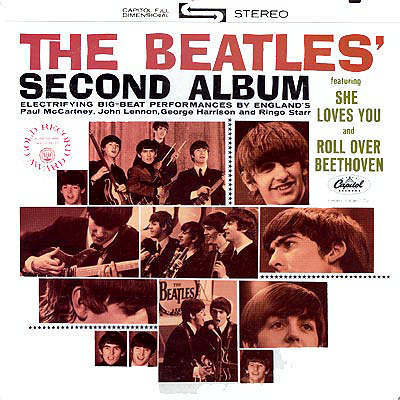
The Beatles' Second Album
“Boys…” the voice said. I think I grasped the edge of my desk expecting to hear “This is not a drill” followed by instructions containing the words “duck” and “cover.”
Believe it or not, but in 1963 children were regularly shown films of the effects of nuclear explosions – the shock wave obliterating the farmhouse, mannequins disintegrating at the table, the car engulfed in flames and spinning wildly through the air – and then instructed to dive beneath our small wooden desks for safety in the event of this nuclear fire. I don’t know if anyone has ever really charted the effects of this on the so-called “baby boom” generation. The corresponding rise in popularity of the “Theatre of the Absurd” may not be a coincidence.
But I digress….
The voice of the priest continued.
“I want to make it very clear that under no condition will beetle haircuts be permitted in this school.”
We sat, silent, uncomprehending, still behind the curve of new cultural trends. But while it was true that not a single kid in the room had any idea what the priest was talking about, it was also true that every kid in the room wanted one.
There are many different definitions of “THE SIXTIES.” Some put the decade in literal terms from 1960 to 1969. Some use the death of JFK in 1963 through the resignation of Nixon in 1974. Some trace it from the birth of The Beatles on Ed Sullivan to the death of Meredith Hunter at Altamont. A new academic journal on the era uses a “long sixties” of 1955-1975. Those of us who were around during those times each have a personal sixties; mine starts with that announcement.
All of this is documented in a million other places: The Beatles were signed to EMI in England which, even though it owned Capitol Records in the US, could not get Capitol to release the early Beatles recordings. The ones that were released appeared on small regional labels like Tollie, Swan, and Vee-Jay and registered no impact on Top 40 radio. Finally in late 1963, early 1964 Capitol could no longer ignore the success the band was experiencing across Europe and released the first US LP, Meet the Beatles.
Actually 1964 was a pretty good year for Beatles albums. In addition to Meet The Beatles, Capitol also released The Beatles’ Second Album, Something New, Beatles ’65 and a double LP, The Beatles Story, that collected news stories, interviews and snippets of live recordings. United Artists also released the soundtrack to A Hard Day’s Night, and Vee-Jay records released Introducing The Beatles compiling all the early tracks they still had the license for.
During the week of April 4, 1964 The Beatles occupied the first five slots of the Billboard Hot 100, #1 - "Can't Buy Me Love," #2 - "Twist and Shout," #3 - "She Loves You," #4 - "I Want to Hold Your Hand" and #5 - "Please Please Me," the only group in rock and roll history to achieve this feat. That same week they also had another seven charting records in the Hot 100: "I Saw Her Standing There," 31; "From Me to You," 41; "Do You Want to Know a Secret?" 46; "All My Loving," 58; "You Can't Do That," 65; "Roll Over Beethoven," 68. The Beatles had twelve songs on the charts that week, a feat never matched before or since.
In 1964, the Beatles had the never-matched total of 15 American million-selling records (9 singles and 6 LPs), representing US sales of over 25 million in 1964 alone.
In other words, 1964 was a very good year for the Fabs.
But it is The Beatles’ Second Album that fascinates me because it is this, and not “Revolution” that stands as the most political statement they ever made. It also rocks harder than any of their other records as it manages to avoid any of the pop ballads favored by Paul McCartney that usually slowed down the group's other early albums.
As Bruce Eder writing for the All Music Guide notes:
The Beatles' Second Album stands as probably best pure rock & roll album ever issued of the group's music. In the process of pulling songs from various British and American EPs, singles (including "She Loves You") and B-sides, as well as tracks left over from the editing of With the Beatles for American release, the compilers somehow No other long-player by the group featured them doing more covers of songs by black American artists or songwriters, including Little Richard ("Long Tall Sally"), Chuck Berry ("Roll Over Beethoven"), Smokey Robinson ("You Really Got a Hold on Me"), Barrett Strong ("Money"), and others, and just to show how rich a vein this all was at the time of its release, the version of "Roll Over Beethoven" here actually charted briefly as a single.
In his new book, The Beatles’ Second Album, Dave Marsh writes:
"The Beatles showed their allegiance to the principles of the civil rights movement when they refused to play any racially segregated shows on their 1964 concert tour. It was an unusual statement. The Beatles never again took a political stand as a group, and very few performers made such demands when they worked in the South. Making that choice did not endear them to many white American adults, Southern or Northern....
....I don't know what was in that teacher's conscious mind; I do know that everything he tried to teach us smacked of the message I got at home, which was that white was right and black needed to be kept back, or, since it was advancing, north and south, into territory that had been "ours," pushed back. That stuff about the Beatles being revolutionary is more than just talk. There was a war going on, and we were asked to take sides."
The racial history of US pop music up until The Beatles is Pat Boone covering Fats Domino and Little Richard, sanitizing the music, bleaching the color from it, neutering any hint of sexuality. But The Beatles covered these songs as triumphant celebrations of the original artists and every copy of the album that sold was an engraved invitation to an army of middle class white kids to go to the record stores and track down the albums of black America.
The White Southern Christian Citizens Brigades that were formed (along with some Northern ones) in the mid-1950s to fight the threat of race-mixing inherent in the records of Elvis, Chuck Berry, Jerry Lee Louis and Little Richard had been successful. Elvis was in the army, Berry was in prison, Jerry Lee in exile and Little Richard had found Jesus. Pat Boone and the legion of the one-named teen idol pop crooners (Frankie, Dion, Fabian, etc.) had fought back the Visigoths of pop culture.
But in 1964 the Visigoths were back at the gates and this time they had WMDs.