Saturday, October 18, 2008

Friday, October 17, 2008

R.I.P. Levi Stubbs

Front cover of their 1967 LP Reach Out

Four Tops lead singer Levi Stubbs, who possessed one of the most dynamic and emotive voices of all the Motown singers, died in his sleep today at the Detroit house he shared with his wife. He was 72.

With Stubbs in the lead, the Four Tops sold millions of records, including such hits as "Baby I Need Your Loving," "Reach Out (I'll Be There)" and "I Can't Help Myself (Sugar Pie, Honey Bunch.)"

The group performed for more than four decades without a single change in personnel. Stubbs' death leaves one surviving member of the original group: Abdul "Duke" Fakir.

Stubbs "fits right up there with all the icons of Motown," said Audley Smith, chief operating officer of the Motown Historical Museum. "His voice was as unique as Marvin's or as Smokey's or as Stevie's."

In the summer of 1967 I was 13, about to turn 14. I was growing up in Philadelphia, 3,000 miles from the intersection of Haight and Ashbury. That summer for me was the Summer of Motown. And above all other voices, the voice of Levi Stubbs stands out in my memory as the lead singer in the soundtrack of our lives.


It's funny, but the one song I can't find a video of on Youtube is perhaps their best, "Bernadette."

One song I did find however is Billy Bragg's brilliant "Levi Stubbs' Tears."


With the money from her accident
She bought herself a mobile home
So at least she could get some enjoyment
Out of being alone
No one could say that she was left up on the shelf
"It's you and me against the world kid" she mumbled to herself

When the world falls apart some things stay in place
Levi Stubbs' tears run down his face

She ran away from home on her mother's best coat
She was married before she was even entitled to vote
And her husband was one of those blokes
The sort that only laughs at his own jokes
The sort a war takes away
And when there wasn't a war he left anyway

Norman Whitfield and Barratt Strong
Are here to make everything right that's wrong
Holland and Holland and Lamont Dozier too
Are here to make it all okay with you

One dark night he came home from the sea
And put a hole in her body where no hole should be
It hurt her more to see him walking out the door
And though they stitched her back together they left her heart in pieces on the floor

When the world falls apart some things stay in place
She takes off the Four Tops tape and puts it back in its case
When the world falls apart some things stay in place
Levi Stubbs' tears...

At the 60's soul music blog, The In Crowd, there is a download link for the compilation album The Four Tops: The Ultimate Collection, and this description:

"The Ultimate Collection series was a rare success from Motown, one of the first of the label's many compilation series to do justice to some of the finest performers, arrangers, and musicians of the soul era. Nearly every artist with an entry was given the luxury treatment, with a disc-filling running time, excellent compilation decisions, and a pleasing design scheme that reflected the artists in their prime. The Four Tops' entry is arguably the best in the series, since the 25 tracks prove the perfect length to summarize the group's decade at Motown. From 1963 to 1972, the group reached the R&B charts 28 times."

Here's the download link. Enjoy, and rest in peace Levi.

Thursday, October 9, 2008

Ode to Sean Hannity


In light of the death of Hannity's career, John Cleese has written a poem:


Ode to Sean Hannity

by John Cleese

Aping urbanity
Oozing with vanity
Plump as a manatee
Faking humanity
Journalistic calamity
Intellectual inanity
Fox Noise insanity
You’re a profanity
Hannity

Wednesday, October 1, 2008

Guitars redux... The Art of the Inlay


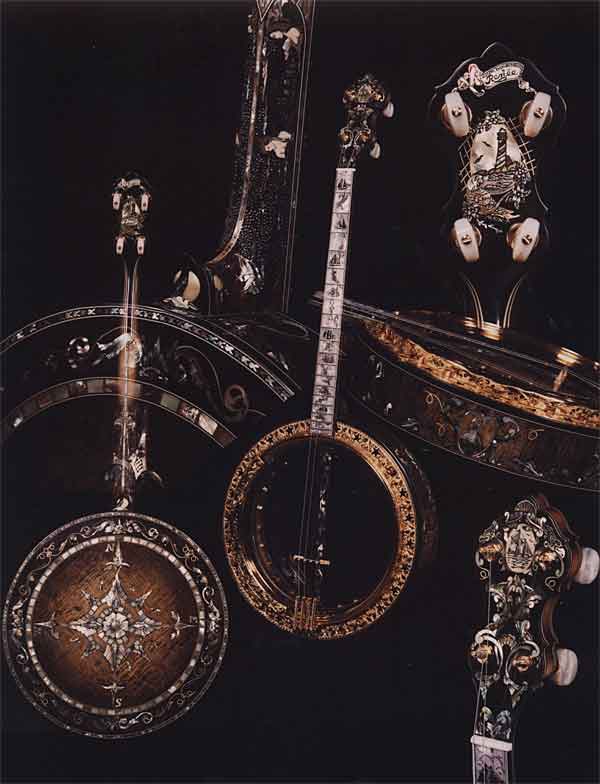
"In its simplest definition, inlay is the decorative process of gluing shell, metal, stone, tusk, and other materials into a cavity hollowed from a surface. It is an ancient practice; the earliest known inlaid object is from Mesopotamia, around 3000 B.C. In recent centuries, artists have applied inlay to musical instruments, adding visual aesthetics that match or augment their musical capacities. The result is the creation of extremely rare and original instruments that transcend their function and become art themselves."

Until recently everyone agreed that the pinnacle for acoustic instruments and decorative inlay, carving and engraving had been the period of 1920-1940. This was the time of the most elaborate guitar and banjo craftsmanship. But recently there has been a renaissance in acoustic instrument making and in the decorative arts that has surpassed that earlier period. We are living at a time when the work that is being done is better than ever. It makes me sad that I won't be around to play some of these instruments in fifty years and hear how they've matured with age.

I've always loved pearl inlay on guitars. The first time I toured the Martin Guitar factory in the mid 1970s and learned that the difference between a model D-28 and D-45 - both rosewood dreadnaught guitars - was in the number of "man hours" involved in adding the pearl around the edges of the body and on the fingerboard and head stock. I also learned that the inlay artists at Martin at that time responsible for those man hours were two women.

Today there is some basic agreement that the best decorative and inlay work is bring done by a small number of artists whose instruments are as prized as any but the rarest vintage guitars and banjos.

When she was inducted into the Four String Banjo Hall Of Fame in 2005, her official bio read:

"By virtually every benchmark, banjos manufactured during the 1920s by major manufacturers such as Vega, Bacon & Day, Paramount, Gibson and Epiphone are believed to have reached a level of design and craftsmanship which is seldom equaled and rarely exceeded in today's musical marketplace. However, on occasion, a contemporary banjo maker emerges who embodies both the vision and skills necessary to rival the priceless instruments of the past in both form and function. Renée Karnes is such an artist.

In 1997 she built a banjo named "the Maritime" that was the most inlayed banjo Renée had done to date, spending approximately 525 hours on the inlay work. A photo of it can be seen here.

A short video of Renée's work (and it is jaw-dropping) can be seen here. Below are a few images of her work:


Larry Robinson began using his father's hand tools at the age of six and was making furniture with power tools by the age of eleven. Even this doesn't explain the incredible artistry he's produced in his career as an inlay artist. The image at the top of this post is Robinson working on the back inlays of the Martin #1,000,000 guitar. Details are here.

Intricate guitar fingerboards have always appealed to me. Looking at the set below, representative of Robinson's work, almost makes me weep. Click on the photo to enlarge it:


The Nouveau theme in thin ivory, kingwood hair, gold dust and silver framing in detail:


Inlaid on maple, this Chinese warrior is incredibly complex. It was used on the headstock by a Chinese guitar company:


Of all his projects, the Nouveau guitar (not related to the fingerboard above) created for no particular person in mind, may represent the absolute peak of Robinson's abilities. Click here for a set of photos and information; make sure you're sitting down.

Why I describe my inlay work as art: A traditional approach to instrument inlay, even when it is complex, typically serves only a decorative function...it can be beautiful and appealing, but it doesn’t fully “engage” a viewer. To me, when a creative act becomes art, when one is fully engaged by it, that is when it communicates successfully. In order to communicate it must have something to say. I endeavor to use the medium as a vehicle to communicate something...to convey at minimum a mood or feeling, at best an actual story, which gives me the ultimate satisfaction. - William "Grit" Laskin


Laskin's abilities are unique. He is able to produce almost photorealistic inlays, and he is best known for what guitar makers call "breaking the nut" meaning that an inlay design that begins on the instrument's headstock continues past the headstock and down onto the fingerboard. If you click on this, you'll thank me.

"I think in the guitar world there is a new market that is developing where some of the work of the great modern day inlayers will be looked at as collectable art that just happens to have a guitar for canvas. I see where some of the crazy prices that paintings and sculptures command will be paid for guitars. I think people will see Inlaid musical instruments in the same light and use them as accent pieces in decorating. Musical instrument Inlay is still pure right now; there is good money in it but not crazy money. The people who are really setting the standard are doing it because they love it. If we ever get crazy money I'm not sure that will always be true." - Harvey Leach


This warrior inlay took 25 hours of work and is made up of a large number of individually cut pieces of mother of pearl and different colored hard woods. It is a good example of the detail Leach achieves in his inlays.


On Leach's "Jurassic Guitar" the theme was "age." The tuner buttons are 65,000,000 year old Baltic Amber, the inlays are 15,000,000 year old gold (deposits), The nut, saddle and scrimshaw background are 15,000 year old Mammoth Ivory, the truss rod cover is a 150 year old Chinese game piece and the back and sides are 50 year old Brazilian Rosewood.

Harvey Leach's most elaborate design work can be seen in detail at his web site.

Tuesday, September 23, 2008

Guitars I've known....

1949 Gibson J-45

The first "good" guitar I owned was a Guild D-25 that I bought from a shop in Northeast Philadelphia, somewhere around Cottman and Bustleton avenues. Guilds are wonderful guitars and, if I had the money, I'd be looking for a 60s or 70s rosewood jumbo; a guitar every bit as nice as a comparable Martin or Gibson and still findable at a fraction of the price.

But I digress, already.

The D-25 is a mahogany guitar with a mahogany top and arched back. It has a deep mellow tone - the result of the top. It has very simple appointments and is, I suppose, the equivalent of the model 17 Martin.

I bought the guitar in around 1972-73. I took it with me to Clarion, PA, and later replaced the original tuners with these really lovely gold Grovers and got a good case for it. Having done that of course I then sold it to my friend, Kim Conner (an amazing individual, read about her here).

Sometime later I bought a Fender Telecaster, either a late 60s or early 70s model; classic blonde body, blonde neck, white pickguard. I bought it at the local music store in Clarion paying around $200 for it. I sold it a year or two later to the father of a friend of mine who bought it to give to his youngest son. A few years ago that son, now married and living somewhere in Ohio, called me out of the blue and asked if I wanted it back. For $7,000.

I always liked his brother best.

When I lived in West Virginia in 1977-1980 I bought a few guitars. I bought the 1949 Gibson J-45 pictured at the front of this post for around $400. I bought a 1967 D-12-35-S Martin - a 12 string D-35 with a 12 fret neck and a slotted headstock (the one I'm playing in the blue-tinted photo on the right). The top was spruce and it was the nicest top I've ever seen on an acoustic guitar. People gauge quality by counting the number of lines of grain in an inch, the higher the number the better. A good top would have maybe 20-30 lines in an inch; this guitar had 100.

The back and sides were Brazilian rosewood. Martin tended to use very straight grained Brazilian rosewood, but the three pieces that made the back of this guitar were as highly figured, deep and "smoky" as the woods on boutique guitars I see today for $10,000. I've never seen another Martin, ever, with wood anywhere near as lovely. The guitar had playability issues; it needed a neck reset and new frets, repairs I couldn't afford. I paid $450 for the guitar and it's value today, with those woods, would be $6,000 or so.

A friend of mine in Pittsburgh called me and told me about a 1969 Martin 000-18 he saw at a local shop for $175 and I rushed to buy it. It was a beat up but lovely guitar. Light as a feather and perfect for the sort of finger-style approach I use. I kept both Martins until the mid-1980s when I was in graduate school and pressed for cash. I sold them both to a physicist at Ohio University. I hope he still has them; he got a hell of a deal.

I still have the Garcia student-grade classical guitar I bought when I was in West Virginia. It was built in 1972 and has really developed a gorgeous tone over the years. Around that time I let two guitars get away that I regret not buying (though, I have no reason to think I'd still own them now).

One was a 1930s National steel-body round neck guitar priced at $175. The other was the best acoustic guitar I have ever played. Both guitars were at The Fret & The Fiddle in Huntington WV, a shop owned by a fellow named Joe Dobbs. Joe was musical partners with Mary Faith Rhodes and together they had a State Department gig that sent them on tour around the world as sort of musical ambassadors. I stopped in the shop one day when they were both there. I had the chance to play their guitars; Joe had a Mossman Golden Era that had been made for him by Stu Mossman. It was Mossman's version of the Martin D-45. Mary had a Martin D-45.

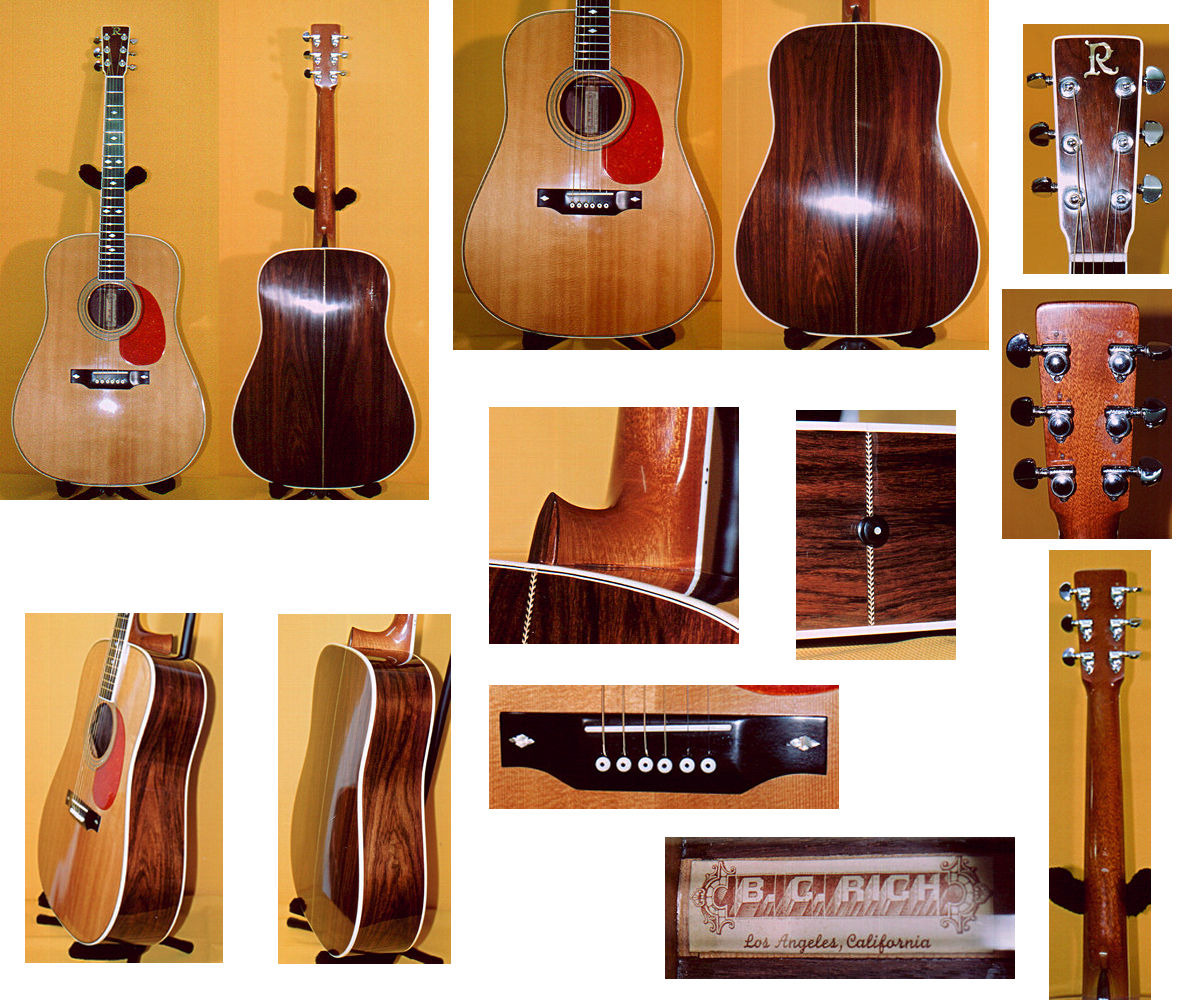
On the wall was a B.C. Rich B-38 6-string. Rich is best known for making odd-shaped solid body guitars favored by heavy metal musicians, but early in the company's development Rich himself built some acoustics. The B-38 was based on the Martin D-28. A dreadnaught, 14 fret neck, sold headstock. The top was orange with age and had mother of pearl around the sound hole. The fingerboard had small snowflake inlays. The back and sides were Brazilian rosewood, the back was very figured and particularly gorgeous. The guitar had an old set of strings on it.

Both Joe's Mossman and Mary's Martin had new strings. I sat there and played all 3 guitars for a half hour or so and the Rich just blew away the other two. It played like a dream and had a sound like guitars sometime sound in dreams. It was $600 which, to me at that time, was the same as $60,000. I walked away, but I still have occasional dreams about that guitar.

After moving to Indianapolis in 1987 I picked up the occasional guitar. I owned a Travis Bean for a while. The Travis Bean has a solid aluminum neck that runs all the way from the headstock to the bridge, giving it amazing sustain. It also makes it very heavy and, unlike a Les Paul for example, where the weight is in the body, the weight here is all in the neck, making it a bit uncomfortable to play. Aluminum also holds the cold very well so that, when the neck gets cold in the Winter, it will stay cold until early Spring.

I bought a jumbo sunburst Yamaha acoustic that played and sounded really good for a while, but has taken a turn for the worse in the past couple years or so. It was at the shop I bought the Yamaha that I let another dream guitar get away; a Gibson B-25 cherry sunburst acoustic 12-string with a small body and an ENORMOUS neck. I remember taking it off the wall and sitting and playing it for a few minutes during which all the sales people and customers came in to watch as the guitar just lent itself to really fast finger picking. I can't remember why I left it there; probably some well-intentioned moment of self-denial.

I bought an 80s American Fender Stratocaster, white with a rosewood fingerboard, that I still have and like a lot. At a local bar one night I bought a 1966 Guild Starfire with a cracked headstock for $50. It's the same model guitar that Jerry Garcia played at the start of the Grateful Dead and used on their first album. It's the guitar I used when I played my first guitar solo on the 3rd Many Bright Things album.

I traded the Travis Bean in on a Jerry Jones reproduction of a Coral Electric Sitar which is great fun (and has a warm neck).

The first time I swallowed hard and got rid of a crate from my record collection was to use the LPs to trade from a 70s Guild F-212 acoustic 12-string which I still have and like a great deal.

A lot of time has passed since then and I have come to understand that the guitarist is more important than the guitar. When I was playing a lot of pool I went out and bought an expensive and really beautiful cue stick. I can still remember the sense of shock and disappointment I felt when I used it the first time and missed every single shot that I'd been missing with the bar room cues.

Thinking about guitars always reminds me of the old joke:

"Excuse me, how do you get to Carnegie Hall?"

"Practice."

Wednesday, September 17, 2008

"Count backwards from 100...."


This is the way the internet works. This is the way information flows here in the 21st Century.

A Bob Dylan fan, I was looking around on the web site, Expecting Rain (if you like Dylan you should click on that and bookmark it) and was looking at the responses to a thread I'd started earlier.

That thread, "She's got everything she needs...." looked at Dylan's influence on the culture by watching it filter down to people like us. I listed 15 or so Youtube videos in which people with guitars recorded themselves performing Dylan's "She Belongs To Me." The versions ranged from very good to very not.

I do a version myself; I came up with this odd way of playing it, fretting it from the top, like a dulcimer. My friend Jeff, who is learning to play guitar, asked me if he could videotape me playing a few songs he wanted to learn. A few days later he told me he'd put a couple of them up on Youtube.

I have arrived.

And I digress.

I snuck my own performance in toward the bottom of the list on that thread and wondered if anyone would find it.

No one did. But one post claimed, "If you want to see something really brilliant..." and posted a link to Peter Bradshaw's film blog at the UK paper, The Guardian who wrote that he was alerted to the video by Philip French of The Observer.

And so it goes.

Bradshaw writes:

The quest for the greatest ever clip on YouTube is over! With tears of emotion, I have watched "100 Movies, 100 Quotes, 100 Numbers." It is an inspired collage, lasting nine minutes and 28 seconds, composed of tiny movie-clips, with fragments of dialogue, simply quoting every number in countdown from 100 to 1: a mind-blowing effort of archive research, somehow trivial and monumental at the same time. The effect is brilliant, hilarious, even weirdly moving. The final ten clips have a tension and a crescendo of their own, as you try to guess what they're going to be. I should have sussed the final one, but I didn't. It functions as a mini-masterpiece on its own terms and also as the basis of a fantastic pub quiz round, in which contestants have to identify each clip.

Its creator is a Mr Alonzo Mosley who describes himself as a 34-year-old librarian from Jacksonville, Florida. I have already sent him an awestruck fanmail through the YouTube site. Let's hope the meanies who work in copyright law do not put the mockers on this because it is so fantastic. I have been watching it on a continuous loop all day. Stop what you're doing and watch it right now! This is why the internet was invented!

Saturday, September 13, 2008

The Art of Labor....


"When you say fiscal responsibility, it seems to me that you really mean rich people keeping their money." — Alice Adams


"Those who want change must be against sacred cows and not only innately irreverent but outwardly, purposefully irreverent in their actions. They must be iconoclastic bulldozers willing to be regarded as profane spoilers of the sacred myths." — Saul Alinsky


"Silence never won rights. They are not handed down from above; they are forced by pressures from below." — Roger Baldwin
"The most potent weapon in the hands of the oppressor is the mind of the oppressed." — Steven Biko

All these, and more here.