Here's a link to an article titled "Tenant protection laws are onerous." By the title you may surmise that the laws are deemed "onerous" because they are very one-sided toward protecting the tenant. Those of us who lack the means to buy Parisian real estate might well title the same article "Tenant protection laws are pretty darn sweet."
The two elements of these laws that caught my attention are these: all agreements between landlord and tenant are for a minimum of three years (unless the tenant wishes a shorter lease), and it is impossible to remove a tenant - even for the non payment of rent - until the end of that term.
Let's review.
In a purely hypothetical example, let's say that my friends Mark, Greg and I were to draw straws and one of us were to rent an apartment in Paris. Something nice, maybe in the Marias, in the 3rd arrondissemont; not too far from the Picasso museum or this little Irish pub where the ex-pats hang out. We all pool our money to get the place rented, and then, well, see above.
Let's review.
At the end of the three years, we are (1) evicted and (2) next guy on the list rents a place and, voila*, three more years of life on whatever the French word for "dole" is.
Three guys, nine years for three months rent and some sort of deposit that, who knows, French law possibly says we still get back. In addition, since there will be periods when none of the three of us are visiting, we can rent the place out to tourists three to six months out of each year.
In 1969 Pharoah Sanders released his LP, Karma. About a year ago the blog Deadly Death: The Diening published a post on the album (including a download of the album that is still working). Their description of the album's centerpiece, "The Creator Has a Master Plan" reads:
"Creator" comes in at 32:47 and wastes not a single note. Opening with a virtual rush of sound, it then quiets down and drops a brief riff from A Love Supreme. The tune then works itself into a groove that would later be known as acid jazz, working with Eastern percussion and allowing the bass to float close to the front of the mix. This first section relies on a modal two-chord structure that keeps the tone bouncy and meditative. At eight minutes Leon Thomas begins a chant-like vocal that varies lines from the mantra "The creator has a master plan, peace and love for every man." The vocals drop and the third movement becomes an unrelenting Coltranesque blitz that tears the mellow mood apart, only to combine the angst and mellowness in the next movement and settle back into a reprise of the first fourteen minutes.
In April 1998 I assembled a group of musicians in a studio and recorded an afternoon's worth of improvisations that later became the album In The Summer Of The Mushroom Honey. In the late fall of that year I brought together another group of musicians, some who had played on the earlier session, for recordings that became the album Waters Of Life, an album that is still unissued. During those sessions I decided to try and record a version of "The Creator Has a Master Plan" in which the sax is replaced by an electric guitar, played by Portland Oregon-based jazz guitarist and teacher, Daniel Noland. I don't have a complete list of everyone who plays on the track, however, I know that Mark Cutsinger played drums, Vess Ruhtenberg played bass, Barry McCabe played acoustic piano and I did the vocals and played percussion. The track is not part of the finished Waters Of Life album and is sort of a musical Ronin, homeless, wandering the endless plains of cyberspace. Give a listen.
A couple years ago I spent some time setting up a My Space page which I later mostly abandoned after I started this blog. Sometime later I set up a Face Book page, but I quickly forgot my log on information and put it out of my mind. Occasionally I would try and access the page, but for some reason I could never get the "lost password" link to work. Finally, about a week ago, I managed to get back on and I found a mailbox full of messages.
The effect was disorienting.
The best way I can describe it is that it was like a scene from a science fiction film in which a group of people who were abducted by aliens thirty or forty years ago suddenly return, walking out of a mist into view. Or, perhaps it is the memories that, like rescued miners, stumble of the mine entrance, their hands shielding their eyes from the daylight.
With every name from the past I found, I would look at who their friends were and find more names that sounded familiar and I would follow those links. I began to look at the photo books of people I didn't know or only vaguely remembered and, after an hour or so of that, I clicked on another collection of photos and found the one above.
I was stunned.
The photograph was taken in 1973, in the basement of my parents' house in Northeast Philadelphia (Cottman & the Boulevard for anyone who knows Philadelphia). The paneling, ceiling tiles, that dartboard, all instantly recognizable. I'm standing at the left; next to me is my friend Cliff. It was Cliff who introduced me to Bruce Springsteen when, after I'd moved to Clarion PA to start college, he mailed me sheets of lyrics from the Asbury Park album that he'd copied out by hand. This photo was taken right around the time I went back to Philadelphia and the two of us drove over to New Jersey, to see the E-Street Band for the first time at a bar called Uncle Al's Earlton Lounge.
$1 cover charge and $1 beers.
Next to Cliff is David, one of my best friends from that time, being held by another person I can't quite remember. I have no idea who took the photo either. I am pretty sure, however, where I got the idea for the sideburns.
I am in awe of the past. I am in awe of the future. I am in awe of the present. The "internet" -- this seemingly infinite mass of information that has no mass -- seems like a connection to another dimension outside of the four we move through.
This is also, however, where understanding that 75% of all the people on Earth today have never used a telephone comes in handy too. It helps pull me back down here on Planet One where real things still really matter.
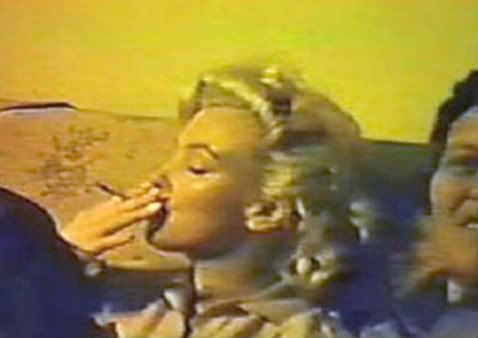
A home movie that shows Marilyn Monroe smoking a cigarette reportedly filled with marijuana was sold at auction for $275,000. The video, which shows Monroe relaxing and laughing with friends, was filmed about 50 years ago at a home in New Jersey. According to the Daily Mail, the person who made the film confirmed that the cigarette contained marijuana, saying: "I got it (the pot). It was mine. It was just passed around. It was not a party. It was just a get-together. You know, come over and hang out."
I'm not sure what it is about this photo, a screen capture from a silent 8mm film shot at a party over half a century ago, that I find so... comforting.
I think it is an echo of my early-1970s self; a fantasy in which I'm passing a joint from Marilyn to John and Paul, sitting in my living room of that small house on Liberty Street in Clarion, PA, Bonnie Raitt's Give It Up on the stereo. Rum and cokes all around.
Twenty-nine years ago today I was at a late-night poker game. A friendly penny ante game at my friend Steve's apartment. Steve lived above a garage on South Street in Clarion, PA. I lived in an apartment above a garage about a block away. We drank beer and played records and I'm sure I bitched and moaned about every card I was dealt. The game broke up about 2:30 and a half-hour later I got a call from Steve. He said his brother, who'd driven home to Fryburg after the game, called to tell him that he'd heard on the radio that John Lennon had been shot.
"He thinks he may have been killed."
This was back before the advent of 24 hour news channels. CNN had started that very year and wasn't on the cable system in that small town yet. I thought, I don't know what I thought; maybe "I hope not", and I went to bed. I woke up late the next morning and turned on the TV and on channel after channel I saw the kind of photo and film montage that can only mean that someone has died.
I was working at a small local record store and I remember being furious with the people who called to ask if their Beatles and Lennon LPs were worth a bunch of money now. One guy called one evening, not too long before I closed the store, and he just wanted to talk about it. Not about the killing, but about Lennon and about the Beatles and about our childhoods and our memories.
I remembered the very first time I'd heard the name "Beatles", sitting in my desk in class at the local Catholic grade school. The parish priest's voice boomed out of the PA system to tell us that, in no uncertain terms, would "beetle haircuts" be permitted. None of us had any idea what he was talking about and yet all of us suddenly wanted one. What we now know as "THE SIXTIES" might have started that very morning.
My favorite John Lennon memory goes a little past thirteen years before that poker game when my friend Bob and I came back from the shop across the street with the new Beatles 45; this was late-November 1967. I had a crappy record player in the basement of my parents house and we sat there, not even taking our coats off, and listened to "Hello, Goodbye", a decent enough I suppose Paul McCartney song (elevated by some fantastic drumming by Ringo) but possibly the single most undeserving A-side of a single ever, or at least so we concluded after flipping the little disc over and dropping the needle on "I Am the Walrus."
In November of 1967 I was fourteen and had only read the stories about LSD in Time, LIFE and Look magazines; now we found out what LSD sounded like. Hearing that song there in that basement was like the moment in The Wizard of Oz where everything shifts from black and white to technicolor (of course, so was hearing "Strawberry Fields Forever" for that matter).
That same year Rolling Stone Magazine appeared for the first time and Lennon graced the cover of issue #1.
Rolling Stone ceased to be relevant sometime in the mid-to-late 1970s, but I always thought that had Jann Wenner had far more class than he does he might have simply and quietly folded the magazine after their last great issue.
Of all the work the individual Beatles did after the dissolution of the band, there is only one moment that, in my opinion, manages to surpass the best of it. On John Lennon's first solo LP, the song "God." His vocal on the lines, "The dream is over... what can I say? The dream is over" is among the most sublime things I have ever heard.
There are a bunch of songs about John Lennon, but the one that I think stands by itself is Paul Simon's "Late Great Johnny Ace."
Every step of the way we walk the line Your days are numbered, so are mine Time is pilin' up, we struggle and we scrape We're all boxed in, nowhere to escape
City's just a jungle, more games to play Trapped in the heart of it, trying to get away I was raised in the country, I been workin' in the town I been in trouble ever since I set my suitcase down
Got nothing for you, I had nothing before Don't even have anything for myself anymore Sky full of fire, pain pourin' down Nothing you can sell me, I'll see you around
All my powers of expression and thoughts so sublime Could never do you justice in reason or rhyme Only one thing I did wrong Stayed in Mississippi a day too long
Well, the devil's in the alley, mule's in the stall Say anything you wanna, I have heard it all I was thinkin' about the things that Rosie said I was dreaming I was sleeping in Rosie's bed
Walking through the leaves, falling from the trees Feeling like a stranger nobody sees So many things that we never will undo I know you're sorry, I'm sorry too
Some people will offer you their hand and some won't Last night I knew you, tonight I don't I need somethin' strong to distract my mind I'm gonna look at you 'til my eyes go blind
Well I got here following the southern star I crossed that river just to be where you are Only one thing I did wrong Stayed in Mississippi a day too long
Well my ship's been split to splinters and it's sinking fast I'm drownin' in the poison, got no future, got no past But my heart is not weary, it's light and it's free I've got nothin' but affection for all those who've sailed with me
Everybody movin' if they ain't already there Everybody got to move somewhere Stick with me baby, stick with me anyhow Things should start to get interesting right about now
My clothes are wet, tight on my skin Not as tight as the corner that I painted myself in I know that fortune is waitin' to be kind So give me your hand and say you'll be mine
Well, the emptiness is endless, cold as the clay You can always come back, but you can't come back all the way Only one thing I did wrong Stayed in Mississippi a day too long
"Mississippi" is one amazing Dylan song for a variety of reasons. Of all the songs that get placed on a "Dylan's best song" list, "Mississippi" seems, to me, the most ephemeral of all. While songs like "Visions of Johanna" "Desolation Row" "Chimes of Freedom" clearly aren't traditional "story telling" songs, they none the less are chock full of images; they are overflowing with meaning, whereas "Mississippi" seems to barely trickle meaning, is more like a leaky faucet than the burst dams of those other songs.
More than any other Dylan song it seems like some odd alchemy of words that barely whisper meaning mixed with a strong performance create a result that is so surprisingly impressive. All the various versions (see here, here and here) lead up to the final album version and that version is clearly the best because it finds that amazing contrast between a lyric that descends into a sort of darkness sung against a progression that ascends into light, counteracting the despair.
One way the song works in to create a sense of urgency in the opening verse. "Our days are numbered, there's no escape." A good chunk of Dylan's best work sets up a dichotomy of "light/dark" "urban/rural" and this does too in the second verse's "I was raised in the country, I been workin' in the town."
The song's structure is comprised of 12 verses arranged in three sets of four verses each and each of those three sets leading up to the repeating enigma: "Only one thing I did wrong / Stayed in Mississippi a day too long."
Here's where the greater context of Love and Theft enters the picture and contributes meaning to "Mississippi." Mississippi has nothing to do with the song per se, but fits into the larger puzzle of the record as a kind of tour through the reconstructed South.
Sung in the first person, it has a narrator; it's just that the narrator is less forthcoming than any other on any other song. To fill 12 verses and say.... almost nothing. It’s like a Steely Dan song.
"Mississippi" is a perfect example of a Dylan song that really resists "interrogation" (you could water board this song and it still isn't giving anything up). But there are two different approaches -- in the first you take a song, sit it in a chair and shine a 100 watt light in its eyes and ask it where it was on the evening of October 5th. That won't work here.
It is the other approach that works -- you take the song to the pub, not to "get it drunk" but to get drunk with it. You sit and drink 6 pints each and it tells you its secrets as you tell it a few of your own.
Recently, I spent the first half of a day listening to the last three albums by Bob Dylan in the order of their release: Love and Theft (2001), Modern Times (2006) and Together Through Life (2009). Each record shares the trait of all great art in rewarding repeat visits. It wasn’t until sometime in 2003 that I realized that Love and Theft was the best album Dylan had ever made. Right now I am of the opinion that Modern Times has the slightest edge over the other two.
The writing on all three is some of Dylan’s best, but the writing on Love and Theft is particularly rich. At the half-way point, the song “Floater (Too Much To Ask)” shows up. Musically, the album is a tour of the popular music of America in the 20th Century, and this song sounds like something from the 1930s-1940s. Lyrically, however, its sixteen verses seem to flash on the screen like scratchy black & white home movies from rural Tennessee circa 1938.
Down over the window Comes the dazzling sunlit rays Through the back alleys - through the blinds Another one of them endless days
Honeybees are buzzin' Leaves begin to stir I'm in love with my second cousin I tell myself I could be happy forever with her
I keep listenin' for footsteps But I ain't hearing any From the boat I fish for bullheads I catch a lot, sometimes too many
A summer breeze is blowing A squall is settin' in Sometimes it's just plain stupid To get into any kind of wind
The character who sings the song is a gentleman we only ever see out of the corner of our eye as we look at the various things he’s describing. Sometimes he describes aspects of everyday life, but other times he describes his own inner thoughts and feelings and we are offered little insights into his psyche.
The old men 'round here, sometimes they get On bad terms with the younger men But old, young, age don't carry weight It doesn't matter in the end
One of the boss' hangers-on Comes to call at times you least expect Try to bully ya - strong arm you - inspire you with fear It has the opposite effect
As the song proceeds it builds up this rhythm moving back and forth between description and autobiography.
There's a new grove of trees on the outskirts of town The old one is long gone Timber two-foot six across Burns with the bark still on
They say times are hard, if you don't believe it You can just follow your nose It don't bother me - times are hard everywhere We'll just have to see how it goes
My old man, he's like some feudal lord Got more lives than a cat Never seen him quarrel with my mother even once Things come alive or they fall flat
Even in the technology stock boom of the 1990s you’d still have been safe singing about times being hard. Times are always hard (and, for that matter, always changing).
You can smell the pine wood burnin' You can hear the school bell ring Gotta get up near the teacher if you can If you wanna learn anything
Romeo, he said to Juliet, "You got a poor complexion. It doesn't give your appearance a very youthful touch!" Juliet said back to Romeo, "Why don't you just shove off If it bothers you so much."
They all got out of here any way they could The cold rain can give you the shivers They went down the Ohio, the Cumberland, the Tennessee All the rest of them rebel rivers
I wonder if, as he’s spun this tale, this man has been sipping something a bit stronger than sweet tea. We’re offered advice (“Sit close to the teacher”), some thoroughly odd and oblique Shakespeare reference, and that utterly fantastic alliteration, “rest of them rebel rivers.”
I wonder about how alcohol effects people differently when he suddenly stops to remind us:
If you ever try to interfere with me or cross my path again You do so at the peril of your own life I'm not quite as cool or forgiving as I sound I've seen enough heartaches and strife
The moment passes, and we move back to autobiography.
My grandfather was a duck trapper He could do it with just dragnets and ropes My grandmother could sew new dresses out of old cloth I don't know if they had any dreams or hopes
I had 'em once though, I suppose, to go along With all the ring dancin' Christmas carols on all of the Christmas Eves I left all my dreams and hopes Buried under tobacco leaves
Perhaps that’s it then; our slightly tipsy narrator has lived his life as a tobacco farmer, running a plantation, his own “dreams and hopes left buried under tobacco leaves.”
And as I think about it, I can’t stop myself from wondering if, thirty-seven years after he condemned him in his most famous self-righteous and criminally distorted “finger pointing” protest songs, Bob Dylan is writing this song from the point of view of an older William Devereux "Billy" Zantzinger.
No matter. The first fifteen verses were just passing the time up to where, his eyes downcast, we’re told that:
It's not always easy kicking someone out Gotta wait a while - it can be an unpleasant task Sometimes somebody wants you to give something up And tears or not, it's too much to ask.
Stan Denski, passed away on May 20, 2025 and lived in Indianapolis, IN, with his wife of 44 years. He plays acoustic and electric 6 & 12-string guitars in various odd tunings (try CGCGCF) and has released four albums under the names Many Bright Things and In The Summer Of The Mushroom Honey and has produced and written liner notes for over 30 others, including all ten volumes of the Love, Peace & Poetry series. As a scholar he has published numerous journal articles, book chapters, and one book. He is comfortable in his own skin and very much happy in his neighborhood and in his life.
On the reason for blogging...
"It does me good to write a letter which is not a response to a demand, a gratuitous letter, so to speak, which has accumulated in me like the waters of a reservoir." - Henry Miller
I live my life in growing orbits which move out over the things of the world perhaps I can never achieve the last but that will be my attempt. I am circling around God, around the ancient tower, and I have been circling for a thousand years and I still don't know if I am a falcon, or a storm, or a great song. ~Rainer Maria Rilke
“The current political situation is very muddled. People tend to confuse the quest for freedom with the embrace of capitalism. It seems doubtful that the joys of capitalism are enough to liberate a people. The bloody failure of socialism is on everybody’s lips, but no one sees capitalist globalization as a failure, in spite of the bloody inequalities that condition the market, and the populations who are excluded from it. The American Revolution failed long before the Soviet Revolution. Revolutionary situations and experiments are engendered by capitalism itself and show no signs of disappearing, unfortunately. Philosophy remains tied to a revolutionary becoming that has nothing to do with the history of revolutions.” - Gilles Deleuze “Two Regimes of Madness”, pg 379
"The point isn't the guitars, or jazz, or even music, but feeling more alive, more capable of compassion, more dedicated to beauty where it lives and love where it needs to go. " - Gary Keenan