Sunday, August 16, 2009
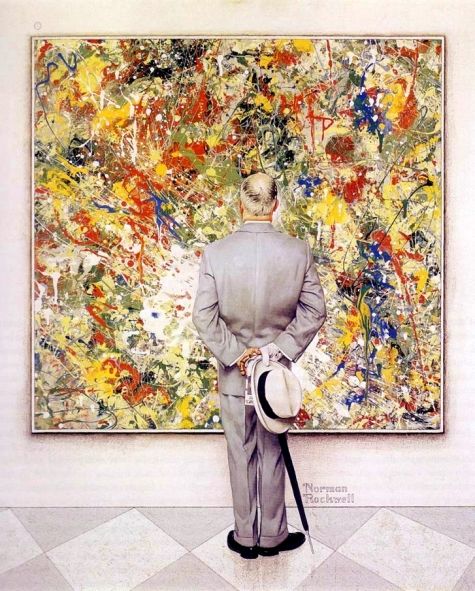
The Connoisseur
I've written a couple posts in the past about Norman Rockwell; I've always liked the clarity and coolness of his style. This painting was the cover of the January 13, 1962 issue of The Saturday Evening Post. Oil on canvas, 37 3/4 x 31 1/2 inches, the image is unabashedly conservative, but a conservatism of a kind that has all but vanished from the contemporary public sphere. The painting both respects and critiques the abstract impressionism of the painting within the painting. It seems to ask whether the artist (apparently Pollock) could ever render an image as "realistic" as the image that contains his painting (Pollock's early work, much of it done for the WPA, would suggest that yes, he could).
Truth be told, I much prefer Pollock. But I also love that sparkling wit in Norman's eye.
Friday, August 14, 2009
Tokyo Rose, Axis Sally and Fox News....
I believe the best framework to really understand likes of Rush Limbaugh, Ann Coulter, Newt Gingrich, Michelle Malkin, Matt Drudge, Lou Dobbs, Bill O'Reilly and the rest of the ultra-right wingnut punditry is to see them as the direct descendants of Tokyo Rose and Axis Sally.
Iva Ikuko Toguri D'Aquino, an American, was the woman most identified with "Tokyo Rose", a generic name given by Allied forces in the South Pacific during World War II to any of approximately a dozen English-speaking female broadcasters of Japanese propaganda.
Mildred Gillars, also known as "Axis Sally," was a female radio personality during World War II, best known for her propaganda broadcasts for Nazi Germany. Gillars' most famous broadcast, and the one that would eventually get her convicted of treason, was a play titled Vision of Invasion that went out over the airwaves on May 11, 1944. It was beamed to American troops in England awaiting the D-Day invasion of Normandy, as well as to the home folks in America. Gillars played the role of an American mother who dreamed that her soldier son, a member of the invasion forces, died aboard a burning ship in the attempt to cross the English Channel. The play had a realistic quality to it, sound effects simulating the moans and cries of the wounded as they were raked with gunfire from the beaches. Over the battle action sound effects, an announcer’s voice intoned, ‘The D of D-Day stands for doom…disaster…death…defeat…Dunkerque or Dieppe.’ Adelbert Houben, a high official of the German Broadcasting Service, would testify at Axis Sally’s trial that her broadcast was intended to prevent the invasion by frightening the Americans with grisly forecasts of staggering casualties.
They sought what Fox News seeks, the destruction of America. Unlike Sally and Rose, who we assume were motivated by some personal ideology, however wrong; Fox and the pundits are motivated solely by greed.
These are the people Richard Brautigan was writing about in his poem "Negative Clank" in his book Rommel Drives On Deep Into Egypt.
Negative Clank
He'd sell a rat's asshole
to a blindman for a wedding
ring.
Tuesday, August 11, 2009
Transmissions from a distant galaxy....
"If the lighter side of rap and hip hop's wordplay and rhyme has a spiritual father, he might be Slim Gaillard (1916–1991, shown here at the right), the great jazzman and scat artist of the 1930s and 1940s, whose nonsense syllables and quick-witted and humorous rhymes can be heard as echoes in the raps of De La Soul, Busta Rhymes, and A Tribe Called Quest. Born in Santa Clara, Cuba, Gaillard was raised in Detroit and New York City. As half of the jazz duo Slim & Slam, Gaillard developed his own hip argot, a musical vocabulary of wildly colliding nonsense syllables and the surprise of unexpected rhyme Gaillard called "vout." Armed with it, a quick wit, and an ability to scat with the best, Gaillard produced hits like "Chicken Rhythm," "Flat Foot Floogie," and "Cement Mixer." Though he was not as famous as Cab Calloway or Scatman Crothers, Gaillard's comic derring-do and hip personal style made him a cult favorite among jazz listeners and fans of scat for generations to come." - (Oxford African American Studies Center)
"Transmissions from a distant galaxy..." is how I feel about this video I just found on Youtube thanks to the most recent Punmaster mailing (you should subscribe to their Music Wire mailings).
Slim Gaillard is one of those black musicians from the first half of the 20th Century who has obscure origins -- he was either born in Cuba, or in Florida, or maybe Detroit. Gaillard first rose to prominence in the late 1930s as part of Slim & Slam, a jazz novelty act he formed with bassist Slam Stewart. Their hits included "Flat Foot Floogie (with a Floy Floy)", "Cement Mixer (Puti Puti)" and the hipster anthem, "The Groove Juice Special (Opera in Vout)". The duo performs in the 1941 movie Hellzapoppin'.
In penning his biggest hit, "Flat Foot Floogie," the sly Gaillard perpetrated a monumentally mischievous prank on the American pop music public. The whole first line read: "Flat Foot Floogie with the Floy Floy." As it happen, a flat-foot floozie (Galliard substitutes "floogie) in the African American slang of the period is defined as a streetwalking prostitute and, in the same lexicon, the floy floy is defined as gonorrhea.
In other words, America was unwittingly singing along to a song celebrating a streetwalker carrying the clap.*
This video was aired on Michelob Presents Night Music, a late-night television show from 1988 and showcase for jazz and eclectic musical artists hosted by Jools Holland.
* From Wikipedia.
Sunday, August 2, 2009
Songs For Political Action....
Songs For Political Action: Folk Music, Topical Songs And The American Left 1926-1953 is a 1996 10 CD box set by the German-based Bear Family label.
Anyone unfamiliar with the Bear Family might want to take a tour of the web site and see some of the most excessive CD box sets anyone has ever imagined. It’s one thing to imagine a collection of early 60’s British skiffle performer, Lonnie Donegan. It’s another thing entirely to imagine it as an 8-CD box set with 60-page book (“More Than Pye in the Sky”).
Or, consider this: Currently in print are four different CD box sets for Dean Martin; an 8-CD & 84-page book set, another 8-CD & 84-page book set, and two different 6-CD plus DVD plus book sets (that’s 28 CDs, 2 DVDs and 4 books of Dino). You’ll also find three 4-CD Tex Ritter box sets, and page after page of multiple multi-CD boxes by Marty Robbins, Petula Clark and countless other artists from every genre and era.
When you look at a Bear Family box set of an artist you’re not particularly interested in there is a tendency to think, “How bizarre.” But, when you find that 12 CD box for one of your favorites that contains every alternate version, demo version, foreign language version, outtake, and a glossy hard cover book with full color photos of every LP, single, E.P., Indonesian flexi-disc, etc., there is a tendency to think, “It’s about time.” The Bear Family is the music collector’s dream label.
Songs For Political Action is a perfect case in point. 296 songs on 10 CDs with a 215-page hard cover coffee-table book makes for a box set that can’t be lifted with just one hand. It also makes for a stunning listening experience.
When compared to most of the developed world, America is still a very young country. It is a characteristic of youth to be disinterested in history, and that historical ambivalence is a defining aspect of the American character. The history of the American Left of the 1930s and 1940s is the history of average Americans struggling to gain the rights and rewards that most of us in 2009 pretty much take for granted.
This description from the Bear Family catalog places the collection in a concise context:
“Maybe it didn’t bring about the social and economic equality that it strove for, but the American Left of the 1930s and 1940s did leave one lasting legacy: the urban folk song revival. The energetic, politically daring music of the Almanac Singers and its predecessors, contemporaries and successors continue to resonate through today’s singer-songwriters. Spanning the years 1926 to 1953, the discs offer a comprehensive overview of this enduring music, from the labor choruses and New York’s socially conscious theatrical scene of the 1930s, to the Almanac Singers´ influential, the postwar idealism of People’s Songs and ends with the disturbing anti-Communist hysteria of the McCarthy era that silenced many of these talented, dedicated performers.”
The discs are organized historically and thematically: #1 - The Leftist Roots of the Folk Revival. #2 – Theatre and Cabaret Performers: 1936-1941. #3 – The Almanac Singers: March 1941-July 1941. #4 – Fighting the Fascists: 1942-1944. #5 – World War II and the Folk Revival. #6 – The People’s Songs Era: 1945-1949. #7 – Pete Seeger: 1946-1948. #8 – Charter Records: 1946-1949. #9 – Campaign Songs: 1944-1949. #10 – An Era Closes: 1949-1953.
Listen to songs like “I’m Going To Organize, Baby Mine” “There Is Mean Things Happening In This Land” “Farmer’s Letter To The President” “Write Me Out My Union Card” “We Shall Not Be Moved” “Bad Housing Blues” “Which Side Are You On?” “Oh, What Congress Done To Me” “Commonwealth of Toil” “Unemployment Compensation Blues” “The U.A.W. Train” “Susan’s in the Union” “Swingin’ On A Scab” “Song Of My Hands” “In Contempt” “Put My Name Down” “Talking Un-American Blues” “Joe McCarthy’s Band” and you’re listening to the history of America; the history of the individual men women who fought and died for simple things like a living wage, voting rights, the right to organize, and the dignity of the average American.
Throughout the collection there is an underlying passion for America, for the ideals and principles that America should extend to every citizen. It is fitting that the last song on the last disc is Woody Guthrie’s “This Land Is Your Land.” This passion for America, and a stubborn refusal to accept nothing less than America’s promise of a fundamental fairness, rests right on the surface of lyrics like:
“Was a high wall there that tried to stop me
A sign was painted said: Private Property,
But on the back side it didn't say nothing --
This land was made for you and me.
One bright sunny morning in the shadow of the steeple
By the Relief Office I saw my people --
As they stood hungry, I stood there wondering if
God blessed America for me.”
Guthrie was a true phenomenon in his time, extraordinarily popular. I’ve always like Grapes of Wrath author, John Steinbeck’s description:
“Woody is just Woody. Thousands of people do not know he has any other name. He is just a voice and a guitar. He sings the songs of a people and I suspect that he is, in a way, that people. Harsh voiced and nasal, his guitar hanging like a tire iron on a rusty rim, there is nothing sweet about Woody, and there is nothing sweet about the songs he sings. But there is something more important for those who will listen. There is the will of the people to endure and fight against oppression. I think we call this the American spirit.”
I think I paid about $250 or so for this box a few years back and it’s been worth that to me. When I was a kid I had an Uncle Joe who always bought me books, every birthday, Christmas, and often whenever he’d come to visit. If I had money, I’d buy a copy for every kid I know as I’m pretty sure this isn’t the history they're getting in schools today, and if anyone ever said a truer thing than “Those who forget history are condemned to repeat it.” I’d sure like to hear it.
Sunday, July 26, 2009
"Jesus is Changing Soon" - A Short Short Story
is changing
soon”
Throughout the spring and summer and into the fall the signs appeared as far north as 94th street and all the way south into Walnut Glenn.
Occasionally, a sign would appear that, from the handwriting, had clearly been written by someone else. These would last no more than a day before they would be painted over or erased, but the original signs were never disturbed.
In the winter, downtown bars began to find business cards left on tables; white, with the same three lines in the same handwriting, printed on them. Nothing else.
Cards were also found at public libraries, movie theaters, and grocery stores.
After the first couple months, people were waiting for some sort of aesthetic punch line. A local band’s new album, an art installation project, something. Sometime in 2003, the appearance of new signs seemed to slow and then stop, sometime around May; possibly, it was suggested, on the anniversary of the very first sign.
The business cards also stopped around that time. Whatever cards were found were collected by local artists; someone created postcards featuring photos of the signs that were sold in some downtown shops.
An editorial, written by the pastor of a local Baptist church, appeared in the city newspaper, critical of the signs, suggesting they represented a mockery of faith. A rebuttal editorial, written by a local Unitarian minister, argued that the signs represented a belief that 19th Century Christianity was ill-suited for a 21st Century world.
Similar battles were also fought from local pulpits.
Sometime in late 2002, a group emerged on the city’s north side that believed the signs were a prediction that the Second Coming of Christ would happen in 2012. That group, labeled “Jesus 2012” by the local media, grew in size at a brisk pace, until meetings with attendance well into four figures was common.
In 2006, two sociologists at a local university conducted a study of the initial phenomenon and mapped six hundred and sixty eight original signs. During their investigation they managed to find one piece of surveillance video from a security camera in which a sign appeared on a plywood sheet covering a window of an abandoned building. In the video, a Ford van arrives at 3:11 a.m. and parks. The driver of the van can be seen looking at papers for nine minutes and eight seconds. When the van leaves, the words are now visible on the plywood; on the video no one is seen on the street coming on the sidewalk from either direction. A traffic camera at the corner, a half block from where the van had stopped, shows that the van never reached the corner.
After the study appeared, a local evangelical Christian cable access program ran a series of shows in which a handwriting analyst studied all six hundred and sixty eight of the original signs and determined that two of them were forgeries.
By the middle of 2007 nine chapters of the “Jesus 2012” group had appeared in Lexington, Louisville, Cincinnati, Columbus, Knoxville, Huntsville, Indianapolis and Kokomo. The Chicago chapter was the largest, with eleven thousand members.
Around that time “person or persons unknown” used a chain saw to cut out the sign from the plywood window cover that had been identified in the Journal of Urban Sociology article. In a separate incident, twenty-three blocks of homes were without power for two days when a squirrel chewed on an exposed wire after someone removed a transformer cover upon which a sign had been painted.
After a newspaper story about the stolen plywood, three different men were arrested for selling little plastic envelopes that each held a splinter of wood and a card that read, “PIECE OF THE TRUE SIGN - $10.”
The cover of the November 2007 issue of Christianity Today was a sheet of plywood on which was written in a familiar script, “Is Jesus Really Changing in 2012?” Also in November of 2007 a graduate committee in the Ph.D. program in religious studies at Stanford University approved the first dissertation proposal that sought to investigate the signs. The study combined semiotics and hermeneutics in its methodology. Within a year there would be over two-dozen MA and Ph.D. theses in US universities devoted to some aspect of the phenomena.
The documentary, Jesus is Changing Soon, premiered at the Cleveland Film Festival in March of 2007. The following month, Jesus 2012, opened at the San Francisco Film Festival. Both films eventually broke long-standing records held by Michael Moore for documentary sales on DVD.
During the sweeps week of 2008, the TV series, C.S.I. Miami, featured a program about the murder of an artist who had been painting “What Does Jesus Want Now?” graffiti around Miami. The murderer turned out to be the mentally disturbed daughter of a popular television evangelist.
Around the same time, the animated series, South Park, aired the episode, “Cartman is Changing His Underwear Soon” in which the character of Eric Cartman is taunted by street graffiti, eventually found to be the work of Kyle Broflovski.
In the fall of 2009 a conference, Jesus is Changing Soon: Cultural Interstices of Religion and Art, was held at the University of North Carolina at Chapel Hill where over twenty panels saw papers presented by leading scholars from around the globe. A special edition of the journal, Cultural Studies, followed, and Oxford University Press has announced a forthcoming edited collection of work culled from that conference. Borrowing from a famous routine by Lenny Bruce, spoken word artist Jello Biafra released a live CD entitled, “To” is a Preposition, “Change” is a Verb.
By the spring of 2009 there were dozens of new courses offered on the phenomenon at universities in the US and abroad.
The Jesus 2012 movement continues to grow with chapters in all fifty states, in England and Germany and a membership now believed to be over two million. When interviewed, members most often explain that they were attracted to the movement because it offers the finality of an actual expiration date. “No matters what happens,” one woman in Liverpool explained, “we will not be having this conversation in 2013.”
Most recently, reports from Saudi Arabia and Iran have surfaced describing graffiti, in both Arabic and Farsi, translated, “The Prophet is Becoming.”
Saturday, July 25, 2009
The Exploration of Space and the Consciousness of Cathedrals
Ignore for the moment that conservative Republicans mostly believe the moon landing was a hoax ("If it's real then why aren't there dinosaurs in the photo? Well? Answer that, smart guy!") and take a moment to reflect on the 40th anniversary of the Moon landing and contemplate the reasons why that seemed to represent the swan song for America's program of space exploration.
In a neighborhood coffee shop the other day I watched a twenty-something guy get frustrated to the point of apoplexy with his laptop computer because it took over twenty seconds to load a Youtube video. This, to me, represents the current consciousness we bring with us when we regard time.
Now consider that the nearest star to our solar system is Proxima Centauri, part of a triple star system called Alpha Centauri; Proxima is 4.22 light years from Earth. Considered to be science fiction only a few decades ago, the technology of ion drive propulsion has increased the speed of a potential inter stellar vehicle well beyond anything we've known in the past. Using ion drive propulsion, a vessel from Earth would take 81,000 years to make the one-way journey. In human terms, that is 2,700 generations of people, living and dying along the way. Or, imagine the launch of the spaceship in late 2010, and then imagine the parade celebrating it's arrival in 83015 (allowing the additional 4.22 years for the radio message "We made it!" to arrive).
Now imagine another quantum leap forward in propulsion technology allowing the ship to maintain the top speed attainable through gravitational assist, and you can cut a large amount of time off that figure. Now the travel time is reduced to 19,000 years (600 generations). You've cut 62,000 years off your travel time, not too shabby.
Nuclear pulse propulsion is a theoretically possible form of fast space travel. Very early on in the development of the development of the atomic bomb, nuclear pulse propulsion was proposed in 1947 and Project Orion was born in 1958 to investigate interplanetary space travel.
The Partial Test Ban Treaty of 1963 is largely attributed to the cancellation of Project Orion (due to the obvious design flaw that huge amounts of radioactive waste would be pumped into space), but what kind of velocities could a nuclear pulse propulsion spaceship attain? Some estimates suggest a ballpark figure of 5% the speed of light (or 5.4×10⁷ km/hr). So assuming a spacecraft could travel at these speeds, it would take a Project Orion-type craft approximately 85 years to travel from the Earth to Proxima Centauri.
Now we're talking. We've managed to slice 80,915 years off our original estimate (ignoring the nuclear pollution of the galaxy for a moment). But even 85 years in Youtube minutes is impossibly long. Such a monumental expenditure of time and money, it's difficult to imagine a Presidential administration putting energy behind a journey that would not see a "Welcome back!" parade until forty-two and a half administrations later.
If we consider what happens when inter stellar travel time consciousness collides full on with Youtube download time consciousness... you can see what the problem is. One solution might be if North Korea or Iran were to announce that they are putting resources into a space program for the purpose of inter stellar exploration. That might do it.
Within 48 hours every Republican with a hideous fake tan would be converging on Fox News demanding action be taken (just so long as poor people don't somehow benefit).
But I digress....
In 1160, Bishop Maurice de Sully had a vision in which he saw a new cathedral in the place where the current Parisian cathedral, St Stephen's (built in the 4th century) stood. Shortly after he assumed the title of Bishop of Paris, de Sully had the old cathedral demolished. Three years later, in 1163, the cornerstone for the new cathedral was lain. In 1196 de Sully died just as the nave (the central approach to the high altar in Gothic church architecture) was completed.
In 1345 the Cathedral of Notre Dame was completed and opened to the people of Paris.
Human history is nothing if not a story linked by similar multi-generational projects.
And this brings me back to one of my favorite quotations. About 15 years ago now I ducked my head inside a luncheon that was going on as part of a Women Studies conference and listened to a speaker who quoted someone who said,
"The trick is that we have to be willing to work for a future that, all along, we know we will never live to see."
There are certain things we know, now, even if reality hasn't yet caught up. One day same sex unions will be no big deal. One day people won't be thrown into prison for smoking the leaves and flowers of a weed that grows wild in all 50 states. One day there will be universal health care. One day cars will get over 50 miles to a gallon. One day humanity will spread out into the galaxy and consciousness will begin its slow spread out into the universe.
Some of these things could be achieved with a stroke of a pen; but others take time.
More precisely, they require a 12th Century temporal consciousness that allows for multi-generational projects. Who knows? Perhaps the Islamic clerics will prevail and will return the world to a 12th Century Islamic state and, in so doing, allow the work to begin. Nobody can predict the future.
Tuesday, July 21, 2009
Health Care Reform... NOW not later.
Because a national health care system would push the Republican party to the left, forever. No Republican, no matter how conservative or hawkish, could ever run on a campaign promise to, if elected, get rid of your health care.
Because the Democrats, if successful, will be providing enormous relief to, yes, the legendary "Republican base." In the recent words of the President:
"Right now in Washington, our Senate and House of Representatives are both debating proposals for health insurance reform. Today, I want to speak with you about the stakes of this debate, for our people and for the future of our nation.
This is an issue that affects the health and financial well-being of every single American and the stability of our entire economy. It’s about every family unable to keep up with soaring out of pocket costs and premiums rising three times faster than wages. Every worker afraid of losing health insurance if they lose their job, or change jobs. Everyone who’s worried that they may not be able to get insurance or change insurance if someone in their family has a pre-existing condition.
It’s about a woman in Colorado who told us that when she was diagnosed with breast cancer, her insurance company – the one she’d paid over $700 a month to – refused to pay for her treatment. She had to use up her retirement funds to save her own life. It’s about a man from Maryland who sent us his story – a middle class college graduate whose health insurance expired when he changed jobs.
During that time, he needed emergency surgery, and woke up $10,000 in debt – debt that has left him unable to save, buy a home or make a career change. It’s about every business forced to shut their doors, or shed jobs or ship them overseas. It’s about state governments overwhelmed by Medicaid, federal budgets consumed by Medicare, and deficits piling higher year after year.
This is the status quo. This is the system we have today. This is what the debate in Congress is all about: Whether we’ll keep talking and tinkering and letting this problem fester as more families and businesses go under, and more Americans lose their coverage. Or whether we’ll seize this opportunity – one we might not have again for generations – and finally pass health insurance reform this year, in 2009.
Now we know there are those who will oppose reform no matter what. We know the same special interests and their agents in Congress will make the same old arguments, and use the same scare tactics that have stopped reform before because they profit from this relentless escalation in health care costs. And I know that once you’ve seen enough ads and heard enough people yelling on TV, you might begin to wonder whether there’s a grain of truth to what they’re saying. So let me take a moment to answer a few of their arguments.
First, the same folks who controlled the White House and Congress for the past eight years as we ran up record deficits will argue – believe it or not – that health reform will lead to record deficits. That’s simply not true. Our proposals cut hundreds of billions of dollars in unnecessary spending and unwarranted giveaways to insurance companies in Medicare and Medicaid. They change incentives so providers will give patients the best care, not just the most expensive care, which will mean big savings over time.
And we have urged Congress to include a proposal for a standing commission of doctors and medical experts to oversee cost-saving measures. I want to be very clear: I will not sign on to any health plan that adds to our deficits over the next decade. And by helping improve quality and efficiency, the reforms we make will help bring our deficits under control in the long-term.
Those who oppose reform will also tell you that under our plan, you won’t get to choose your doctor – that some bureaucrat will choose for you. That’s also not true. Michelle and I don’t want anyone telling us who our family’s doctor should be – and no one should decide that for you either. Under our proposals, if you like your doctor, you keep your doctor. If you like your current insurance, you keep that insurance. Period, end of story.
Finally, opponents of health reform warn that this is all some big plot for socialized medicine or government-run health care with long lines and rationed care. That’s not true either. I don’t believe that government can or should run health care. But I also don’t think insurance companies should have free reign to do as they please.
That’s why any plan I sign must include an insurance exchange: a one-stop shopping marketplace where you can compare the benefits, cost and track records of a variety of plans – including a public option to increase competition and keep insurance companies honest – and choose what’s best for your family. And that’s why we’ll put an end to the worst practices of the insurance industry: no more yearly caps or lifetime caps; no more denying people care because of pre-existing conditions; and no more dropping people from a plan when they get too sick.
No longer will you be without health insurance, even if you lose your job or change jobs. The good news is that people who know the system best are rallying to the cause of change. Just this past week, the American Nurses Association, representing millions of nurses across America, and the American Medical Association, representing doctors across our nation, announced their support because they’ve seen first-hand the need for health insurance reform.
They know we cannot continue to cling to health industry practices that are bankrupting families, and undermining American businesses, large and small. They know we cannot let special interests and partisan politics stand in the way of reform – not this time around.
The opponents of health insurance reform would have us do nothing. But think about what doing nothing, in the face of ever increasing costs, will do to you and your family. So today, I am urging the House and the Senate, Democrats and Republicans, to seize this opportunity, and vote for reform that gives the American people the best care at the lowest cost; that reins in insurance companies, strengthens businesses and finally gives families the choices they need and the security they deserve. Thanks." - President Barack Obama's Weekly RemarksCall, write AND phone your elected representatives and tell them you support health care reform. If you have the time to read this you have the time to do it now.