Sunday, May 2, 2010
Albums of Magic and Beauty... Redux: Death, Dying and Rock’n’Roll
George Harrison’s wonderful posthumous album, Brainwashed, helped move rock and roll into the uncharted waters of the 21st Century.
I can remember sitting in a Catholic grade school classroom and the voice of the Parish Priest booming out of the public address speaker high up on the wall in the front of the room. The voice, sounding like I imagined the voice of God might sound liken said that, "under no conditions, will beetle haircuts be permitted."
I had no idea what he was talking about, none of us did, but anything that could put that little edge in God’s voice seemed like it might be worth checking out.
A little later, in February 1964, I remember sitting in my living room and, with my sisters and mom and dad, watching The Beatles’s debut performance on The Ed Sullivan Show.
This is not about nostalgia; it is about continuity and memory.
For many people my age the life cycles of The Beatles taught us something about aging and, yeah (yeah, yeah), dying. When Brian Epstein succumbed to “misadventure” it was the moment, collectively, we learned that people really could die. But, where Lennon’s death was a reminder that we could die, Harrison’s is the unsettling reminder that we will.
The memory of hearing John Lennon’s Double Fantasy in the days right after his death in December 1980 is caught up with the sense of tragedy that Lennon’s senseless murder evokes. Listening to George Harrison’s Brainwashed the inevitable comparisons between these two records have some important limitations.
On the album’s official web site, Rolling Stone editor Anthony DeCurtis wrote:
There can be no question about the depth of Harrison's spiritual convictions, and Brainwashed makes that clear yet again. In his final years, Harrison confronted the imminence of his death, and that experience provides the foundation of this album, though not in a luridly explicit, confessional way. It's more like the events of his last years lent an inevitable gravity to issues Harrison had pondered for decades. When mortality stopped being a philosophical problem, but could be felt every moment in the beat of his pulse, these are the songs that George Harrison wrote.
Unlike Double Fantasy, Brainwashed is written by a man who knows his time is almost gone. That sense of immanent departure clings to every track here like little wisps of smoke from an incense censor.
Pop music hasn’t been exclusively “youth music” for quite some time, and as pop music sensibilities intersect and merge with the personal and political realities of adult life we get new kinds of albums that have no real precedent in rock & roll. Lou Reed’s 1992 album, Magic and Loss, structured like a novel in 14 chapters, confronted and examined the powerful feelings brought on by the loss of close friends to cancer. Warren Zevon's The Wind (2003) was released two weeks before his death from lung cancer.
What if all this talk of death and dying is not morbid and depressing? What if one of the core reasons that art is essential for the health and well being of a culture is in its ability to explore things like this and report its finding back to us in albums like these?
I expect to hear some claims that this is not the proper subject matter for a rock and roll record, that rock “works best from the neck down,” and so on. But this is blue sky stuff. When we were twenty and making this music we kind of thought we’d live forever. As we headed into thirty and saw the bodies of those who’d fallen prematurely we thought “live fast, die young, leave an attractive corpse.” Now, as we slam into fifty at high speed we’re mostly thinking, “Hey, sixty’s not that old.”
There was a MTV interview that replayed in the day after George’s death. Both George and Ravi Shankar were on the program and you could sense that each of them found some comfort in the others presence. There was a guitar case sitting in the studio and the program’s host (whose name escapes me now) mistook it for Harrison’s and asked if he’d play something. Always gracious, George agreed and played 3 or 4 tunes. The one song that sticks out from his impromptu solo acoustic set was "Any Road," the opening song on Brainwashed.
I’ve always been a sucker for records with strong opening tracks and the reason I’ve been raving over this since I first heard it is at least in part because of how good this opener is. About half way through George sets up the album’s balance between self-deprecating observation and Zen advice:
I’ve been traveling on a wing and a prayer / By the skin of my teeth by the breadth of a hair / Traveling where the four winds blow / With the sun on my face – in the ice and the snow / But oooeeee it’s a game / Sometimes you’re cool, sometimes you’re lame / Ah yeah it’s somewhere / And if you don’t know where you’re going / Any road will take you there.
Besides having some of George’s best songwriting in years, this is a fantastic slide guitar album. What guitar fans will notice here is that Harrison’s slide style has moved into a more Ry Cooder-sounding direction than on any of his previous albums. His use of Indian micro-tonal scales is still present on tracks like "Marwa Blues" and the album’s title track, but there’s more of a blues-based character to his slide playing on the rest of the album than I think I’ve ever heard from him before.
Aware of his approaching death, most of the lyrics here are automatically given layers of extra meaning, and lines like these from "Rising Sun" gently return to the album’s central theme: But in the rising sun you can feel your life begin / Universe at play inside your DNA / You’re a billion years old today / Oh the rising sun and the place it’s coming from / Is inside of you….
The album was completed by Harrison’s son, Dhani, and ELO-founder and former Traveling Wilbury, Jeff Lynn. Lynn is notorious for a heavy-handed production style that borders on the obnoxious, but under Dhani’s supervision and with specific instructions left by George for Jeff to please not overdo it, the production is mostly sparse and to the point.
The album’s closer, the title track "Brainwashed," is also the album’s crown jewel. It sounds both like an extension of "Beware of Darkness" and also has a lyrical flair that reminds me quite a lot of a vintage Bob Dylan song (Dylan and Harrison had collaborated on a number of occasions and I was always dreaming that a full length project might one day show up). There is an unmistakable Dylan cadence to lines like:
They brainwashed my great uncle
Brainwashed my cousin Bob
They even got my grandma when she was
working for the mob
Brainwash you while you’re sleeping
While in your traffic jam
Brainwash you while you’re weeping
While still a baby in your pram
Brainwashed by the military
Brainwashed under duress
Brainwashed by the media
You’re brainwashed by the press
Brainwashed by computer
Brainwashed by mobile phones
Brainwashed by the satellite
Brainwashed to the bone
A cadence that switches back to pure Harrison on choruses like:
God God God
Your nature is eternity
God God God
You are Existence, Knowledge, Bliss
Frozen in time back in 1964 into his role as “the quiet one” I still miss George, his dry British humor and his understated guitar playing. Perhaps there is some solace to be found in the quotation that adorns the center of the CD booklet.
“There never was a time when you or I did not exist. Nor will there be any future when we shall cease to be.” (Krishna to Arjuna in the Bhagavad-Gita)
Tuesday, December 8, 2009
The Late Great Johnny Ace
Twenty-nine years ago today I was at a late-night poker game. A friendly penny ante game at my friend Steve's apartment. Steve lived above a garage on South Street in Clarion, PA. I lived in an apartment above a garage about a block away. We drank beer and played records and I'm sure I bitched and moaned about every card I was dealt. The game broke up about 2:30 and a half-hour later I got a call from Steve. He said his brother, who'd driven home to Fryburg after the game, called to tell him that he'd heard on the radio that John Lennon had been shot."He thinks he may have been killed."
This was back before the advent of 24 hour news channels. CNN had started that very year and wasn't on the cable system in that small town yet. I thought, I don't know what I thought; maybe "I hope not", and I went to bed. I woke up late the next morning and turned on the TV and on channel after channel I saw the kind of photo and film montage that can only mean that someone has died.
I was working at a small local record store and I remember being furious with the people who called to ask if their Beatles and Lennon LPs were worth a bunch of money now. One guy called one evening, not too long before I closed the store, and he just wanted to talk about it. Not about the killing, but about Lennon and about the Beatles and about our childhoods and our memories.
I remembered the very first time I'd heard the name "Beatles", sitting in my desk in class at the local Catholic grade school. The parish priest's voice boomed out of the PA system to tell us that, in no uncertain terms, would "beetle haircuts" be permitted. None of us had any idea what he was talking about and yet all of us suddenly wanted one. What we now know as "THE SIXTIES" might have started that very morning.
My favorite John Lennon memory goes a little past thirteen years before that poker game when my friend Bob and I came back from the shop across the street with the new Beatles 45; this was late-November 1967. I had a crappy record player in the basement of my parents house and we sat there, not even taking our coats off, and listened to "Hello, Goodbye", a decent enough I suppose Paul McCartney song (elevated by some fantastic drumming by Ringo) but possibly the single most undeserving A-side of a single ever, or at least so we concluded after flipping the little disc over and dropping the needle on "I Am the Walrus."
In November of 1967 I was fourteen and had only read the stories about LSD in Time, LIFE and Look magazines; now we found out what LSD sounded like. Hearing that song there in that basement was like the moment in The Wizard of Oz where everything shifts from black and white to technicolor (of course, so was hearing "Strawberry Fields Forever" for that matter).
That same year Rolling Stone Magazine appeared for the first time and Lennon graced the cover of issue #1.

Rolling Stone ceased to be relevant sometime in the mid-to-late 1970s, but I always thought that had Jann Wenner had far more class than he does he might have simply and quietly folded the magazine after their last great issue.

Of all the work the individual Beatles did after the dissolution of the band, there is only one moment that, in my opinion, manages to surpass the best of it. On John Lennon's first solo LP, the song "God." His vocal on the lines, "The dream is over... what can I say? The dream is over" is among the most sublime things I have ever heard.
There are a bunch of songs about John Lennon, but the one that I think stands by itself is Paul Simon's "Late Great Johnny Ace."
Monday, February 9, 2009
The Day the Earth Stood Still....

February 9, 1964. Forty-five years ago today The Beatles made their first appearance on The Ed Sullivan Show and... pick one.
(1) The "Sixties" officially started.
(2) The decline and fall of Western Civilization got underway.
(3) Two months and eighteen days after we buried a President it was OK to smile again.
The first wave of rock & roll had been repelled. By February 9, 1964 Elvis was in the Army, Chuck Berry was in prison, Jerry Lee Lewis was in exile, and Little Richard had gone to church. Put in their place were the teen idols: Bobby Rydell, Paul Anka, Fabian, Dion. In a government laboratory scientists were able to successfully remove every molecule of soul and humanity from the songs of Fats Domino and Little Richard and grow Pat Boone in a test tube.
But the first battle had been fought with conventional weapons. On February 9, 1964, The Ed Sullivan Theater was added, just below Hiroshima, Nagasaki and the Bikini Atoll, to the list of sites where nuclear weapons had been detonated.
Watch it today, and the energy is still there.
Friday, January 30, 2009
Up On the Roof....

London, 3 Savile Row, January 30, 1969. Two and a half years (which, in pop music years, is about ninety-seven) after their last live performance on August 29, 1966, at Candlestick Park in San Francisco, The Beatles (plus one) set up equipment on the rooftop of their London head quarters and played live for what would turn out to be the very last time.
The initial idea - of the concert and of the album and of the film - was right there in the working title, "Get Back." The growing sense of separation of John, Paul and George into individual solo artists -- well illustrated by the White Album; 2 LPs that often seems like a collection of solo tracks -- and the disintegration of the very idea of the Fab Four had given McCartney the idea that the band needed to move away from the complex studio effects and heavily arranged music that had become their specialty and "get back" to basics. Unadorned, straight forward, basic rock & roll.
The album was to be called Get Back, the cover photo had been taken and had the four Beatles on the same EMI stairwell they'd posed on in 1963 for their debut LP. This idea had three parts: the album, an accompanying "making of" film, and a live performance. Various ideas had been floated for the live show, a small club gig, an invited audience on an ocean liner, etc.
The reality however was inescapable. The four musicians had grown up and grown apart. Remember that, as the band slowly fell apart leading up to rooms full of nothing but lawyers, not one of the Beatles -- not John, Paul, George or Ringo -- had yet turned thirty. Eventually the theme of "Get Back" was replaced by the more dour-sounding "Let It Be." The film that was eventually issued was structured around this central theme of break down and dissolution, which is a shame because the boys clearly could still play.
The rooftop concert demonstrates that, at the bitter end, there is no denying that these musicians were still capable of pure unadulterated magic. Below is the final performance in three video segments. Enjoy.
Sunday, June 29, 2008
The Supremes Redux....
Between 1961 and 1963, the Supremes released eight singles, none of which charted within the Top 40 positions of the Billboard Hot 100. Jokingly referred to as the "no-hit Supremes" around Motown's Hitsville U.S.A. offices, the girls tried to make up for their lack of a hit by taking on any performing chore that was available at the studio, including doing hand claps and singing backup for Motown artists such as Marvin Gaye and The Temptations. During these early years, all three members took turns singing lead on various songs: Mary Wilson favoring the soft ballads; Florence Ballard favoring the soulful, hard-driving songs; and Diana Ross favoring the more mainstream pop songs. Most of their early material was written and produced by Berry Gordy or Smokey Robinson.In December 1963, the Supremes song "When the Lovelight Starts Shining Through His Eyes", peaked at number 23 on the Billboard pop chart. "Lovelight" was the first of many Supremes songs written by the Motown songwriting and production team of Holland-Dozier-Holland. Also, in late 1963, Berry Gordy made Diane Ross, now going by Diana, the official lead singer of the group, because he felt her distinctive, nasal quality would help the group cross over to white audiences. Ballard and Wilson were periodically given solos on Supremes albums, and Ballard continued to sing her solo number, "People", in concert for the next two years.
In the spring of 1964, the Supremes recorded a single titled "Where Did Our Love Go". The song was originally intended by Holland-Dozier-Holland for The Marvelettes, who rejected it. In August 1964, while traveling as a part of Dick Clark's Caravan of Stars tour, "Where Did Our Love Go" reached number one on the US pop charts. It was also their first song to reach the UK pop charts, going to number three.
"Where Did Our Love Go" was followed by four more US number-one hits: "Baby Love" (also a number-one hit in the United Kingdom), "Come See About Me", "Stop! In the Name of Love" and "Back in My Arms Again." Between late 1966 and early 1967, the Supremes charted four more number-one hits in a row: "You Can't Hurry Love", "You Keep Me Hangin' On", "Love Is Here and Now You're Gone", and "The Happening."*
The rise of The Supremes coincided with the arrival of the British Invasion and, for a brief moment that felt like it lasted forever - like most brief moments do when you live through them - the Top 40 charts (which we studied like clerics poring over scriptures) were weekly battles between The Beatles and The Supremes.
My memory of the Summer of 1965 was of an ongoing battle between the boys and the girls at the local public swimming pool over the juke box and the back and forth of "Can't Buy Me Love" "Baby Love" "Help!" "You Can't Hurry Love" created the most perfect soundtrack imaginable.
To this day, "She Loves You" and "Baby Love" hold the top 2 positions in my own personal "Best Songs of the Sixties" list.
In 1964 The Supremes released the LP, A Bit Of Liverpool, a collection of British Invasion covers of songs by The Beatles, Gerry & The Pacemakers, The Dave Clark Five and The Animals. It's fun to hear Lennon & McCartney channeled through Motown.
There are, of course, arguments made now with the benefit of four decades of hindsight that understand the success of The Supremes in terms of "market forces making black music more palatable to white audiences," which is proof that arguments can be both accurate and utterly beside the point at the very same time.
"Baby Love", like The Beach Boys' "Surfer Girl" or Chad & Jeremy's "Summer Song" or The Happenings' "See You In September" these songs represent the very last moments of innocence in a culture that would never know that kind of innocence ever again.
* The first 4 paragraphs are taken from the Wikipedia Supremes entry.
Friday, May 23, 2008
Somebody call Martin Scorsese....

I can understand the pleasure Martin Scorsese must be taking in working on his recent films, No Direction Home (2005) and this year's Shine a Light. I've read that his next project along these lines is a still untitled George Harrison documentary scheduled for a 2010 release. This will sort of extend his work on Bob Dylan and The Rolling Stones to include The Beatles, but I think he may be missing the best opportunity of all.
Thursday, February 7, 2008
Across the Universe
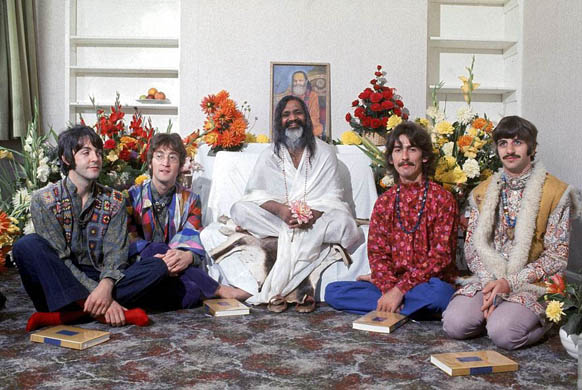
Tags: Maharishi, Beatles, meditation, LSD, aliensThis past November I wrote about growing up in Philadelphia in the 1960s. I was motivated by the recent sale of the house I grew up in, and by a cover photo on a Sunday NY Times Magazine that reminded me of a photo I took in 1968 after seeing the Maharishi Mahesh Yogi when he toured the US with The Beach Boys. While the Beatles love affair with TM was short-lived (years later Paul McCartney confessed in an interview that the supposed sexual indiscretions attributed to the guru were false and that the Maharishi becoming upset by the Beatles drug use at the Himalayan retreat was the actual cause for the rift ), even the momentary intersection was responsible for some interesting things.
Looking back at the era, the arrival of the Maharishi onto the pop culture scene of the late 1960s makes quite a bit of sense. The chain of events included:
* George Harrison taking interest in the Indian musical instruments that appear in some of the scenes in the Beatles’ second feature film, Help!
* A friendship between Roger McGuinn of The Byrds and the owner of the World Pacific record label (Ravi Shankar’s US label) led to David Crosby bringing Ravi Shankar to George Harrison’s attention.
* John Lennon and George Harrison’s introduction to LSD-25 by way of being dosed by their dentist, Dr. John Riley, at a dinner party in 1965.
Canadian poet and song writer, Leonard Cohen, has spent quite some time in a California Zen monastery and his teacher, an old Japanese Zen master who heads that center, said something once that I think has a whole lot to do with the experience of psychedelic drugs.
“You can’t live in God’s realm too long. There are no restaurants or toilets.”
The Beatles move from LSD to meditation mirrors the experiences of the US Buddhist community as a whole. Tricycle: The Buddhist Review conducted a poll in Autumn of 1996:
"Number of responses: 1,454 (63% from the magazine, 37% from the web). 89% said that they were engaged in Buddhist practice. 83% said that they had taken psychedelics. Over 40% said that their interest in Buddhism was sparked by psychedelics, with percentages considerably higher for boomers than for twenty-somethings. 24% said that they are currently taking psychedelics, with the highest percentage for people over 50 and under 30. 41% said that psychedelics and Buddhism do not mix OR: 59% said that psychedelics and Buddhism do mix. The age group that expressed the most confidence in a healthy mix was under 20. 71% believe that "psychedelics are not a path but they can provide a glimpse of the reality to which Buddhist practice points." 58% said that they would consider taking psychedelics in a sacred context. (In the "under 20" category this percentage was 90 %)."
I remember that, when the Maharishi was in town in 1968, people could go to his hotel and get a private consultation with him for the price of one week’s salary and a bouquet of flowers. That consultation resulted in receiving one’s mantra, a nonsense word that you would repeat during meditation and that would help clear one’s mind. A major reason for my own independent skepticism regarding TM is the whole idea of the “top secret mantra.” Many years later a bunch of people who’d received TM training around the same time suddenly realized that they’d all been given the same mantra.
No wonder it’s a secret.
This is not, however, to dismiss the idea of daily meditation. If you’ve ever spent twenty minutes sitting on the floor or on a pillow trying to empty your mind you will gain an immediate insight to how The Beatles White Album came about.
For a little while in the late 1990s until about early 2002 my office was located directly next door to the Indianapolis Zen Center and I would often join them for their evening meditation. One night there was just myself, the center’s Abbot, and his assistant. After the half-hour of sitting in silence the Abbot’s assistant remarked, “I don’t know what was going on; my mind was a young puppy tonight.”
Perhaps monks who’ve been at it for twenty or so years can actually “empty their minds,” but most of us will find that, when we try, it is as if a damn of the most bizarre images and ideas has burst and floods our minds.
Flooded, I imagine, by characters like Bungalow Bill, Rocky Raccoon, blackbirds, warm guns, savory truffles, and all the little piggies.
So, from a dentist’s tea cup to a Himalayan retreat, from the giggles muffled by the Maharishi’s beard to the greatest double LP in pop music history.
And into deep space.
Polaris, 431 light-years away, is the destination NASA sent The Beatles song "Across the Universe" to commemorate the 50th anniversary of its first space mission. On Monday, February 4th at 7 p.m. Eastern time, the array of huge antennas that were usually tuned to listen for inbound signals from space beamed the best of John Lennon’s Rikikesh compositions to a spot (186,000 x 60 x 60 x 24 x 365 x 431) miles away.
Born sometime between 1911 and 1918, named Mahesh Prasad Varma at birth, the Maharishi Mahesh Yogi died this past February 5th in Holland. In the end I think he is bets remembered as basically a good fellow whose impact on the world was for the good and whose momentary affair with the counterculture of the 1960s influenced some fine music. Without it, there’s a chance that side two of The Beatles’ Sergeant Pepper LP might not start with “Within You Without You,” and that would be a tragedy.
Thursday, January 3, 2008
Glad All Over
I can remember all sorts of specifics from my youth. I think as I get older my memory of things back in the mid-1960s actually improves (while my memory of this morning gets fuzzy). But, while I can remember watching band after band take the stage on The Ed Sullivan Show, I can’t remember what it was like to actually have a serious discussion over who was better – the Dave Clark Five or The Beatles, even if I do remember the question coming up.
There was a brief window in 1964, maybe even into early 1965 when The DC5 were riding high in the charts and showing up all over TV. Pretty soon however, you realized that Lennon & McCartney were actually growing as writers, turning out song after song and stretching the boundaries of what pop music could be, while Dave Clark & Company had pretty much done what they were going to do, never really producing a complete “album” as opposed to a steady flow of LPs with one hit single and tons of in-one-ear-and-gone-tomorrow filler.
But Dave Clark, the mastermind behind the band, understood the pop music business as well as any of the era’s impresarios and stretched the band’s talents to include eight top ten records and 15 albums in the United States between 1964 and 1967. In those three short years they made more appearances on the Ed Sullivan show than any other band, eighteen in all.
Dave Clark was born on December 15, 1939. With a reputation as a daredevil, he worked as a stuntman in over 40 films. When his soccer team needed money in 1960, he decided to form a band. He bought a set of drums and learned how to play them. The band started out life as a backing group for Stan Saxon, a North London singer. They signed a recording contract with Ember/Pye in 1962, and became more and more popular in England. Their first single in the UK was “Do You Love Me.”
Shortly after Liverpool gave the world Mersey Beat, the DC5 began to promote themselves as the vanguard of the “Tottenham Sound.” The band’s peak came early when in January 1964 they knocked the Beatles "I Want To Hold Your Hand" off the top of the UK Singles Chart (the position it had held for 6 weeks) with "Glad All Over." Toppling the Beatles brought some major press for the group and they took advantage of this with the release of their next single, "Bits and Pieces" which reached number 2 on the British Charts.
The Dave Clark Five took the U.S. by storm with 6 sold out tours and 15 Top 20 hits in three years. One of their tours included an amazing 12 sold out shows at Carnegie Hall in 3 days. Five more records from the group were released in 1964 that reached the top fifteen in the U.S., including the top ten songs, "Can't You See That She's Mine" (#4) and "Because" (#3). Their hot streak continued the following year with "I Like It Like That" (#7), "Catch Us If You Can" (#4) and their sole U.S. #1, "Over and Over", which had been released earlier by Bobby Day as the flip side of his hit, "Rockin' Robin".
All told, The Dave Clark Five placed 17 records in Billboard's Top 40 to go with 12 Top 40 United Kingdom hits between 1964 and 1967. Their song "Over And Over" went to number one in the U.S. on the Billboard Charts Hot 100 at the end of December 1965.
The band was also distinctive on three ways. In a design uncommon for a pop group of that (or any) era, the leader was the drummer. Dave Clark would play and sing with his drums positioned at the front of the stage, with the guitarists and keyboard to his rear and sides. The group was also unique in the British Invasion because it featured a saxophone, a sort of hold over from the early rock bands of the 1950s (and an element that would not resurface in a rock band for another decade when Clarence Clemmons took center stage with The E-Street Band).
The real genius of Dave Clark, and what set him apart from all of his contemporaries, was a business sense that was decades ahead of its time. Right from the beginning, he held ownership of all the DC5 masters and continued receiving royalties for years. Even more, he retained all the rights of the group’s numerous TV appearances, which is why you so rarely see them included in the growing stream of British Invasion TV specials. In the DVD series that’s been released collecting old Ed Sullivan highlights there are multiple disc releases of the British Invasion era that feature The Beatles, Rolling Stones, Animals, Herman’s Hermits, Freddy & The Dreamers and others, but there isn’t a single DC5 clip included.
Perhaps it was Clark’s background in cinema that was responsible for the band’s most individual accomplishment.
After the success of the Beatles movie A Hard Day's Night in 1964, the DC5 released their own film Catch Us If You Can (released in the United States as Having a Wild Weekend) in 1965. Directed by first time director John Boorman whose next film would be the film that gets my vote for Best US Crime Film Ever, Point Blank (1967), and Deliverance four years after that (and Boorman got closer than Kubrick to directing The Lord of the Rings in 1970, producing a screenplay that’s a very interesting single film adaptation), the film is immediately interesting for the way in which it deviates from the Richard Lester Hard Day’s Night pop-group-in-a-movie-formula. The Wikipedia entry has a nice summary:
“Far from being a conventional pop vehicle, this serious, thought-provoking film concerns itself with the frailty of personal relationships, the flimsiness of dreams, and the difficulty of maintaining spontaneity and integrity in a stage-managed ‘society of the spectacle.’ (That such a message is articulated through one of the very mass media that have created this society is just one of several ironies.) Boorman, an established documentary filmmaker and veteran of TV commercials, already displays great technical skill in this early film. This debut offering is particularly compelling (it drew favorable notices from Pauline Kael and Dilys Powell), not least because of the enormous cultural energy of the time (mid-1960s) in which the film was made.”
By 1967 pop music was awash in the bright colors and paisley of psychedelia which proved a difficult fit for the band. One of the strangest moments in pop music came with their last single, a cover of Neil Young's "Southern Man." The best description was a comment made by my friend, Indianapolis musician John Sheets after I played the single for him. There was a long pause, and John looked at me and said in the most serious tone I've ever heard him use, "Everything about that was wrong."
Below, however, is the "psychedelic" DC5 covering The Youngbloods in the early 1970s and doing a rather nice job of it.
When the group split, Clark attended drama school. Mike Smith continued in the music business, writing commercial jingles and producing other artists. Lenny Davidson became a guitar teacher in Hertfordshire and ran a business that services church organs. Rick Huxley went to work for the Vox musical instrument company before opening Musical Equipment Ltd in Camberwell, and then turned to electrical wholesaling. Dennis Payton went in to the real estate business and continued to play music part time until his death in December 2006.
In March of 2008 The Dave Clark Five will be inducted into the Rock & Roll Hall of Fame.
Saturday, December 8, 2007
I'm Not There....
Restored to bright and vibrant color, The Beatles second film, Help!, has just been reissued on DVD. I bought a copy a week or two before I saw the new Todd Haynes Bob Dylan anti-biopic I’m Not There. I mention the two films together because I remembered that among the ideas kicked around for the third Beatles film was one that called for the four Beatles to play four different aspects of one character. At one point the Italian director Michelangelo Antonioni was supposedly connected to the idea – most likely apocryphal given that Blow Up is the most critical film even made about “the sixties” generation – but nothing ever came of it.
Without question however, the most bizarre third Beatles film that never happened involved a plan to have Stanley Kubrick direct the four Beatles in a film version of Tolkien’s Lord of the Rings with George as Gandalf, Paul as Frodo, Ringo as Sam, and John as Gollum.
Dennis O’Dell, the head of Apple Films had worked with Kubrick on the production of Doctor Strangelove. In The Beatles film Magical Mystery Tour (which I think represents a home movie more than a follow-up to Help!) there is a sequence for the lone Beatles’ instrumental “Flying” in which O’Dell took some aerial footage shot for Doctor Strangelove but never used, and colorized it, giving it a sufficiently psychedelic look. Amazingly, when the film debuted on British TV on Boxing Day 1967, Kubrick watched it at home, recognized his pilfered footage and called O’Dell.
Around the same time someone gave John Lennon a set of the Tolkien books which he read during those moments when the acid wore off long enough for the letters to stop swirling around the page. Needless to say, John was hooked. O’Dell took the idea of a Beatles’ Lord of the Rings to United Artists who said they were interested, but because of what would be a sizable budget, required that a “name” director be part of the deal.
You can see where this is going.
O’Dell met with Kubrick who said he was interested but that he’d never read the Tolkien books. Stanley had booked passage on a ship back to the US and said he would read them on the trip. When he returned he called O’Dell and announced that the books were quite good but completely unfilmable and bowed out of the discussion. By that time Lennon’s attention had already moved on to the next batch of shiny bright things and the idea was quietly abandoned.
I love this story because it reminds me of something I can easily forget when I listen to The Beatles. By the time the band was reduced to nothing more than a room full of lawyers in 1970-71 not a single Beatle had yet turned thirty years old. The idea of the four of them tripping their way across Middle Earth is the perfect LSD-fueled fantasy of twenty-something young men.
But I digress….
Before I tell you what I think about I’m Not There, let me say that I think you should see it. Unlike most films playing as I write this, it’s worth your time.
I don’t believe you have to be a "fan" of Bob Dylan to see this film.
Dylan occupies a place in the culture comparable to the one occupied by The Beatles. A person who owns no Beatles albums, who would fail a “name that tune” round of Beatles songs, who might not even be able to successfully match “John “Paul” George” “Ringo” to the four photos that came with The White Album, would still have absorbed enough information about The Beatles through his skin in the process of walking through the world by this point to watch a documentary on The Beatles and make sense of it.
The idea here was to not make the standard biopic in which the actor playing the “young Bob” would have some conversation with his mother in their Hibbing, Minnesota kitchen over oatmeal about following one’s dream before a slow dissolve turned him into the actor playing the “older” Bob walking up the steps of the Brooklyn State Hospital on his way to meet Woody Guthrie.
If that sounds like a film you’d like to watch, well, WHAT THE HELL IS YOUR PROBLEM?!?!?
Sorry. I just hate “biopics.”
And where I’m Not There develops problems is in the degree to which it actually fails to escape the gravitational pull of the standard biopic for all it’s cleverness in casting six actors to play Bob Dylan.
Among the most interesting portrayals is one by the young 11 year-old African-American actor, Marcus Carl Franklin, as “Woody Guthrie.”
Before single-handedly forcing a redefinition of “authenticity” in folk music by the sheer power of his will and talent, Bob Dylan entered the stream of the folk revival understanding (1) that there were “authentic” lives and (2) that his wasn’t one of them. What an odd notion, that authentic people could never be Jews from Minnesota whose fathers owned appliance stores.
Bob Dylan would have never survived in the media culture of 2007.
Having developed a reputation as an engaging performer with albeit limited appeal, he’d lucked out and gotten a good review in the NY Times that brought him to the attention of John Hammond, Sr. who signed him to Columbia and produced a debut LP that sold fewer copies than any record in Columbia’s history. It was when he began to write that he began to attract an audience.
Befriended by the reigning Queen of Folk Music, Joan Baez, Dylan wrote “Blowing in the Wind” a song that, totally unlike the rest of his massive catalog, resembles “Amazing Grace” and “We Shall Overcome,” songs that sound as if they have no authorship, as if they were delivered on stone tablets or first heard rising from a burning bush.
But Robert Allen Zimmerman from Hibbing, Minnesota, had crafted a fictitious biography for himself. His parents were dead, or had been carnival folk, or both. He was raised in a traveling carnival that roamed across the southwest, or by wolves in South Dakota. He learned songs first hand at the knee of Blind Snake Oil Roberts and Old Sorrowful and Lightning Hopkins and Blind Boy Fuller.
One of the best bootleg recordings of early Bob Dylan is a radio program called “Folksinger’s Choice” hosted by Cynthia Gooding which aired in New York sometime in 1962 (I have seen both November and March dates listed). Dylan performs fourteen songs, a mix of early originals, traditional songs, and songs by Hank Williams, Bukka White, Howlin’ Wolf and Woody Guthrie. The performance is incredible, but the interview, also extensive, is amazing. If Gooding had asked Dylan his belt size, the date or the time I am certain he’d have lied about those too!
CG: When I first heard Bob Dylan it was, I think, about three years ago in Minneapolis, and at that time you were thinking of being a rock and roll singer weren't you?
BD: Well at that time I was just sort of doin' nothin'. I was there.
CG: Well, you were studying.
BD: I was working, I guess. l was making pretend I was going to school out there. I'd just come there from South Dakota. That was about three years ago?
CG: Yeah.?
BD: Yeah, I'd come there from Sioux Falls. That was only about the place you didn't have to go too far to find the Mississippi River. It runs right through the town you know. (laughs).
When I say that Dylan wouldn’t have survived the media climate of 2007 I mean that the story that broke sometime in, I think, 1964 in which a reporter tracked down Dylan’s (still living) parents and his High School year book photo played out fairly quickly. Dylan mostly refused to comment on it and the world moved on. A world that didn’t have 300 24-hour cable news channels looking for “stories.” In today’s world, Dylan could have easily been tarred as the Vanilla Ice of the folk revival.
I suspect that after the interview Dylan went home with Gooding, stayed for a couple weeks, ate all her food, stole her record collection and moved on.
I’m not joking about the record collection either. The young Bob Dylan was one of the original “turn table artists.” Until Dylan’s generation, musicians learned their craft at the feet of other musicians who came before them. Ramblin’ Jack Elliot (a Jew from Brooklyn born one Elliott Charles Adnopoz in 1931) really did run away from home and join a rodeo and learn his first guitar chords from a rodeo clown. Jack heard Woody Guthrie, tracked him down and traveled with him throughout the western US for years learning his craft.
But Dylan, like almost everyone who followed him, would learn his craft on the edge of a bed sitting by a turntable playing records, sometimes slowing them down to figure out guitar parts. Among the stories told about Dylan’s early days in New York is one about his theft of a stack of records from someone who’d been nice enough to offer his couch and the friends of that guy who showed up one night intent on retrieving the records and putting a beating on the voice of their generation.
One of the purloined records was the Rosetta Stone of the folk revival, Harry Smith’s Anthology of American Folk Music. A compilation of recordings of American folk and country music commercially released as 78 rpm records between 1927 and 1932, the anthology was released in 1952 on Folkways Records as three two-LP sets. This was the document that brought the works of Blind Lemon Jefferson, Mississippi John Hurt, Dick Justice, The Carter Family and Clarence Ashley to the attention of this new generation of performers. In the liner notes to the 1997 reissue, the late Dave van Ronk wrote that "we all knew every word of every song on it, including the ones we hated.”
As early as 1927, Carl Sandburg understood that “A song is a role. The singer acts a part . . . all good artists study a song and live with it before performing it . . . . There is something authentic about any person’s way of giving a song which has been known, lived with and loved, for many years, by the singer.”
Robert Cantwell, in his book When We Were Good: The Folk Revival, writes that by 1965 “the folksinger’s persona had evolved into a loosely conventional form, that of the casually road-weary traveler in jeans and boots or peasant frocks, clothes rumpled as parents would allow, erratic hair, one who speaks a pidgin idiom neither south nor west but vaguely regional and proletarian, that non-regional dialect of the Shangri-La West that Bob Dylan and Jack Elliot hailed from, that mythical nowhere where all men talk like Woody Guthrie and are recorded by Moses Asch.” (pp. 328-329)
“Whoever Bob Dylan was, Columbia’s high-fidelity micro-grooves brought his callow voice, wretchedly overwrought, his stagey panhandle dialect, his untutored guitar and harmonica – all of his gallant fraudulence – into dormitory rooms with shocking immediacy. And when, in the spoken preface to his shattering ‘Baby Let Me Follow You Down,’ he waggishly reported that he had learned the song from one Rick Von Schmidt, a blues guitar player from Cambridge, whom he had ‘met one day in the green pastures of. . .ah. . .Harvard University,’ the folk revival had met one of its own.” (p. 345)
“The folk revival, then, is really a moment of transformation in which an unprecedented convergence of postwar economics and demographic forces carried a culture of personal rebellion across normally impermeable social and cultural barriers under the influence of authority of folk music, at once democratic and esoteric, already obscurely imbued with a spirit of protest. This passage across social lines, again, transformed it, endowing it with new expressive forms, and with a legitimacy both wonderful and terrible – terrible because the massively politicizing issue of the Vietnam War, beginning in 1965, would swell it to a tidal wave of protest that swept destructively over the cultural landscape, leaving behind it deep racial, class, gender, and other moraines.” (p. 346)
By 1965 Dylan’s emerging persona became the source of a self-contained “authentic” self. The more other songwriters scrambled to write “Bob Dylan” songs, the more authentic Bob Dylan became in contrast.
But, I digress….
Pretty much everything above lies in the subtext of Marcus Carl Franklin performance as “Woody.” Later in the film, in the odd and disjointed old western town of “Riddle,” Franklin reappears dressed as Charlie Chaplin with Chaplin moustache and cap and cane, only for a moment before disappearing back into, well, the “Riddle.”
Haynes says there was a seventh Dylan in the original screenplay, a Chaplin character created to represent the Dylan of the folk coffeehouse scene in New York whose performances were – and people just coming to Dylan today will find this incomprehensible – funny. But the character was cut for length, and length is the other problem I think the film suffers from. Just as Chaplin Dylan was reduced to a cameo, I think dropping the lion's share of Ben Whishaw’s Arthur Rimbaud Dylan could have helped the problem of the film’s length.
In a traditional narrative, there is a feeling you get as a story proceeds; a sense of where you are – beginning, middle or end – at any point. When a film that really tells no story is long, the feeling that this may never end is not a particularly pleasant one. Cutting most of the Rimbaud Dylan and trimming the Woody Dylan – what’s up with the big whale in the river anyway? – would have been a good step in cutting some length.
Walking out of the theatre, I wasn't sure what to make of Christian Bale’s performance as both the Protest Dylan and Gospel Dylan. After a few days of letting them resonate, I think he does a superb job of playing a man who is more uncomfortable in his own skin than anyone I think I’ve ever seen.
It’s here where a mini tsunami of Dylan iconography is unleashed in the form of famous photos, still images that spring to life, concert posters, and a spot-on perfect performance by Julianne Moore as Joan Baez. I’m not sure it’s even possible to explain how impressive her performance is to someone unfamiliar with the various stages of Baez. The Bale/Jack Rollins/Protest Dylan is, at times, uncomfortable to watch which is, I think, the point.
Bale’s later transition into the Gospel Dylan is extraordinary as well. Here again we get the underlying shift in the Dylan persona, done in a way that side-steps the standard biopic very well. This Rollins/Dylan is an ordained minister. Unlike the “real” Dylan, this Dylan never came back from his conversion, and in the end is reduced to preaching a dire “last days” message to a room of maybe 8 people. The fact that he even plays music seems inconsequential.
The film has a point of view - it doesn't like this apocalyptic evangelical variant of Christianity. It is very clear on this point.
What Haynes has done with Heath Ledger’s Robbie the Actor Dylan – who we first see as he becomes famous for his portrayal of the Jack Rollins/Protest Dylan in a “biopic” is, along with the idea of the Woody Dylan, to create the most successful attempt to fracture, shatter, and generally screw with traditional biopic conventions.
Of all the Dylans here, Ledger’s looks more like the Woodstock-Self Portrait-era Bob than even Blanchett does the 65-66 Bob. And Ledger performance is aided enormously by Charlotte Gainsbourg playing a character assembled from biographical bits of Suze Rotolo and Sarah Lowndes-Dylan made into a French painter. In offering this next-to-impossible-to-sort-out jumble of truth and fiction Haynes simultaneously gives us the “real” (i.e., unreal) “Bob Dylan” and shines a light on new directions in the biopic. For me, these are the peak performances in the film.
I’ve read one criticism of the push for a “Best Actress” Oscar for Cate Blanchett that argues that she only merits “Best Supporting Actress” because she plays the same part played by five other actors in the same film. This sounds like it was written by someone who read a synopsis but hasn’t actually seen the film; Blanchett’s “Jude Quinn” (I don’t know either, maybe some weird weld of “Hey Jude” and “Quinn the Eskimo”) totally dominates the movie. She has more screen time and the combination of her skills – she is the “best actor” here – and the unavoidable novelty of casting – like Travolta in Hairspray ratcheted up by the power of ten – allow her to, at times, disappear into the part.
But it is in these sequences, shot in black & white so as to resemble D.A. Pennebaker’s Don’t Look Back, that I’m Not There downshifts into an almost conventional biopic mode. We get great performances by David Cross as Alan Ginsberg and Peter Friedman as Albert Grossman/Morris Bernstein and Bruce Greenwood as the journalist-cum-inquisitor/Mister Jones/Pat Garrett. We even get the Bobby Neuwirth-Bob Dylan-Edie Sedgwick (“Co-Co Rivington”) love triangle. The Jude Dylan sequence comes closest to the “dumping the notebook” phenomenon in which Haynes finds so many period factoids so interesting that he seems to squeeze one in at every opportunity.
The scene that almost saves this sequence is the meeting by the river where Dylan arrives with The Beatles in an explosion of the visual comedic style of A Hard Day’s Night as they tumble and roll on the grass. The four exit through the gate to the rear, first herded to the left by a bowler hat-wearing Brian Epstein, to remerge in the background a moment later running to the right chased by a small crowd of screaming fans. As Jude Dylan enters he is immediately waylaid by Max Walker playing a perfect collection of tics that comprise every fact-obsessed Bob Dylan “fan.” This was the one moment I laughed out loud in the theatre.
Haynes' intent seems most obscure in the film's last sequence with Richard Gere as a Billy the Kid Dylan living quietly in the old western town of Riddle. The Charlie Chaplin Dylan makes his brief appearance here, a band plays "Goin' To Acapulco" and the visual style of the cover of The Basement Tapes album is heavily referenced in the various characters and still life's on display. Modernity is about to destroy the old ways of the town; when Billy Dylan protests, an ancient Pat Garrett imprisons him. He escapes and hops a freight train heading out of town where he finds Woody's guitar, dusts it off and strums as he watches his dog run after the train but not quite make it.
That last bit, Dylan abandoning the dog rather than jumping off, getting the dog, and catching the next train I read as Haynes' quiet little reference to what a self-centered jerk the "real" Bob Dylan is, cutting off friends and lovers and never looking back. One person I discussed the film with saw it more as a reference to sacrifice, but it seems more like the dog's sacrifice than Bob's so I'm not sure what that means.
The whole Pat Garrett and Billy the Kid period is a minor footnote in Dylan's biography and I'm not really sure why it's elevated to play the role it does here. Nor am I clear on why Dylan, who played a character named "Alias" in the Peckinpah film, is recast now as one of the leads. The entire Billy the Kid Dylan sequence has this other narrative imposed upon it with its own characters and its own drama, but the drama is more dream-like than anything else. The sort of dream you have that makes perfect sense until you slowly wake up, your rational mind kicks in, and all the "sense" your dream made blows away like so much smoke.
The "sense" to be found in Dylan's best work is more like that dream sense; a kind of non-rational connect-the-dots of imagery and the play of language across the surface of the texts (think "Visions of Johanna" "Desolation Row"). So it is with most of this film; and that may well point to a fundamental structuring device here as one of a series of dreams.
In the end, it is the longest sequence, the only black & white sequence, the one that everyone who will write about this film will write about - as if the casting of Cate Blanchett to play the androgynous Dylan of 65-66 is somehow more novel than casting an 11 year-old black actor to play the 20 year-old Dylan - is the one that comes most dangerously close to the very film Haynes set out not to make.
Monday, November 12, 2007
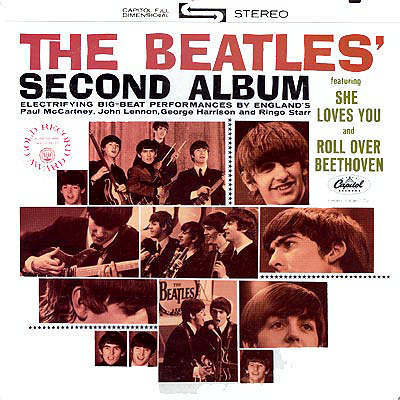
The Beatles' Second Album
My first memory of hearing the name “The Beatles” is an odd one. I was sitting in a classroom in Saint Matthews, the local Catholic boy’s school. I think I was in the 5th grade at the time. Occasionally the tiny public address speaker in the front of the room would crackle in anticipation of an announcement from the disembodied voice of Mother Superior, a figure not that unlike the character of Death in Bergman’s The Seventh Seal or the character of the Emperor in Star Wars. But above even Mother Superior in the pantheon of my childhood authority was the voice of the parish priest. It was the voice we would expect to hear shortly before the incoming Soviet ICBM’s struck the high priority target of the naval shipyards five or six miles from where we sat. It was as close as you could get in 1963 in Northeast Philadelphia to the voice of God.“Boys…” the voice said. I think I grasped the edge of my desk expecting to hear “This is not a drill” followed by instructions containing the words “duck” and “cover.”
Believe it or not, but in 1963 children were regularly shown films of the effects of nuclear explosions – the shock wave obliterating the farmhouse, mannequins disintegrating at the table, the car engulfed in flames and spinning wildly through the air – and then instructed to dive beneath our small wooden desks for safety in the event of this nuclear fire. I don’t know if anyone has ever really charted the effects of this on the so-called “baby boom” generation. The corresponding rise in popularity of the “Theatre of the Absurd” may not be a coincidence.
But I digress….
The voice of the priest continued.
“I want to make it very clear that under no condition will beetle haircuts be permitted in this school.”
We sat, silent, uncomprehending, still behind the curve of new cultural trends. But while it was true that not a single kid in the room had any idea what the priest was talking about, it was also true that every kid in the room wanted one.
There are many different definitions of “THE SIXTIES.” Some put the decade in literal terms from 1960 to 1969. Some use the death of JFK in 1963 through the resignation of Nixon in 1974. Some trace it from the birth of The Beatles on Ed Sullivan to the death of Meredith Hunter at Altamont. A new academic journal on the era uses a “long sixties” of 1955-1975. Those of us who were around during those times each have a personal sixties; mine starts with that announcement.
All of this is documented in a million other places: The Beatles were signed to EMI in England which, even though it owned Capitol Records in the US, could not get Capitol to release the early Beatles recordings. The ones that were released appeared on small regional labels like Tollie, Swan, and Vee-Jay and registered no impact on Top 40 radio. Finally in late 1963, early 1964 Capitol could no longer ignore the success the band was experiencing across Europe and released the first US LP, Meet the Beatles.
Actually 1964 was a pretty good year for Beatles albums. In addition to Meet The Beatles, Capitol also released The Beatles’ Second Album, Something New, Beatles ’65 and a double LP, The Beatles Story, that collected news stories, interviews and snippets of live recordings. United Artists also released the soundtrack to A Hard Day’s Night, and Vee-Jay records released Introducing The Beatles compiling all the early tracks they still had the license for.
During the week of April 4, 1964 The Beatles occupied the first five slots of the Billboard Hot 100, #1 - "Can't Buy Me Love," #2 - "Twist and Shout," #3 - "She Loves You," #4 - "I Want to Hold Your Hand" and #5 - "Please Please Me," the only group in rock and roll history to achieve this feat. That same week they also had another seven charting records in the Hot 100: "I Saw Her Standing There," 31; "From Me to You," 41; "Do You Want to Know a Secret?" 46; "All My Loving," 58; "You Can't Do That," 65; "Roll Over Beethoven," 68. The Beatles had twelve songs on the charts that week, a feat never matched before or since.
In 1964, the Beatles had the never-matched total of 15 American million-selling records (9 singles and 6 LPs), representing US sales of over 25 million in 1964 alone.
In other words, 1964 was a very good year for the Fabs.
But it is The Beatles’ Second Album that fascinates me because it is this, and not “Revolution” that stands as the most political statement they ever made. It also rocks harder than any of their other records as it manages to avoid any of the pop ballads favored by Paul McCartney that usually slowed down the group's other early albums.
As Bruce Eder writing for the All Music Guide notes:
The Beatles' Second Album stands as probably best pure rock & roll album ever issued of the group's music. In the process of pulling songs from various British and American EPs, singles (including "She Loves You") and B-sides, as well as tracks left over from the editing of With the Beatles for American release, the compilers somehow No other long-player by the group featured them doing more covers of songs by black American artists or songwriters, including Little Richard ("Long Tall Sally"), Chuck Berry ("Roll Over Beethoven"), Smokey Robinson ("You Really Got a Hold on Me"), Barrett Strong ("Money"), and others, and just to show how rich a vein this all was at the time of its release, the version of "Roll Over Beethoven" here actually charted briefly as a single.
In his new book, The Beatles’ Second Album, Dave Marsh writes:
"The Beatles showed their allegiance to the principles of the civil rights movement when they refused to play any racially segregated shows on their 1964 concert tour. It was an unusual statement. The Beatles never again took a political stand as a group, and very few performers made such demands when they worked in the South. Making that choice did not endear them to many white American adults, Southern or Northern....
....I don't know what was in that teacher's conscious mind; I do know that everything he tried to teach us smacked of the message I got at home, which was that white was right and black needed to be kept back, or, since it was advancing, north and south, into territory that had been "ours," pushed back. That stuff about the Beatles being revolutionary is more than just talk. There was a war going on, and we were asked to take sides."
The racial history of US pop music up until The Beatles is Pat Boone covering Fats Domino and Little Richard, sanitizing the music, bleaching the color from it, neutering any hint of sexuality. But The Beatles covered these songs as triumphant celebrations of the original artists and every copy of the album that sold was an engraved invitation to an army of middle class white kids to go to the record stores and track down the albums of black America.
The White Southern Christian Citizens Brigades that were formed (along with some Northern ones) in the mid-1950s to fight the threat of race-mixing inherent in the records of Elvis, Chuck Berry, Jerry Lee Louis and Little Richard had been successful. Elvis was in the army, Berry was in prison, Jerry Lee in exile and Little Richard had found Jesus. Pat Boone and the legion of the one-named teen idol pop crooners (Frankie, Dion, Fabian, etc.) had fought back the Visigoths of pop culture.
But in 1964 the Visigoths were back at the gates and this time they had WMDs.
Friday, July 20, 2007
The White Album - Two
I blogged earlier about a writing exercise in which the first lines of all the songs on The Beatles' White Album were used as the first lines in a short story or poem. Here is the very first song on the album, "Back in the U.S.S.R."Flew in from Miami Beach, BOAC
we didn’t speak until the car ride home
it was pleasant
but there were undercurrents
churning up the waters
we left
a wake
all the way on I-70
in the
rearview
I could see
the other cars and SUVs
changing lanes
trying to avoid it.
Thursday, June 28, 2007
The White Album - One
A year or so ago I was in a writer's group and I came up with an exercise that involved writing on slips of paper the first lines of every song on The Beatles' White Album and handing them out. The idea is that the paper is no longer blank once you copy that line, where you go can be anywhere, though you should have no connection with whatever narrative might be in the song.I thought I'd return to that and try to do all thirty odd songs in the next, oh, I don't care how long it takes. I have a few from the exercise and I'll start with a favorite from one of George's songs.
Piggies
“Have you seen the little piggies?” she asked the child. The little boy looked to be about four and enraged over the fundamental unfairness of the world as only a four year old can be. Purple with anger, screaming; perhaps nature’s way of weeding out those of us born with arterial faults before we can reproduce. The boy seemed pretty strong, and inconsolable. But the woman tried, gently pulling him over to the enclosure where a smiling Llama stood by the rail. The beast had a genuine oddness about it that stopped the boy in his tracks. Face still wet, his color returned and he stared at the shaggy chewing orange-brown monster that towered over him. Now the child had that look of awe that Huxley described, albeit in a different context altogether, as seeing “what Adam saw on the morning of creation.” The thought struck me as I watched the boy’s face; this is a brave new world each and every time.
Sunday, May 27, 2007
History and Mythology and Methamphetamine
What he was doing then, long before personal computers and the internet, is what I think we would all do today if we had a high-speed internet connection, a blog, and some crystal meth. I can remember how those little lines of fine white powder just burnt like hell, very different from the coke we’d sometime share that would numb the back of your throat and make everything glow a wee little bit as it made everything slightly more interesting.
For a lot of people I think drugs are all about the pleasure. But for some, for the curious, it’s all about how they make the world more… interesting.
Anyway… I don’t do those things anymore, my body can’t survive the strains it could shake off thirty years ago. But I was playing on line a while ago and had a kind of metaphorical flashback to 4 or 5 in the morning, in that little house on the alley as I started to write something about the ancient Greeks and the British invasion.
So, you need to understand that Euhemerus was a Greek mythographer (4th Century BC) at the court of Cassander, the king of Macedonia. He is chiefly known for a rationalizing method of interpretation, known as Euhemerism, that treats mythological accounts as a reflection of actual historical events shaped by retelling and traditional mores.
The writer Robert Graves said of Greek myth: "True myth may be defined as the reduction to narrative shorthand of ritual mime performed on public festivals, and in many cases recorded pictorially." (The Greek Myths, Introduction). Graves was deeply influenced by Sir James George Frazer's mythography The Golden Bough, and he would have agreed that myths are generated by many cultural needs.
Myths authorize the cultural institutions of a tribe, a city, or a nation by connecting them with universal truths. Myths justify the current occupation of a territory by a people, for instance. All cultures have developed over time their own myths, consisting of narratives of their history, their religions, and their heroes. The great power of the symbolic meaning of these stories for the culture is a major reason why they survive as long as they do.
Myths that are based on a historical events over time become imbued with symbolic meaning, transformed, shifted in time or place, or even reversed. One way of conceptualizing this process is to view 'myths' as lying at the far end of a continuum ranging from a 'dispassionate account' to 'legendary occurrence' to 'mythical status'. As an event progresses towards the mythical end of this continuum, what people think, feel and say about the event takes on progressively greater historical significance while the facts become less important. By the time one reaches the mythical end of the spectrum the story has taken on a life of its own and the facts of the original event have become almost irrelevant.
This method or technique of interpreting myths as accounts of actual events, euhemerist exegesis, dates from antiquity and can be traced back (from Spencer) to Evhémère's Histoire sacrée (300 BCE) which describes the inhabitants of the island of Panchaia in the Indian Ocean as normal people deified by popular naivety.
As Roland Barthes affirms, "Myth is a word chosen by history. It could not come from the nature of things.”
Roland Barthes (1915 – 1980) was a French literary critic, literary and social theorist, philosopher, and semiotician. Barthes's work extended over many fields and he influenced the development of schools of theory including structuralism, semiology, existentialism, Marxism and post-structuralism.
Barthes' 1957 book Mythologies was a collection of interrogations of pieces of cultural materia conducted to expose how bourgeois society used them to assert its values upon others. For instance, portrayal of wine in French society as a robust and healthy habit would be a bourgeois ideal perception contradicted by certain realities (i.e. that wine can be unhealthy and inebriating). He found semiology, the study of signs, useful in these interrogations. Barthes explained that these bourgeois cultural myths were second-order signs, or significations. A picture of a full, dark bottle is a signifier relating to a signified: a fermented, alcoholic beverage - wine. However, the bourgeois take this signified and apply their own emphasis to it, making ‘wine’ a new signifier, this time relating to a new signified: the idea of healthy, robust, relaxing wine. Motivations for such manipulations vary from a desire to sell products to a simple desire to maintain the status quo. These insights brought Barthes very much in line with similar Marxist theory.
Now, the thing that I want to take from all of this is this notion of “mythology” not as some imaginary realm of dragons and elves, but as the end of a process that involves the removal of actual events from their concrete historical moorings.
And so we fast forward to early 1964 and the beginning of what we all now call the “British invasion.”
I started thinking about the British invasion as an example of cultural mythology when I read the article “Before the Beatles: International Influences on American Popular Recordings, 1940-63” by William L. Schurk, B. Lee Cooper and Julie A. Cooper in the May 2007 issue of the journal Popular Music and Society. It is an academic journal and, as such, most often stuffed full of the self-evident nit-picked into absurdity. I published a couple times in the journal, presented papers at their conferences over the years and, because of my odd mix of academic and music business credentials, I am a member of their advisory board (which is to say, I don't pay for the journal).
But I digress….
In their introduction the authors write that, “This discographic compilation is designed to debunk the myth of 1964 as the foreign influence watershed year in American recorded music. . . . The misconception being examined is that, until the arrival of The Beatles, Dave Clark Five, Herman’s Hermits, Hollies, Kinks, Zombies, and others in 1964, American recording charts were largely devoid of foreign-born performers.”
In 40 pages chock full of charts and tables these scholars present a very well-reasoned argument that there was a significant non-US presence in the pop charts well before the supposed invasion, and that US-artists fared far better during the invasion than is generally believed. But I would extend this conclusion a bit farther.
The mythology of the British invasion is tied to a much larger mythology of America in the 1960s, and an even larger mythology of the 1960s itself. The exit of Eisenhower, the arrival of JFK, Kennedy’s subsequent assassination, the baby boom, Vietnam, rise of drug use, etc., all neatly places the 1950s in a conservative pin-striped box and the 1970s into a polyester disco shirt box, the 80s into a Reagan-Gordon Gekko-shaped box and so on.
If there is anything the culture needs to get over more than the myth of the 1960s I don’t know what that might be.
The essence of that myth is that we had our chance, the planets were aligned, we could have had a utopia, but we blew it. Now the planets won’t align for another 9,000 years so, really, what’s the point? This is a horrible, self-centered, banal, and destructive mythology, more destructive than any Reagan-based mythos the Republicans can muster.
I still like paisley, I long for the return of ruffled cuffs and collarless jackets, and I kind of miss the beads. But perhaps it’s time to see the 1960s as the superficial paper-thin bourgeois “revolution” that it was (and take another look at the 1950s while we’re at it) and try walking forward one more time before the light fades entirely.
Saturday, April 21, 2007
Great Debut LPs #1….
I’ve been into buying original mono copies of some classic records in recent months. I got a lovely “6 eye” late-50s Kind Of Blue last month, and the first Buffalo Springfield LP in mono and with “Baby Don’t Scold Me” which was dropped from all but the very first copies. It was replaced with their hit “For What It’s Worth” (“There’s something happening here, what it is ain’t exactly clear…”).I have an actual memory of sitting at the base of the Washington Monument with a girl named Patty something and she had a Martin D-18 guitar and sang that song, and Peter Yarrow’s “The Great Mandela” right there at the base of the monument after we’d taken a bus from Philadelphia to DC for one of the big anti-war marches.
She was the first person I knew with a Martin guitar. We went out a couple times but she lived way out in Bucks County in this house that seemed impossibly large to me at the time and I remember I just sort of let the whole thing fall away.
One time I was supposed to drive out and meet her for something or other and I was with my friend Michael Murphy. Michael had just started at a community college and made friends with some grad student lecturer in the English department and we stopped by to see him. I can’t quite remember the guy’s name but it was a really great one, something like “Huxley Praxton” or something equally memorable.
The guy was the first person we ever knew who grew his own pot. He grew these enormous plants that he would dry hanging from chains in the attic. He rolled joints in one of those tobacco rolling machines that rolled joints way fatter than the ones we’d roll by hand. His pot was also stronger than we were used to. We sat around and smoked 2 or 3 and then left for Bucks County.
I was driving my father’s blue Galaxie 500 and Michael was giving me directions. Every time we reached a intersection I’d ask “Which way?” and every time I asked Michael said “Make a left.” After a half hour or so of this as the terrain became less and less familiar I realized that, like myself, Michael was also higher than he'd ever been. So much so that his entire vocabulary had been wiped clean and the only words he remembered were “a” “left” and "make."
“Do you have any idea where we are?”
“Make a left.”
“Isn’t that the boulevard?”
“Make a left.”
“Man… I am really high. Have you ever been this stoned before?”
“Make a left.”
It was only by sheer luck that we managed to stay in Pennsylvania.
But I digress.
I bought a mono copy of The Rascals Once Upon a Dream a few days ago. This was their Sgt. Pepper (everybody had released their own Sgt. Pepper in the wake of The Beatles' LP), an elaborate package with inner book and loads of effects between songs. There’s even the requisite sitar track “Satva” which is actually rather beautiful. When I was putting it away I pulled out the other Rascals LPs I owned and stuck on a mono copy of their debut, Good Lovin’, released when they were The Young Rascals and forced to wear some pretty hideous matching Little Lord Fauntleroy outfits on front.
These guys were maybe the best blue-eyed soul garage band ever. The LP was released in March of 1966 and, other than an excusable and disposable version of “I Believe”, doesn’t have a weak track on it. Side two is a lesson in how to be a garage band in the US in the mid-60s with definitive versions of the title track, “Mustang Sally” and “In the Midnight Hour.”
The band is dominated by the two vocalists, organist Felix Cavaliere and percussionist Eddie Brigati. Drummer Dino Danelli is one of the best rock steady drummers of the era and the guitarist, Gene Cornish, is a solid player who brings some folk rock leanings to the band with his cover of Dylan’s “Like a Rolling Stone.” The cover is a decent one, helped by Cavaliere's Hammond organ. He's a better organist than Al Kooper so he is able to quote from Kooper's signature playing on the original Dylan track, while embellishing it enough to balance the fact that Cornish, while earnest, isn't Dylan.
I get the impression that it was the guitar player who most likely took acid first, but probably after this record, which has an overall vibe of the garage band. American garage band music reaches right up to the beginnings of psychedelia. If I had a few wishes to spare I know one would be for a box of tapes of the countless bands that played on every block in my neighborhood in the Summer in the mid 1960s. The row houses had garages that opened onto the alleys out back and on Summer evenings all the local bands would set up on the back steps and small back yards and play (mostly the songs on this album).
Childhood is supposed to be infused with magic and tragedy is often defined by the degree to which this is absent. Those were magic times. And it reminds me of a rare moment of affection on Frank Zappa’s Joe’s Garage, the title track: “Down in Joe’s garage / we didn’t need no dope or LSD / just a couple of quarts of beer / would fix it so the intonation / did not offend your ear.”
As good as side two is on this record, it’s the opening cut on the first side that makes you stand up and pay attention. The Beatles had done a cover of Larry Williams’ “Slow Down” but the Rascals’ version derives its power from not owing anything to the Fabs. The song virtually explodes out of the speakers, an effect even more pronounced on the more direct mono version. For the first 10 seconds or so it sounds like it’s poised on a precipice between 1966 and 1968, one foot in the future, the way everything would sound in another 18-20 months. It’s the best track on a great LP and it’s right there, before the hit single, before the more recognizable garage band or soul covers. It’s what makes a really good record a great record.
The defining characteristic of a great debut album is that it present the band, fully formed and this record does that in spades. Connections, the follow-up, may actually be a better record overall, but this has earned a spot on the list of great debut albums.
I will explore this in the future, just as the actual idea of an “album” recedes into the past. Nice timing, no?
Saturday, March 31, 2007
Top Ten Times Two....
In the beginning there were "lists." Primitive mail order catalogs that were typed, full of typos, shrunk and photocopied and folded and mailed and this was how collectors of rare private press and obscure psychedelic and related records communicated back in the last century, in the dark times before the internet.Lists were followed by the earliest attempts at guide books, The Acid Trip, Flashback and a few I'm just not recalling at the moment; horribly incomplete and filled with misinformation. The BIG BANG was the 4th Edition of the Goldmine Magazine Record Collector Price Guide, the first official book to contain the titles and information (and values) for these obscure LPs. This was, for many of us, a tragedy beyond comprehension. Record stores and dealers who had previously put these records out for $1 when they found them suddenly understood what they had. Damn their eyes.
Fast forward to 2007 and the state of the art for guide books is a new book out of Sweden called The Acid Achives: The Ultimate Guide to Underground Sounds 1965-1982. The book limits its content to records released in the United States and Canada (bypassing Europe, Asia and South America which represent content for another 5 volumes) but manages to offer a huge catalog of information nonetheless. Reviews were written by a group of people and I contributed a small pile to the mix (in the name of full disclosure I also was involved in the reissue of a few of the records from the first list below and I've marked those with a * after the name). I also compiled two "Top Ten" lists of records in the style or spirit of those compiled in the book. One list represents a favorite stack of ten records that are not reviewed in the book, the other lists ten which are. All twenty are worth sticking on a list for future research if you don't recognize some of them. First, the top ten from LPs that are contained in the Archives.
Peter Grudzien "The Unicorn" – The people who list it under “so bad it’s good” completely miss the fact that it’s actually just good, probably great. The most focused and unique vision I’ve ever encountered on a record album. The record has been reissued on CD. Original copies are very rare and expensive.
Bobb Trimble "Harvest of Dreams" – As thick and multi-layered as the first Snoop Dog record; a genuinely psychedelic LP from a closeted New England musician. You'll find it hard to believe. His first record Iron Curtain Innocence is rarer but this is the better one. There is a Parallel World CD reissue that collects tracks from both albums, and a UK Radioactive label bootleg CD of this one.
Plastic Cloud – Same – This and the first Country Joe and The Fish are the records to pull out when asked “So, what’s this psychedelic music I keep hearing about?” Had they been from San Francisco they’d be a household name. A Canadian band whose one record has been reissued on LP and CD; originals now selling for over a grand.
McKay "Into You"* – The best description, “Jerry Garcia jamming with Neil Young on Tonight’s The Night” really isn’t very close. Great songwriting (a rarity on private-press records) and a loose feel that just works magic. The original LP was a pressing of 300 copies and has never had the respect it really deserves so it's $400-$600 price tag is actually a bargain if you're into original LPs. The 1993 LP reissue is all analog from masters and also a 300 press that's hard to find but worthwhile. The CD reissue is also from the masters and has 16 non-LP bonus tracks that are really good.
Perry Leopold "Experiments in Metaphysics" – If the question is “How can a solo acoustic and voice record be psychedelic?” then this is the answer. Philadelphia singer/songwriter pressed this LP in a bronze sleeve without a title and gave them away on street corners. Originals are very expensive today but a CD reissue is very affordable.
Rayne- Same* – Completely lost in time and the one record I can play for friends who don’t like “psych music.” Originals are $1,000+, the 1994 reissue LP is gorgeous and a new LP reissue is just out now on the German Shadoks label. Never on CD for some reason.
Anonymous "Inside the Shadow"* – Like Rayne, just not of a particular time, and like McKay, a record of nothing but great songs. Check the lengthy review at the Acid Archives site for all you need to know about this amazing record.
Numbers Band "Jimmy Bell's Back In Town" – Maybe the most underrated record in the book, surely the most undervalued. And hey, if you “don’t like horns” then give me your copy of Forever Changes or shut up. From Kent, Ohio. Fantastic. Well under $100 as an original and well worth it. A CD is out and not too hard to find.
Lazy Smoke "Corridor of Faces" – So the lead singer swears he wasn’t trying to sound like John Lennon, I’ve lied too. The garage version of Magical Mystery Tour. Boston-area I believe, LP and CD reissues are around but the strangest thing is that NONE of them actually reproduce the original, very simple, black and white sleeve.
Brigade "Last Laugh" – There is an earnestness here that just will not be contained. Can’t so much recommend it as not live without it. I hated this record for years and one day, stuck in traffic in Pittsburgh, it just opened up to me. Amateurish, hell yeah, but wonderful.
Now for the ten from the general population. these are the records I suppose that would go to the desert island if push came to shove.
Bob Dylan "Freewheelin'" – The first (of 8 as I count them) museum quality masterworks by the greatest writer of his generation. A blend of Woody Guthrie, Buddy Holly, James Dean and, well, everything.
Jimi Hendrix "Axis: Bold As Love" – His guitar is as strong as on the debut, but it’s his songwriting that’s the focus here. “Little Wing” is as good a song as any ever written.
Forever Amber “Love Cycle” – David Wells said that if this had been a major label LP it’d be remembered as one of the best of the era; the fact that it was made by some UK art school students who then vanished makes it an accomplishment of epic proportions. More memorable melodic hooks per inch than any other record, ever. A multi-thousand dollar rarity, only 99 copies were pressed in 1969. But it is as good as Pet Sounds. There's a US LP reissue that sounds awful and a European one that sounds great. Also a CD that's out of print but perfect.
Tim Hardin "3 Live" – The LP ends with “Lenny’s Tune” for Lenny Bruce and the sound of one junkie singing to another without pretense is as heartbreaking as the best Hank Williams.
Van Morrison "Moondance" – All his best records are a battle between R and B and mysticism and it’s here that the two meet for some pints in the local pub.
The Beatles “The Beatles’ Second Album” – The very record that introduced an entire generation of white American kids to black American music; after this, there was no going back. Also has "She Loves You" which is the best song about an orgasm this side of Beefheart's "White Jam."
Phil Ochs "Pleasures of the Harbor" – The best of his electric catalog and “The Crucifixion” is his greatest moment.
Paul Butterfield Blues Band "East West" – Next to Hendrix, Michael Bloomfield was the greatest blues-based rock guitarist of the 1960s and his playing here will stop any argument to that in its tracks.
Grateful Dead "Blues for Allah" – Unlike many of his peers, Garcia occasionally makes these jumps in his understanding of the guitar and it’s never more evident than here.
Bob Dylan “Love and Theft” – On Dylan’s hands-down best record of all he’s finally grown up to be the character he was playing at being in 1965-66. Maybe the best record I own.