Showing posts with label Jazz guitar. Show all posts

Sunday, February 3, 2008

Dylan Jazz....


Lost in piles of budget exploitation records, Glen Campbell meets Bob Dylan and makes a gem of an album that’s not going to see a CD reissue anytime soon.

Back in the early ‘70s, I wasn’t in the mood for guys singing about rhinestone cowboys or Wichita linemen, especially with full orchestras and background singers. It was a time of very serious artists with serious acoustic guitars who played mostly unaccompanied and always wrote their own serious songs (how could you sing about feelings that weren’t your own?).

Dave was this banjo-playing bartender friend of mine who let me drink for free in a dark roadside motel bar just outside of the town I was living in at the time. I kept him company and watched him win hundreds of dollars from road-weary truck drivers with his “red card, black card E.S.P.” card trick that, countless beers and truckers later, I finally figured out how to do. Late one evening at his apartment somehow Glen Campbell’s name came up in a conversation and I sneered and made some comment about "rhinestone linemen." A little later he put on a record and said, “Listen to this.” It was some bluegrass track and in the middle was a totally monster mandolin solo.

“Holy smokes!” I said. “Who’s that mandolin player?”

“That isn’t a mandolin player.” My friend said. “That’s Glen Campbell on a 12-string.”

While I didn’t become a fan at the time, that was later after I realized that Jimmy Webb was a genius, I did stop sneering and developed a respect for Campbell, Tommy Tedesco, Howard Roberts, Hank Garland and another hundred faceless session musicians I’ve learned about over the years.

If you ever see The Monkees video for “Valerie,” notice how the camera cuts from a wide shot of the whole band to a super tight close up of the hand on the fret board of Mike Nesmith’s Gretsch White Falcon guitar during the solo. If I had a favorite Monkee it would be Mike, no doubt. His solo material is really quite good. But the guitar solo in “Valerie” is about as beyond his abilities as a guitarist as James Joyce’s “Ulysses” is beyond mine as a writer (or a reader for that matter). If you could see the arm attached to that hand it’d be attached to Glen Campbell [*actually, it turns out that's an internet legend; the guitarist is really session legend, Louis Shelton].

As the rules of irony might dictate, during the Glen Campbell scorning period of my life my musical idol was Bob Dylan. It was Dylan after all who turned the definition of folk “authenticity” on its head and in the wake of his work nobody was authentic if they weren’t singing their own songs (and another strike against the Rhinestone Cowpoke).

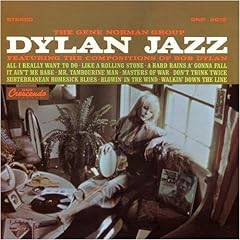
Where the irony enters is in the form of this album, Dylan Jazz. An album of Dylan songs done instrumentally in small jazz-combo arrangements by the Gene Norman Group and lifted up into someplace special by the guitar playing of Glen Campbell.

The GNP Cresendo label was the creation of Gene Norman, whose jazz club, The Crescendo, was a famous Sunset Strip nightclub in the 1940s and ‘50s and home to performances by every major jazz artist of that era. Gene Norman started his GNP label in 1954 and later struck gold with releases of Star Trek and Trek-related albums. Gene Norman told me the funniest joke I ever heard.

I met him in his hotel room at a NARM convention in San Francisco about six or so years back. He was in his late-70s and sat on the edge of his bed smoking a huge cigar.

“I heard a good joke the other day.”

There was a theatrically long pause for effect.

“I met a man who didn’t own a record label.”

You can’t see me but I’m still laughing almost too hard to type.

Gene showed me his passport. Where it has occupation listed his had, “Impresario.” I still think it was among the coolest things I've ever seen.

Needless to say, Gene is relegated to playing the electric cash register in “The Gene Norman Group.” The musicians here are Jim Horn on sax and flute, Glen Campbell on guitar, Al Delory on piano, Lyle Ritz on bass, and the great Hal Blain on drums. The album was produced by Leon Russell and Snuff Garrett and sounds like everyone involved had a pretty good time in the process.

The sleeve here is a surprisingly hip quotation of the sleeve of Dylan’s 1965 LP “Bringing It All Back Home.” An issue of Time magazine lies on the table by a harmonica. The woman sits by an acoustic guitar and holds a tambourine. The covers of two older Dylan LPs are to the bottom right, the top of his 1962 debut record just peeking into the frame.I have a fatal weakness for guitar players, a fact well illustrated by the leaning tower of record crates across the room, and this is one wonderful jazz guitar album.

Most tracks are only briefly recognizable during an opening passage where the melody line can be heard, then take off into some terrific flights of fancy mostly via Campbell’s outrageous guitar playing. My friend, Scott Ballentine, is one of the better guitar players in Indianapolis, and his taste in guitar music is pretty brutal. I’ve never come up with a favorite airy arty solo finger-style acoustic guitar record that he didn’t ridicule within the first 10 or 11 seconds. Some of my all-time favorite guitar players, such as Larry Coryell and Lenny Breau, don’t rate much above a begrudgingly mumbled “Mmmm yeah, they’re OK.” It has become my mission to find guitar records that slap that “show me something” smile off his face, and I am happy to say that this one left both cheeks stinging.

Scott, like me but even more so, is not dazzled by shows of technical virtuosity alone. There’s got to be somebody there. There’s got to some feeling, some heart, some soul in the notes and in the spaces between the notes or it’s just not going to be worth going back to a second and third time.

Dylan Jazz is stuffed full of spirit, heart, soul, whatever you want to call it. A good deal of it flows from Glen Campbell’s fingers on the lesser-known “Walkin’ Down the Line,” in particular. Songs that are musically a bit on the monotonic side like “Masters of War” and “A Hard Rains A’ Gonna Fall,” are opened up melodically wider than I might have thought possible.

I’ve collected Dylan LPs for over 20 years and have never come across this until Punkin Holler Boy, John Sheets, gave me an old beat up copy he had lying around. I just slightly upgraded that one, courtesy of eBay, but still kick myself over a German pressing on the Vogue label I missed about a month or two back. The first time I saw Lou Reed’s Metal Machine Music on CD I realized that just about anything might come out on disc eventually, but I’m not holding my breath waiting for this one. However, I was surprised as all get out to just now find that the album is available from iTunes as a download.

Thursday, March 29, 2007

The Greatest Guitar Player, Ever.


"He is one of the true geniuses of the guitar. I suppose he is a musician's musician. His knowledge of the instrument and the music is so vast, and I think that's what knocks people out about him. But he's such a tasty player too. I think if Chopin had played guitar, he would have sounded like Lenny Breau." -Chet Atkins

"Lenny Breau played more great stuff at one time than anybody on the planet... with feeling and tone. He was the best that ever lived, bar none." - Danny Gatton


The guitar has, for various reasons, been the most popular instrument in the US for over a couple hundred years now. Unlike other stringed instruments like the violin or cello, it is fretted and easy to learn the fundamentals which will pretty quickly allow you to amuse yourself and not annoy those around you. Unlike the piano, it is portable and relatively easy to haul around with you. Unlike brass and reed instruments, you can play and sing along at the same time. The great acoustic guitarist Leo Kottke was asked just what it is about the guitar that makes it so unique and he explained that there is no other instrument on which the most casual player can suddenly stumble upon some odd combination of right and left hand technique that’s both interesting and never been done before. That’s a big part of the fascination as well.

I have a number of friends who teach guitar both here in Indianapolis and around the country and they have students who run the gamut from 12 year olds who want to sound like Eddie Van Halen to corporate attorneys who want to play jazz standards (or vice versa). I have spent hours on occasion in friendly arguments over which names belong on the list of the truly great guitar players. The early innovators in various styles like Segovia (who single handedly took the guitar from the gutter to the concert halls), Django Reinhardt and Charlie Christian (and Carl Kress and George Barnes for that matter) who invented the single-note lead lines that have dominated guitar music forever. There is no one playing electric guitar in a rock context who doesn’t owe a debt to Jimi Hendrix. My own list would add names like Wes Montgomery, Larry Coryell, Joe Pass, Michael Bloomfield, Duane Allman, Jerry Garcia, Carlos Santana, Danny Gatton, Roy Buchanan, Davy Graham, Ralph Towner, Robbie Basho, Michael Hedges, and, if I don’t just pick this as an arbitrary stopping point, the rest of this article will be comprised of nothing but names and commas.

While I certainly listen to as many guitarists as I can – just this morning I’ve listened to records by Attila Zoller, Peter Finger, Chris Proctor, John Fahey, and Gene Bertoncini while I’ve been working on this – I have never hesitated when I’ve been asked “Who’s the best guitar player you’ve ever heard?”

While often referred to as a Canadian guitarist, Lenny Breau was born August 5, 1941 in Auburn, Maine. His parents, Hal "Lone Pine" Breau and Betty Cody were country and western performers who were active together as a live and recording act from the mid 1940's to the late 1950's. In 1957 the family moved to Winnipeg, Manitoba in Canada and formed a band to perform regularly on CKY Radio's live broadcast of the show “Caravan.” The majority of Lenny’s career was in the jazz clubs of Toronto, Edmonton, Winnipeg, and Vancouver. Like the two other players who might well be the answer to this question if Lenny had never been born, Joe Pass and Michael Bloomfield, Lenny also struggled with heroin addiction for a long portion of his adult life. The last period of Lenny's life (1981-84) was spent primarily teaching and playing in Los Angeles where, on August 12, 1984, he was found dead in the swimming pool of his apartment complex. Although his death was originally thought to be an accidental drowning, the Los Angeles Coroner report determined that Lenny had been strangled. The case remains unsolved to this date.

Listening to Lenny Breau on the guitar is more like listening to Art Tatum on the piano than anything else I’ve ever heard. For me, there are three qualities that all the greatest musicians I’ve heard seem to share [look back to my David Bromberg post for the first appearence of this idea]. First, there is an intellectual element. The player understands music theory, harmony, chord substitutions, scales, modes, etc. These represent the grammar and vocabulary of the musical language. It is, for example, impossible to imagine someone writing a great novel with a working vocabulary of 100 words. Second, there is a physical dimension to playing an instrument. Most players understand some things that they cannot get their fingers to actually do. I know what an A Minor scale is, and I know what 16th notes are, but I simply cannot play that fast even though I’ve heard others play much faster. I lack the physical ability to realize those ideas. Third, and this is the tricky one, in addition to the body and the mind there is the heart. The element that will always separate the great players from the technically proficient ones is the ability to instantly access their emotional lives. That is, to pour something of themselves, their soul if you will, into the music. What I mean by this is that there are perhaps thousands or even tens of thousands of singers with a far greater range than Billie Holliday ever had, and not a single one can sing “Strange Fruit” and leave me so devastated.

Lenny Breau’s discography is pretty varied and, as with Art Tatum and Joe Pass, I find the non-group recordings the most rewarding. The style that Lenny developed involved using the guitar as a polyphonic instrument. This is what classical players do, where the bass, middle and treble strings represent different sections of the orchestra. Lenny was able to play a complex bass line, play complex chords on top of that, and add fluid single note solos on top of that, all done in real time with no special effects. There are two CDs I’ll specifically recommend as the best places to begin if you’d like to explore the music of Lenny Breau. Cabin Fever is a solo album on the Guitarchives label (owned by B.T.O. guitarist, Randy Bachman). Lenny’s friend, Glen McDonald, bailed a despondent Lenny out of jail and took him to a cabin deep in the Canadian forest. The cabin had no electricity or running water; McDonald brought a small reel-to-reel recorder and a gasoline-powered generator and left Lenny there with a borrowed Ramirez classical guitar. If you turn the lights down when you listen it can be like having Lenny in the room with you; as intimate a recording as any I’ve ever heard.

The other CD is a double-disc set, Live at Bourbon Street, which pairs Lenny with bassist Dave Young at a Toronto jazz club. This features Lenny performing with his custom 7-string electric Kirk Sand guitar. Unlike other 7-string players, Lenny adds an extra high string rather than extending the bass. These 17 tracks recorded on June 14th, 1983, are the most impressive guitar music I think I have ever encountered and, as with most great art, every time I return to this I come away with new observations.

Other players have picked up the torch of Lenny Breau’s phenomenal style. I’d heartily recommend the series of “Beatling” CDs by Steven King on which he plays solo acoustic arrangements of Beatles’ tunes with a skill that borders on the frightening. Bay-area Blue Note recording artist, Charlie Hunter, has taken the bass/treble approach to new places with a hybrid instrument that combines bass and guitar strings. Regardless of technical innovations and all sorts of contemporary flash however, "Lenny Breau" remains my answer to the question, “So, who’s the best guitar player ever?”