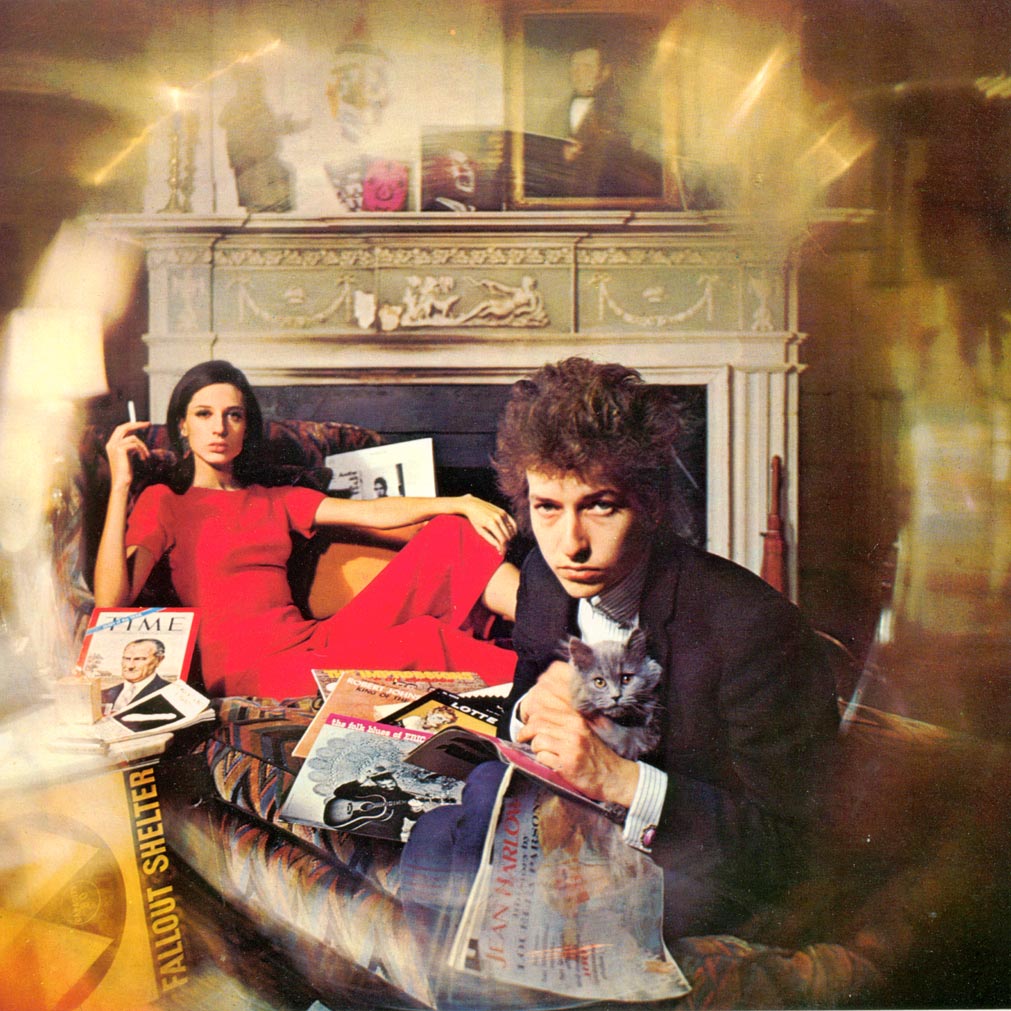
 If side one suggests, lyrically, a crack in the dam, on side two the levee breaks, the concrete crumbles… pray for those people in the houses down in the valley.
Yes, “Mister Tambourine Man” is a reference to guitarist Bruce Langhorn, but this is clearly not to suggest that the song has anything to do with Langhorn. It’s easy to read the text as a drug song as well – “Take me on a trip…” “The smoke rings of my mind…” but that’s a bit too easy too. I believe the pleasures here are all right on the surface, not to be found in some deeper meaning needed to be dug out.
Now the language play begins in earnest.
The magnificent parody video of “Subterranean Homesick Blues” done by Weird Al would never work here. These lyrics can’t be replaced by nonsense verse and palindromes. It’s also right that the rock band backing is gone too, nothing here to get in the way of Dylan the writer, the wordsmith.
“My weariness amazes me, I'm branded on my feet / I have no one to meet /And the ancient empty street's too dead for dreaming.”
“Though you might hear laughin', spinnin', swingin' madly across the sun / it's not aimed at anyone / it's just escapin' on the run /And but for the sky there are no fences facin'.”
And he saves the best for last. The “one hand waving free” calls up my favorite line in any Springsteen song – “What else can we do now but roll down the window and let the wind blow back your hair?” Find me a popular image of FREEDOM in which something isn’t waving. Go on, I double dog dare you.
“Then take me disappearin' through the smoke rings of my mind
Down the foggy ruins of time, far past the frozen leaves
The haunted, frightened trees, out to the windy beach
Far from the twisted reach of crazy sorrow.
Yes, to dance beneath the diamond sky with one hand waving free
Silhouetted by the sea, circled by the circus sands
With all memory and fate driven deep beneath the waves
Let me forget about today until tomorrow.”
The Byrds added McGuinn’s Rickenbacker 12-string – a guitar whose distinctive sound is not just in the novelty of an electric 12-string guitar, but in the way the Rickenbacker is strung on the lower 3 sets of strings with the octave strings in the opposite position than they are on other makes of 12-strings – and changed the time signature. And, as good as it is, their version is more a novelty that Dylan’s acoustic recording which has a certain naturalness to its presentation that suggests some sort of psychedelic troubadour.
I have a friend in New York who collects rare psychedelic records and is a Dylan fan, but bristles at the description of these records as psychedelic; something I find genuinely puzzling as Dylan’s LSD use starts around the time of Another Side and can be heard rising up in the lyrics of songs like “Chimes Of Freedom.” To me, the 1965-1966 trilogy seems increasingly acid-fueled as it grows in intensity; much like John Wesley Harding seems so ahead of the curve as far as post-acid music is concerned.
“Gates of Eden” and “It’s Alright, Ma (I’m Only Bleeding)” seem to me cut from the same cloth as “A Hard Rain.” I’ve long suspected The Doors got the idea of ending their records with their own epic songs (“The End” “When the Music’s Over”) from this and the next couple records. And what better way to announce “This is an epic” than to begin with a reference to the mother-of-all epics.
“Of war and peace the truth just twists / its curfew gull just glides.”
The lines that end “the gates of Eden” are interesting too for the choice of “inside” “outside” etc. It seems like a precursor to “Desolation Row” in that regard. “Mail them from (not “too”) Desolation Row… etc.” By the next record the rather stern, foreboding – I always imagine them made of wrought iron – gates of Eden get transformed into the run-down funky neighborhood of “Desolation Row.” Creatively, it’s a move that suggests an Old Testament story rewritten as a John Steinbeck novel.
“Gates of Eden” is stuffed full to bursting with a tableau of characters that leap forth from Dylan’s inflamed imagination. The curfew gull, the cowboy angel, a lamp post that stands with folded arms and iron claws; the savage soldier, shoeless hunter, utopian hermit monks… the list expands throughout the song as these vague, half-formed images root around in your mind, reaching one of its peaks is the fourth from last verse:
“The motorcycle black Madonna, two-wheeled gypsy queen
And her silver-studded phantom cause the gray flannel dwarf to scream
As he weeps to wicked birds of prey who pick up on his bread crumb sins
And there are no sins inside the Gates of Eden”
That dichotomy is one that I think Dylan borrows from the Beats – the hip outsider world versus the square gray flannel world – and it’s clear which side Dylan prefers (remember too how the gray flannel world continually tries to capture that icon of resistance and co-opt it. See: the Fonz).
One of Dylan’s strongest 1990s songs is the outtake “Series of Dreams” and I think many of the songs from 1965 can be approached as series of dreams. The closing verse here sort of supports that idea:
“At dawn my lover comes to me, and tells me of her dreams
With no attempts to shovel the glimpse into the ditch of what each one means
At times I think there are no words but these to tell what's true
And there are no truths outside the Gates of Eden.”
Close your eyes and try to imagine bringing Bringing It All Back Home home in March of 1965. Maybe it’s a little chilly, that last little bit of winter hanging on before the world changes. Back then Columbia records were not sold in plastic shrink wrap. The record was sealed inside the cover, it came in a plastic inner sleeve that had a perforated edge that you had to tear off to open the sleeve and take the disc out. The edge always ended up tearing the bag itself, so, there you are, that little strip of plastic in your hand, setting the disc down onto the platter of your Garrard turntable, your copy of Another Side of Bob Dylan leaning up against one speaker, dropping the tone arm and BOOM!
You just sat through the most amazing side one of a record, probably ever. Your head is spinning, you can barely remember your own name; you stumble back to the player and flip the record over and drop the arm on side two. While the blaring electric yowl of side one is gone, the simple acoustic arrangements put the exploding surrealism of the lyrics even more front and center.
You’re not in Kansas anymore.
The structure of “It’s Alright, Ma (I’m Only Bleeding)” is five sets of three verses each divided by a series of three-line refrains that stick a variation of the title in the last if the three lines. There is a relentlessness here that actually works against the song after a bit, at least it seems that way to me now, 40 years later. We’re told “there is no use in trying” because “he not busy being born is busy dying” and we’re really just “one more person crying.” And “while others say don't hate nothing at all except hatred” “it's easy to see without looking too far that not much is really sacred” and “even the president of the United States sometimes must have to stand naked” (a line that caused crowds to explode in the fires of Watergate when Dylan returned to the road in 1974 after an eight year absence).
The third set of verses reminds me of a section in Dylan’s magnificent “Last Thoughts on Woody Guthrie.” Compare this set of verses about half way through “It’s Alright, Ma…”
“Advertising signs that con
You into thinking you're the one
That can do what's never been done,
That can win what's never been won
Meantime life outside goes on
All around you.
You lose yourself, you reappear
You suddenly find you got nothing to fear
Alone you stand with nobody near
When a trembling distant voice, unclear
Startles your sleeping ears to hear
That somebody thinks
They really found you.
A question in your nerves is lit
Yet you know there is no answer fit to satisfy
Insure you not to quit
To keep it in your mind and not forget
That it is not he or she or them or it
That you belong to.”
…to this section of “Last Thoughts on Woody Guthrie”
"Cause you can't find it on a dollar bill
And it ain't on Macy's window sill
And it ain't on no rich kid's road map
And it ain't in no fat kid's fraternity house
And it ain't made in no Hollywood wheat germ
And it ain't on that dimlit stage
With that half-wit comedian on it
Ranting and raving and taking yer money
And you thinks it's funny
No you can't find it in no night club or no yacht club
And it ain't in the seats of a supper club
And sure as hell you're bound to tell
That no matter how hard you rub
You just ain't a-gonna find it on yer ticket stub
No, and it ain't in the rumors people're tellin' you
And it ain't in the pimple-lotion people are sellin' you
And it ain't in no cardboard-box house
Or down any movie star's blouse
And you can't find it on the golf course
And Uncle Remus can't tell you and neither can Santa Claus
And it ain't in the cream puff hair-do or cotton candy clothes
And it ain't in the dime store dummies or bubblegum goons
And it ain't in the marshmallow noises of the chocolate cake voices
That come knockin' and tappin' in Christmas wrappin'
Sayin' ain't I pretty and ain't I cute and look at my skin
Look at my skin shine, look at my skin glow
Look at my skin laugh, look at my skin cry
When you can't even sense if they got any insides.”
I also hear strong similarities in the way this has to be sung and with “Subterranean Homesick Blues.” I’d love to discover a lost outtake in which that same band rocked-out on a version of “It’s Alright, Ma…” Try to imagine these lyrics sung on top of that driving electric band with Michael Bloomfield’s guitar at the wheel:
“While them that defend what they cannot see
With a killer's pride, security
It blows the minds most bitterly
For them that think death's honesty
Won't fall upon them naturally
Life sometimes must get lonely.
My eyes collide head-on with stuffed graveyards
False gods, I scuff
At pettiness which plays so rough
Walk upside-down inside handcuffs
Kick my legs to crash it off
Say okay, I have had enough
What else can you show me?”
“What else can you show me?” indeed.
Maybe the album opens with “It used to go like that, now it goes like this” which is kind of an aggressive way of saying “things have changed.” But the album ends on a more melancholy note, as if Dylan accepts that his exit from the Folk/Protest Pantheon can never be that easy. Hearing this the first time in the swirling context of “Dylan has sold out!” and condemnations in Sing Out! magazine (with the wonderful reply from Johnny Cash who, at that time, hadn’t yet met Bob) and the story of how, after being booed from the stage at Newport, Dylan returned with an acoustic guitar and played this song and then left (true, not true, who cares) it is without question that when you heard this song at the end of the acoustic side of this record you heard it as the most eloquent “Dear John” letter of all time, from Bob to the folk community.
“You must leave now, take what you need, you think will last.
But whatever you wish to keep, you better grab it fast. . . . .
Look out the saints are comin' through
And it's all over now, Baby Blue.”
How many songs does this guy actually know? Who else takes “When the Saints Come Marchin’ In” and twists it into that line, “Look out now, the saints are comin' through….”?
Ancient New Orleans idiom music recycled as end of an era folk melancholia.
Jesus.
The thing that just knocks me off my feet and won’t let me up is this endless parade of characters, all arising as if from the subconscious of the body of 20th century modernist literature. The list grows: the orphan with his gun (how do you cry “like a fire” anyway?), the empty-handed painter, seasick sailors, reindeer armies, and the vagabond who's rapping at your door.
Listen to the explosion of songwriters A.D. (After Dylan) as they all do their best to populate their songs with similar characters. Just off the top of my head, look at this cast of characters from “Blinded By the Night,” the opening track off Bruce Springsteen’s first album:
Madman drummers bummers and Indians in the summer (with a teenage diplomat), some all-hot half-shot, some fleshpot mascot, young Scott with a slingshot, some brimstone baritone anti-cyclone rolling stone preacher from the East, some new-mown chaperone, some fresh-sown moonstone, some silicone sister with her manager's mister, and Go-Cart Mozart, little Early-Pearly, some hazard from Harvard, and some kidnapped handicap. And, if there’s room, add Crazy Janey, her mission man, Wild Billy with his friend G-Man, Hazy Davy and Killer Joe (from the cast of “Spirits in the Night”).
I don’t quite know what to make of the fact that this is also a record of my own time.
My memories of 1965 are hazy at best, I would have been 12 years old in March of that year, and turned 13 in late August. I can’t say for sure but I’m fairly certain I came to Dylan via The Beatles. My earliest recollection of The Beatles is an interesting one, I think.
I remember sitting in a classroom in the Catholic grade school I attended when the voice of the Mother Superior came over the public address system. She told us that the parish priest had something important to tell us. The appearance of the priest on the school’s PA was reserved for the deaths of presidents or a 5 minute heads up before a full scale first strike by the Russians. Duck and cover my 4th grade Polish ass… we were nervous.
“Boys,” the disembodied voice intoned; “I want you all to understand in no uncertain terms that beetle haircuts will not be tolerated.”
That was it.
It was like one of those coded messages transmitted over allied radio in enemy territory, “The captain has embarked and we will engage the fish in October; I repeat, the captain has embarked and we will engage the fish in October. That is all.”
But I didn’t have the code. And as I looked around at my fellow Catholic youth, in our matching uniforms of short-sleeve white shirts and blue plaid school ties, I could tell no one else did either. No matter, whatever it was, we wanted one. This was probably in December 1963 and may mark the actual start of the sixties.
I was with the Beatles starting with that first Ed Sullivan Show appearance in February 1964. This was where the fuse of my later record collecting self was lit. At some moment in there, with some LP or single, I must have experienced that first, primal pleasure rush that comes when you show someone something you have that they don’t have and you can see them want it and realize you feel good because it makes them feel bad.
It’s hard to describe the heady rush of those times; the acceleration of the culture. Think of it this way: The Beatles released the albums Meet The Beatles, The Beatles’ Second Album, Something New, A Hard Day’s Night, Beatles 65, The Early Beatles, Help!, Beatles VI, Rubber Soul, Yesterday and Today, and Revolver in 1964-1965.
During that same period Bob Dylan released The Times They Are A-Changing, Another Side of Bob Dylan, Bringing It All Back Home, Highway 61 Revisited and Blonde On Blonde.
Rufus Wainwright released five albums between 1998 and 2007, and he’s fairly prolific by contemporary standards.
If your own adolescent consciousness was forming at that same time, if your own growth covered a comparable distance from “I Want To Hold Your Hand” to “Tomorrow Never Knows” or from “Boots of Spanish Leather” to “Visions of Johanna” then it’s in that context that a 12 year-old runs out to buy Bringing It All Back Home when it hit the stores in March/April 1965.
So…. It’s the impact of living through those times versus hearing this record for the first time in 2007 that I can’t quite measure. I just don’t know if it means anything or, if it does, what it means.
The recent CD remaster of Bringing It All Back Home is exceptionally well done with sound that rivals the original vinyl pressing. Some Dylan fans complained that the Dylan remastered CDs were too short and should have added some bonus material but I think “bonus tracks” are a curse of the CD age; most especially true for reissues of genuinely great albums. Should this ever get reissued again with a bunch of outtakes tacked on at the end, I’ll tell you now, I won’t buy it. This album needs extra material like The Bicycle Thief needs extra scenes.


