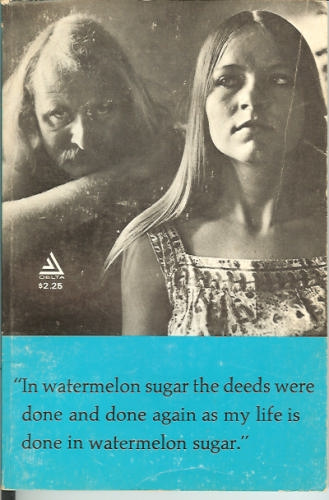
In the February-March issue of
Book Forum Geoff Nicholson has a short article titled, "Rare Bits & Pieces." My friend on the Expecting Rain discussion forum, "The Revelator," knowing that I am more than fond of the author, Richard Brautigan, sent me the link to Nicholson's article because in the amazing book collection he describes is perhaps the most perfect piece of Brautigan ephemera, ever: the author's 1970 Texas fishing license. Above my own small collection of Brautigan first editions is my one piece of Brautigan ephemera, a framed invitation from Grove Press to the reception celebrating the publication of his first novel,
A Confederate General From Big Sur.
Nicholson's article is so much fun that, even though you can read it by clicking the link in the first sentence above, I'm going to post the whole thing below with the hope that neither he nor
Book Forum object:
Rare Bits & Pieces
Artist richard prince has amassed an idiosyncratic collection of first editions and literary curios.
By Geoff Nicholson
If by some chance you happen to be passing through Rensselaerville, a formerly wealthy, now eerily becalmed, mill town in far upstate New York, you might possibly notice a neat, substantial, brick-built house at the center of town. It’s elegantly austere, nineteenth-century, with two doors and six windows symmetrically arranged on the front, and on the side is one of those plaques telling you how far you are from other places in the world: 29 miles from Catskill, 262 from Montreal, and 2,358 from Panama.
It would be a uniquely alert traveler who’d see that plaque and immediately think, “Ah yes, Panama, the Canal Zone, allegedly the birthplace of artist, appropriator, photographer (indeed rephotographer), and all-round provocateur Richard Prince. This must be the building where he keeps his rare-book collection.” But that’s exactly what it is.
A cursory acquaintance with Prince’s art might not suggest he’s the most bookish of artists. His iconography features Marlboro men, cowboys (clothed and naked), nurses (ditto), “girlfriend” imagery from biker magazines, hoods from muscle cars, sometimes muscle cars themselves. His latest works feature doctored photographs of Rastamen and big-breasted women. It’s not exactly Virginia Woolf territory. And yet, and yet.
There have always been clues about Prince’s literary side. The artist’s books and catalogues he’s produced demonstrate a bibliophilia not shared by all visual artists. Photographs have appeared in some of them showing neat stacks of books, like the one in his 2004 publication
Man of a dozen or so volumes, all first editions, paperbacks by Charles Willeford and Rudolph Wurlitzer on top, hardbacks by Don DeLillo and Richard Price at the bottom.
Prince has also produced some quirky literary texts. A 1985 piece, published in
ZG magazine, is a conspicuously faked, yet very knowing, interview with J. G. Ballard, the gimmick being that the older, more established Ballard is the one asking all the questions. A few years later, in the terrific essay “Bringing It All Back Home,” Prince describes his feelings about collecting, presenting himself as a New York flaneur, energetically seeking out and buying books, some of them rare and valuable, some not, though his preference is evidently for the former. “I want the best copy,” he writes. “The only copy. The most expensive copy. . . . I want the copy that is rarer than anyone had previously dreamed of. I want the copy that dreams.”
These days, as I discovered when I met up with him in Rensselaerville, Prince is able to get exactly what he wants. When he bought Brigid Berlin’s legendary but little-seen, and indeed unpublished,
Cock Book for $175,000, in 2005, the acquisition was reported as both gossip and art-world news.
To visit the Prince Library is a pleasure and a privilege and also something of a rarity. Prince explained that he didn’t bring many people there. “Most people just aren’t that interested in books,” he said uncomplainingly. “It’s like a gentleman’s club with only one member.” About once a week, he drives the few miles from his house to the library and sits alone there, enjoying his collection, examining (to take examples more or less at random) his copy of
The Colossus inscribed by Sylvia Plath to Ted Hughes, complete with a little heart drawn next to his name, or a first edition of Jack Smith’s
The Beautiful Book (Dead Language Press, 1962), one of two hundred, with nineteen tipped-in photographs; a copy sold at auction for a little over $34,000 last year.
Prince says he doesn’t imagine there are any local bad elements planning a heist, but even so there’s a serious security system, and within the house is a sanctum sanctorum, a room-size, walk-in fireproof safe where the truly irreplaceable treasures live. It comes as no surprise to discover that the interior of the building is laid out like a very fine exhibition space. The place is uncluttered, the collection and the visitor are given room to breathe, yet the moment you enter you’re in no doubt that you’re surrounded by wonders.
Yes, those are Diane Arbus photographs, uneditioned ones she made herself, essentially contact prints. Yes, that crash helmet with the fabulous psychedelic paint job is signed by Mountain Girl, Ken Babbs, and Ken Kesey. There on the wall is a check from the Security National Bank of Northport, New York, made out from Jack Kerouac to Allen Ginsberg for $40, dated 1960. It’s been framed alongside a wire report of Kerouac’s death and a photograph, and of course these fugitive bits of literary ephemera have become a Prince artwork.
Prince is a conceptualist, and he originally conceived that his collection would cover the period from 1949, the year of his birth and also of the publication of Orwell’s
1984, to the actual year 1984. Neat—perhaps a little too neat. Like many collecting schemes, the boundaries got distorted: acquiring a full set of
Black Mask magazine extended it into the past, as did buying a first edition of
Ulysses (one of one hundred signed copies, Shakespeare & Co., 1922). Nevertheless, ’49 to ’84 is an “interesting time” for those intrigued by counterculture in its broadest sense: not just the Beats but also the hippies; not just Kesey and Leary but Nabokov and Heller and Pynchon; not just Warhol but also
Zap Comix. “I paid $15,000 for Zap, volume 1, number 1,” Prince said. “People thought I was insane.” Then he added, “Basically, my collection is about sex, drugs, Beats, hippies, punks.” Imagine a long, thoughtful pause here. “And great reads.”
The less precious items in the collection are “open access,” on shelves, in cabinets, sometimes arranged into miniature shrines; a frieze of multiple editions of
Lolita in many languages, an accumulation of Richard Brautigan publications along with his fishing license from the State of Texas, dated August 13, 1970; fee: $2.15. In a rear room, spread out on a shelving unit, are layers of pulp paperbacks, which I suspect could never live up to the spiciness of their titles and covers:
Beat Nymph,
Girl Artist,
Unfortunate Flesh. Among them, incredibly, was a copy of
Grapefruit signed by John and Yoko. Prince looked at it ambivalently, “Yeah,” he said, “this should probably go upstairs.”
When Prince opens the safe upstairs housing his collection of true rarities, there’s initially rather little to see. The books and manuscripts are in custom-made black leather clamshell boxes, their titles stamped in gold on the spines. What’s inside sets the mind and pulse reeling: a copy of
Roots inscribed to Buckminster Fuller, an uncorrected proof of Michael Herr’s
Dispatches once owned by Hunter S. Thompson, a copy of
Catch-22 inscribed to Joseph Heller’s daughter.
A book lover must positively swoon. I can now say I’ve handled Nabokov’s own two-volume Olympia Press edition of
Lolita, with his handwritten corrections. And I’ve very nearly handled some Pynchon letters from the early ’60s, by which I mean I’ve held the plastic folder containing them, getting close enough to read his address on Third Street, Manhattan Beach, though Prince asked me not to reveal the recipient.
I’ve also touched some Kerouac marvels—Prince owns a great many. His letters to Neal Cassady,
Visions of Cody inscribed to Cassady, various versions of
On the Road, advance and review copies and one inscribed to his sister. There’s also a copy signed “to my Buddy Steve”—that’s Steve Allen—and this very book is the one that sits atop the piano in the famous television interview. Alas, I didn’t get to see the scroll manuscript of
Big Sur: It was out at the bindery.
There is a strange, and it seems to me admirable, alchemy at work here. Art-market wealth is being transmuted into literary wealth. Of course, it’s an unequal transformation. All the power is on the art side. Prince’s painting
Millionaire Nurse sold in 2008 for $4.7 million. However, as Prince has become ever more collectible, he has become ever more of a collector.
“Sometimes,” he told me, “it seems like this collection of mine is too good to be in private hands. It should be in somewhere like the Morgan Library.” In fact, he’s already negotiating to donate it to the Morgan if they let him have an exhibition there for a couple of years. He also has plans to make a catalogue-cum–artist’s book.
“Sometimes,” he said, “I think a catalogue of the collection would be enough for me. I’d still be able to look at it.” But, I suggested, he wouldn’t be able to touch and smell it, rearrange it, and do all those other things that collectors do. “That’s true,” he admitted, though I didn’t sense he’d find that any great problem. “Collecting like this is a full-time hobby,” he said. “And I have other things I want to do.”
 Iva Toguri mug shot, Sugamo Prison - March 7, 1946