Showing posts with label psychedelia. Show all posts

Thursday, May 13, 2010

Albums of Magic and Beauty #3... Realization

Johnny Rivers Realization (US 1968)

I've loved the album for as long as I can remember. It's one of those records that has a particularly fragile front cover - the purple seems to come off if you rub it even slightly making really mint covers, forty-plus years later, very hard to find. Every time I find one, I buy it, resulting in a small section in my record racks devoted to Realization preservation.

There are two versions on CD, one the album alone, and another that takes advantage of CD length to include a second LP as bonus. It took a while, but I sought out the single LP version for the same reason I don't want "bonus tracks" popping up at the end of Sgt. Pepper.

This was the LP's first single, released before the album and climbed to #14 on the US Billboard charts. Try as I might, I could not find a video for it that didn't sort of suck.  Just hit play and then look away from the monitor until it's over.


I always get a kick out of the Sgt. Pepper reference since that album was the soundtrack of that summer more than any other single record has ever been the soundtrack of an extended moment (even though it had no singles released from it and wasn't on many jukeboxes).

Writing for the All Music Guide web site, James Chrispell and Bruce Eder provide a really nice succinct description:

Not a concept album, but a song cycle depicting life in southern California in the late '60s, Realization is a fine cycle to catch a ride on. It's also a serious surprise -- when psychedelia reared its head in 1967, the results were frequently disastrous for those performers who'd been specializing in straight-ahead rock and roll, and few had rocked harder or more straight-ahead than Johnny Rivers. Instead of jumping on a bandwagon that had nothing to do with where he was musically, he hijacked the sounds of psychedelic rock -- much as the Temptations did at Motown -- and took it where he was going. Acting as his own producer for the first time, Rivers opened up a slightly gentler side to his work that's equally valid and a lot more interesting, if not quite as exciting as his rock & roll classics. After a few sonic digressions as a lead-in, "Hey Joe" gets going, carrying listeners into Rivers' gorgeous rendition of James Hendricks' "Look to Your Soul." His own achingly beautiful "The Way We Live" follows, and then comes Hendricks' "Summer Rain," which turned into Rivers' last big hit of the 1960s. And then he has the temerity to take "A Whiter Shade of Pale" and make it prettier and harder -- but less spacy -- than the Procol Harum original; from there he plunges into blue-eyed soul on "Brother, Where Are You." The surprises continue right through to the rather delicate, introspective reading of "Positively Fourth Street" at the close, Rivers succeeding in evoking a vast array of thoughts and emotions. For his trouble, helped by the two hits, he was rewarded with a Top Five charting album, and one that has continued to find new admirers across the decades.

River's take on "Hey Joe" (background on the song as well as over 1,500 cover versions listed here) is unique for it's optimistic psychedelia - instead of "shooting his old lady" Joe finds enlightenment.  Standout versions of "Look To Your Soul" and "The Way We Live" are a perfect lead in to "Summer Rain."

Track after track the album maintains a specific tone - a blend of a wistful melancholy with a trace of confusion that is directly tethered to a gradually emerging post-psychedelic culture.

Somewhere along the way I found a picture sleeve 45 released before the album, "Look To Your Soul" with "Something Strange" on the b-side. Rivers is pictured on the front, in a poncho and peace sign medallion in a dark and slightly fuzzy photo.  The labels credit the tracks as "From the album The Realization of Mr. Beelzebub."


In Chronicles, the first volume of his autobiography, Bob Dylan picks River's cover of "Positively 4th Street" that closes Realization as his favorite cover of any of his songs. Whether he would have said the same thing five minutes later aside, Realization remains an album of some magic and beauty.


*You should be able to download the album here, courtesy of Psychedelic Lion.

Wednesday, February 17, 2010

The Creator Has a Master Plan

In 1969 Pharoah Sanders released his LP, Karma. About a year ago the blog Deadly Death: The Diening published a post on the album (including a download of the album that is still working).  Their description of the album's centerpiece, "The Creator Has a Master Plan" reads:

"Creator" comes in at 32:47 and wastes not a single note. Opening with a virtual rush of sound, it then quiets down and drops a brief riff from A Love Supreme. The tune then works itself into a groove that would later be known as acid jazz, working with Eastern percussion and allowing the bass to float close to the front of the mix. This first section relies on a modal two-chord structure that keeps the tone bouncy and meditative. At eight minutes Leon Thomas begins a chant-like vocal that varies lines from the mantra "The creator has a master plan, peace and love for every man." The vocals drop and the third movement becomes an unrelenting Coltranesque blitz that tears the mellow mood apart, only to combine the angst and mellowness in the next movement and settle back into a reprise of the first fourteen minutes.

In April 1998 I assembled a group of musicians in a studio and recorded an afternoon's worth of improvisations that later became the album In The Summer Of The Mushroom Honey. In the late fall of that year I brought together another group of musicians, some who had played on the earlier session, for recordings that became the album Waters Of Life, an album that is still unissued. During those sessions I decided to try and record a version of "The Creator Has a Master Plan" in which the sax is replaced by an electric guitar, played by Portland Oregon-based jazz guitarist and teacher, Daniel Noland. I don't have a complete list of everyone who plays on the track, however, I know that Mark Cutsinger played drums, Vess Ruhtenberg played bass, Barry McCabe played acoustic piano and I did the vocals and played percussion. The track is not part of the finished Waters Of Life album and is sort of a musical Ronin, homeless, wandering the endless plains of cyberspace. Give a listen.

Monday, June 4, 2007

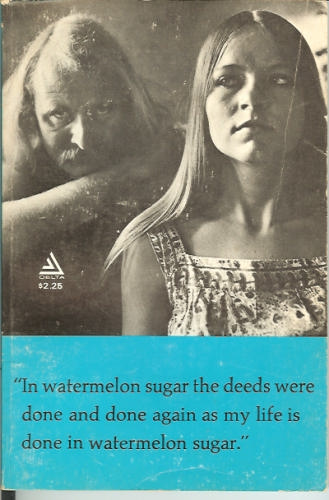
In Watermelon Sugar the deeds were done....

"In Watermelon Sugar the deeds were done and done again as my life is done in watermelon sugar. I'll tell you about it because I am here and you are distant.

Wherever you are, we must do the best we can. It is so far to travel, and we have nothing here to travel, except watermelon sugar. I hope this works out.

I live in a shack near iDEATH. I can see iDEATH out the window. It is beautiful. I can also see it with my eyes closed and touch it. Right now it is cold and turns like something in the hand of a child. I do not know what that thing could be.

There is a delicate balance in iDEATH. It suits us.

The shack is small but pleasing and comfortable as my life and made from pine, watermelon sugar and stones as just about everything here is.

Our lives we have carefully constructed from watermelon sugar and then travelled to the length of our dreams, along roads lined with pines and stones.

I have a bed, a chair, a table and a large chest that I keep my things in. I have a lantern that burns watermelontrout oil at night.

That is something else. I'll tell you about it later. I have a gentle life.

I go to the window and look out again. The sun is shining at the long edge of a cloud. It is Tuesday and the sun is golden.

I can see piney woods and the rivers that flow from those piney woods. The rivers are cold and clear and there are trout in the rivers.

Some of the rivers are only a few inches wide.

I know a river that is half-an-inch wide. I know because I measured it and sat beside it for a whole day. It started raining in the middle of the afternoon. We call everything a river here. We're that kind of people.

I can see fields of watermelons and the rivers that flow through them. There are many bridges in the piney woods and in the fields of watermelons. There is a bridge in front of this shack.

Some of the bridges are made of wood, old and stained silver like rain, and some of the bridges are made of stone gathered from a great distance and built in the order of that distance, and some of the bridges are made of watermelon sugar. I like those bridges best.

We make a great many things out of watermelon sugar here -- I'll tell you about it -- including this book being written near iDEATH.

All this will be gone into, travelled in watermelon sugar."

Richard Brautigan, 1968.

That's the first chapter in Richard's third novel, also my favorite of his books.

I cannot explain what it is about this book. I do think that it is the most psychedelic novel I've ever read, and that's a part of what I love about it.

There is a quality of Brautigan's writing that some people find lazy and unfocused. Some people don't. I'm one of those who doesn't.

The original printing was a paperback by Dell with the cover shown here. The current edition has a completely different cover that, in my opinion, does the book no favors.

I wonder why publishers will change the cover art of a classic novel while record companies never (or rarely) change the covers of classic LPs. The 40th Anniversary of The Beatles Sgt. Pepper album was a few days ago and I can't help but think that, had it been a novel, the anniversary would have been celebrated with a new edition in a brand new sleeve.

I was already pretty happy that it wasn't a novel but now, even more.

Reading Vonnegut's A Man Without A Country last week, and re-reading Slaughterhouse Five at the moment, made me think of Richard Brautigan, and thinking of Richard always makes me pull out a copy of In Watermelon Sugar.