Throughout the mid-1980s and into the mid-1990s I used to spend two or three (sometimes five or six) days a week cruising a circuit of thrift stores, junk shops, flea markets, antique malls and used book and record stores looking for old LPs. Put in romantic terms, I was on a quest for the Holy Grail. Every record collector is on a similar quest. People who collect movie soundtracks have this tiny fire burning in them that whispers that the next yard sale, the next record show, stuck in the back of a box will be that clean copy of
The Caine Mutiny. The Beatles collector picks up every copy of
Yesterday and Today hoping for the tell-tale outline of Ringo’s black turtle-neck showing through the white of the pasted over slick. The Elvis collector knows the next copy of
Speedway will be a mono one. And so on.
There are some odd little records I’d looked for forever. Twenty years after I saw that a friend’s copy of Bob Weir’s album,
Ace, had a different back cover photograph I finally found my copy in a Pittsburgh shop. I must have made an involuntary noise, I rmember the clerk jerked his head in my direction.
Currently I have filed in my head the cover of the very first pressing of Chad and Jeremy’s LP
The Ark on which the title is misspelled “Arc.”
Even though I haven’t gone out and searched in earnest for the impossible object for many years now I still have some memories that make me smile.
At a flea market that’s long gone now, out of the E-Z Listening section I pulled a stone mint in the shrink copy of
Relatively Clean Rivers, a very rare 70s California private pressing by a band whose leader still lives on a goat farm and is the father of the kid who has replaced John Walker Lindh as “
the American Taliban,” tops the US Justice Department’s “Most Wanted” list, and is believed to be living with Bin Laden in the mountains of Pakistan. How’s that for six degrees of separation?
At the Disabled American Veterans thrift store I found a run of a half dozen rare German progressive LPs in perfect shape, wedged among the regular Jimmy Swaggart and Ray Conniff albums. Who among you can stop yourself from wondering how they ever ended up there?
Behind that shop is a flea market that’s dead to the world today but about 10 years ago had a record dealing truck driving husband and wife pair in whose stall I found my clear vinyl copy of
Blows Against the Empire (a record that Paul Kantner claims is an urban legend).
More recently, after abandoning the thrift store circuit – many have shut down, eliminated vinyl, or moved what they have into places where it actually physically hurts to look through them (I’d have taken photos of my knees but I thought I’d always have them….) – I have had some luck in finding the occasionally badly described rare record on eBay and putting in a low-ball bid in the last few seconds in the hopes that no one else has noticed. Most recently I was able to find the second set I’ve ever had of Will Jima’s records this way.
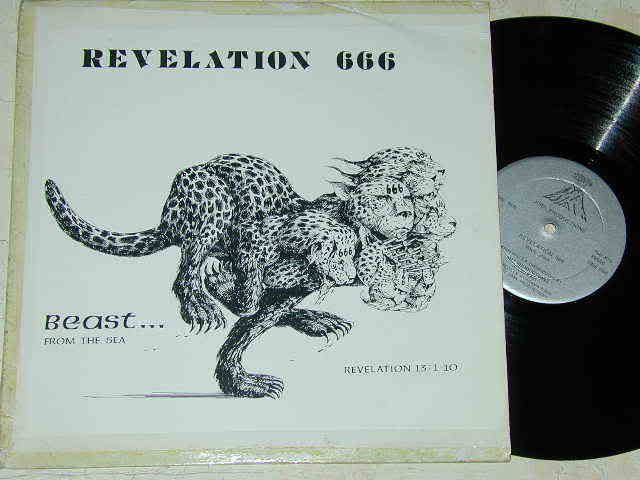
Will Jima was this guy who, back in the 70s was abducted from a dock in Florida by a UFO and briefly held while the aliens taught him the UFO message – the secret meaning of the Book of Revelations. He was then returned to preach the “UFO Message” which is the title of his first record. His second album (and I love the fact that these are also out there, somewhere, on 8-track tape) is called
Revelation 666 and has one of the most amazing LP sleeves of all time (featured on the cover of the Acid Archives book).
I first came across these records on the wall of a shop in Chicago in the late 80s. After holding onto them for a while I sold the second one for about $200 and traded the first one to a New York collector who’d had the second one for years. The second album has a picture of the first album on the back and looking at it had nearly made him mad. I was able to use his desire for that bit of long-sought vinyl closure to nab an upgrade copy of
Peter Grudzien’s
The Unicorn, maybe the best “lost” record of all time.
I saw a description for an eBay auction that read something like “STRANGE UFO RECORD.” It was being sold by someone who didn’t normally sell records; sometimes it’s these guys who will describe a record as in “OK condition” that more often than not turns out to be a dusty M- LP. What was odd about this was the description of the “gatefold cover” and the condition of the “records.” Jima didn’t make an album in a gatefold, nor did he have a multiple LP set. I won the auction for the minimum bid of something like $3 plus $4 for shipping and what I received was this:
Someone had taken the two Jima LPs and some scotch tape and taped the two covers together into a make-shift gatefold. The tape was old and dried out and easy to remove leaving only minor stains on the edges of the second album (see the photo at the front of this post). Both discs were dusty and cleaned up to a nice M-. I auctioned the second one and got $150 and kept the first one.
But I digress.
Earlier today I went to the post office and, on the way back, I stopped at a local antique shop that has a record section in the back, by the stacks of old Playboys. The shop is run by a guy who (1) has some recent LP price guide and (2) has no idea that the condition effects the value. This means he has bins with VG- copies of records priced at $35 that would probably sell for $30 if they were M-. But there are always exceptions.
I passed up a just-too-beat copy of the third Mandrake Memorial LP. I remember seeing those guys at The Second Fret on Sansom Street in Philadelphia back in the late 1960s. Their unique sound was built around an electric harpsichord and their first album is what they sounded like live in a small club.
I found a nice first pressing of The Bee Gees’
Odessa LP in the red “velvet” cover in near mint shape for $10. Better still, a clean white label promotional copy of The GTOs
Permanent Damage on the Straight label, a record that has sold for $300 on eBay, for $15. But best of all, for $20 I found an original “6 eye” mono pressing of Miles Davis
Kind of Blue in beautiful shape. The best sounding record I own is a pressing of
Kind Of Blue done by Classics Records in a set of four 12-inch 1-sided discs that play at 45 rpm. I can't wait to compare these.
This post was inspired by a comment Ted Barron left on my earlier post about record collectors. Ted’s blog,
Boogie Woogie Flu, is always worth checking out.
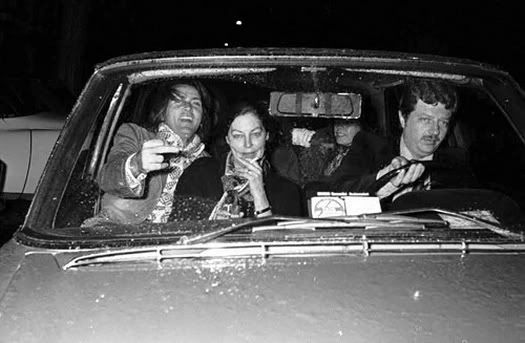 Martin Sheen and Ava Gardner
 Leonard Bernstein and Glenn Gould
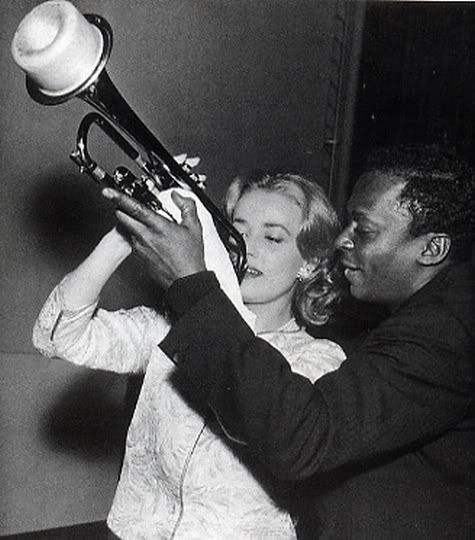 Miles Davis and Jeanne Moreau
 Jean-Paul Sartre and Simone de Beauvoir
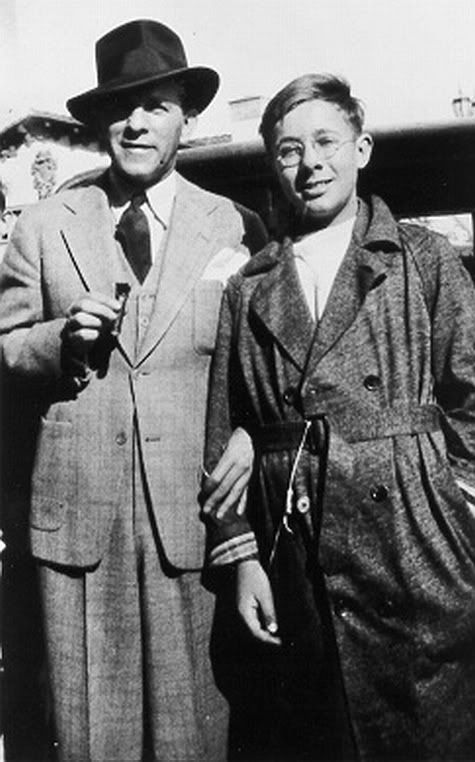 George Burns and Ray Bradbury
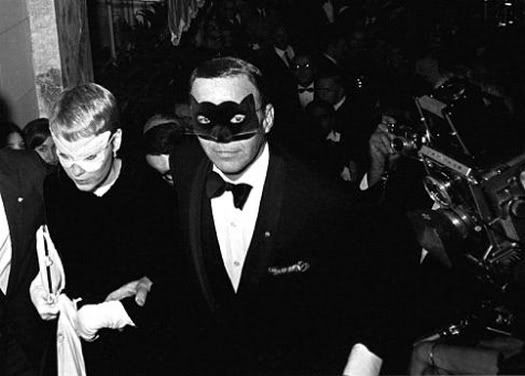 Mia Farrow and Frank Sinatra
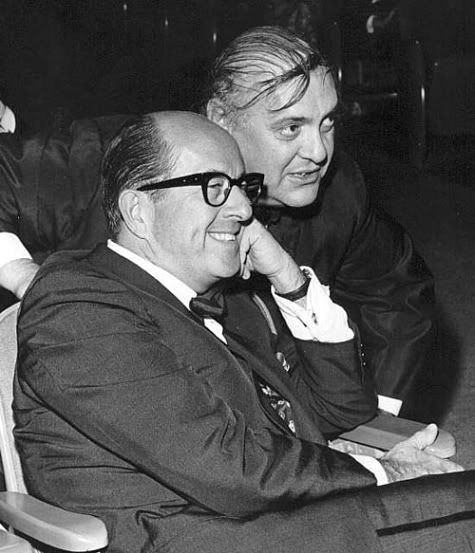 Phil Silvers and Zero Mostel
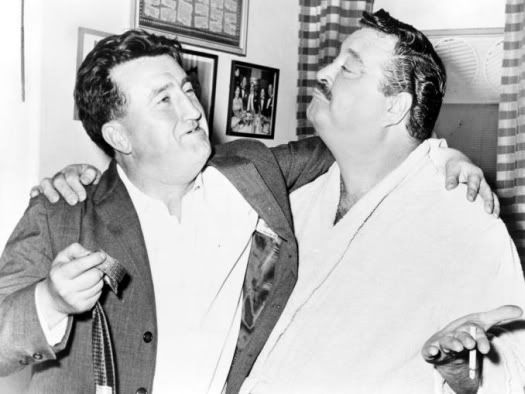 Brendan Behan and Jackie Gleason
 Milton Berle and Marlene Dietrich


