Thursday, June 28, 2007

The White Album - One

A year or so ago I was in a writer's group and I came up with an exercise that involved writing on slips of paper the first lines of every song on The Beatles' White Album and handing them out. The idea is that the paper is no longer blank once you copy that line, where you go can be anywhere, though you should have no connection with whatever narrative might be in the song.

I thought I'd return to that and try to do all thirty odd songs in the next, oh, I don't care how long it takes. I have a few from the exercise and I'll start with a favorite from one of George's songs.

Piggies

“Have you seen the little piggies?” she asked the child. The little boy looked to be about four and enraged over the fundamental unfairness of the world as only a four year old can be. Purple with anger, screaming; perhaps nature’s way of weeding out those of us born with arterial faults before we can reproduce. The boy seemed pretty strong, and inconsolable. But the woman tried, gently pulling him over to the enclosure where a smiling Llama stood by the rail. The beast had a genuine oddness about it that stopped the boy in his tracks. Face still wet, his color returned and he stared at the shaggy chewing orange-brown monster that towered over him. Now the child had that look of awe that Huxley described, albeit in a different context altogether, as seeing “what Adam saw on the morning of creation.” The thought struck me as I watched the boy’s face; this is a brave new world each and every time.

Saturday, June 16, 2007

Henry Miller, Man Ray and Me.....

The scene is an art studio in Clarion, PA, sometime in 1980-1981. Al Charley was an art professor at Clarion State College, a sculptor, and a guy who always made me think of Ken Kesey because they both were artists who’d been champion wrestlers in their youth. There’s something about former wrestlers, something centered about their personalities. I don’t think I have ever met a former wrestler that I didn’t take an immediate liking to. The same is true for physicists, though I don’t really know why. Maybe it’s all the mental wrestling with the fundamental nature of the universe that gives them a similar edge. You might think the same would be true for philosophers or artists but it isn’t. It’s easier for a philosopher to just completely fake it than for a wrestler or physicist. There’s not the arm of someone who isn’t faking it wrapped around your throat; nor is there any math. And I don't know if "faking it" even makes sense in refence to art.

But I digress.

This story involves a cast of characters that include George Barber, Henry Miller, Gilbert Neiman, Man Ray, Earnest Hemmingway and Allen Ginsberg’s father. It may take a while, but it will be worth your time.

George Barber was a professor of English at Clarion State College in Western Pennsylvania, arriving there sometime in the late 1950s (maybe the early 60s) I think. It was George who gave me the answer to a question I had after my first few years at Clarion. During my first year I encountered an array of the most interesting people I’d ever met, people from the arts, sciences, from everywhere, and I was puzzled by how they all arrived in this remote little town of 6,000 hidden in the hills of rural Pennsylvania. George told me that you would find a population of east coast intellectuals stuck away in every small nondescript state college across the eastern half of the country because that’s where they all went to hide in the face of Joe McCarthy and the “red scare” of the 1950s. They taught their classes and lived quiet lives, received the slight protections that academic tenure provides and plugged away in sections of basic composition and surveys of English Lit until they could retire and go off into a forest somewhere and read.

Some would go on to write. A younger colleague of George’s, Terry Caesar, later wrote the finest book about the experience of being an academic I’ve ever found or hope to find, Conspiring with Forms: Life in Academic Texts (University of Georgia Press, 1992). That book reprints Caesar’s earlier essay “On Teaching at a Second-Rate University,” whose publication made his life at Clarion… interesting. Hard to find now, but well worth your trouble.

In 1947, another Clarion refugee had written There’s a Tyrant in Every Country, of which Henry Miller said. “Myself, I’ve never read a better novel about Mexico.”

For a time, Gilbert Neiman lived near Miller in Big Sur and is written about by Miller in his book, Big Sur and the Oranges of Hieronymus Bosch. The excerpt below is from the last part of the section about Gilbert:

The Music! One night, about two in the morning, the door of our shack was thrown open with a bang and, before I knew what was happening, I felt a hand gripping my throat, squeezing it viciously. I knew damn well I wasn’t dreaming. The a voice, a boozy voice which I recognized instantly and which sounded maudlin and terrifying, shouted in my ear, “Where’s that damned gadget?”

“What gadget?” I gurgled, struggling to release the grip around my throat.

“The radio! Where are you hiding it?”

With this he let go his grip and began dismantling the place. I sprang out of bed and tried to pacify him.

“You know I have no radio,” I shouted. “What’s the matter with you? What’s eating you?”

He ignored me, went on pushing things aside, tearing at the walls with furious talons, upsetting chinaware and pots and pans. Finding nothing, he soon relented, though still furious, still cursing and swearing. I thought he had gone out of his mind.


“What is it, Gilbert? What’s happened?” I was holding him by the arm.

“What is it?” he yelled, and I could feel his glare even through the darkness. “What is it? Come on out here!” He grabbed my arm and started dragging me.

After we had gone a few yards in the direction of his house he stopped suddenly, and gripping me like a demon, he shouted: “Now! Now do you hear?”

“Hear what?” I said innocently.

The music! It’s the same tune all the time. It’s driving me crazy.”

“Maybe it’s coming from your place,” I said, though I knew damned well it was coming from inside him.

“So you know where it is,” said Gilbert, accelerating his pace and dragging me along like a dead horse. Under his breath he mumbled something about my “cunning” ways.

When we got to his house he dropped to his knees and began sniffing around, just like a dog in the bushes and under the porch. To humor him, I also got down on all fours, to search for the concealed gadget that was giving out Beethoven’s Fifth. After we had crawled around the house and under it as far as we could, we lay on our backs and looked up at the stars.

“It’s stopped,” said Gilbert. “Did you notice?”

“You’re crazy,” I said. “It never stops.”

“Tell me honestly,” he said, in a conciliating tone of voice, “where did you hide it?”

“I never hid anything,” I said. “It’s there . . . in the stream. Can’t you hear it?”

“He turned over on the other side and cupped his ear, straining every nerve to hear.

"I don't hear a thing," he said.

"That's strange," said I. "Listen! It's Smetana now. You know the one . . . Out Of My Life. It's as clear as can be, every note."

He turned over on the other side and again he cupped his ear. He held this position for a few moments then rolled over on his back, smiling the smile of an angel. He gave a little laugh, then said:

“I know now . . . I was dreaming. I was dreaming that I was the conductor of an orchestra. . . . “

I cut him short. “But how do you explain the other times?”

“Drink,” he said. “I drink too much.”

“No you don’t,” I replied, “I hear it just the same as you. Only I know where it comes from.”

“Where?” said Gilbert.

“I told you . . . from the stream.”

“You mean someone has hidden it in the creek?”

“Exactly,” I said.

I allowed a due pause, then added: “Do you know who?”

“No,” he said.

“God!”

He began to laugh like a madman.

“God!” he yelled “God!” Then louder and louder. “God, God, God, God, God! Can you beat that?”

He was now convulsed with laughter. I had to shake him to make him listen to me.

“Gilbert,” I said, just as gently as could be, “if you don’t mind, I’m going back to bed. You go down by the creek and look for it. It’s under a mossy rock on the left hand side near the bridge. Don’t tell anybody, will you?”

I stood up and shook hands with him.

“Remember,” I said, “not a soul!”

He put his fingers to his lips and went “Shhhh! Shhhh!” (pages 73-75)

When I got to Clarion in the Summer of 1971 Gilbert was teaching in the English department. He was a raging alcoholic and students avoided his classes as much as was possible. He would stagger into his Shakespeare class and talk for an hour about Ginsburg’s Howl, and then spend an hour in his American Poetry class diving into the subtext of The Tempest.

I signed up for one of his classes, I don’t remember what it was, but I was 17 and not at all prepared to be in the presence of that much pain. I dropped the class after one session.

In 1980 I was living in Clarion again. Gilbert’s alcoholism had reached such epic proportions that the college finally revoked his tenure and fired him. He died very quickly after that. Some people felt that the college dismissing him was what killed him, others felt that he would have died on schedule regardless. A story circulated that, like the story that was told after Dylan Thomas died, when an autopsy was performed and the coroner opened him up the room was immediately filled with the overpowering smell of whiskey.

Back to the Art Department and Al Charley….

One afternoon I went into the foundry and up to Al’s office. I was working in the University’s TV studios and Al wanted to record some things he was working on. What it turned out to be was simply a video record; Al would stand in a single light in front of a permanent living room set that took up one corner of the studio where a cable exercise show was taped. The program was The Paul Gaudino Family Fitness Hour which, in 2007, is still running and is now enshrined in the Guiness Book of Records as the longest running exercise program in TV history. I ran a studio camera for the program back in the day when you could still smoke in the studio during a production so long as you had something to use as an ashtray. Al brought a notebook with him and he would read from it; mostly fragments and partial ideas. I think he was just in a very preliminary stage of thinking about how video might be used in his work.

When I went into his office I noticed some bandages on his hands. He told me he’d gone over to visit Gilbert’s widow. She let him in and they went out to the back of the house where she’d built a fire and was burning some of Gilbert’s things. His hands were bandaged because he’d burnt them reaching into the fire to pull out a shoe box. He showed me the box, it was burnt on the bottom and around the edges of the lid. Then he opened it.

I’ve never had any experience that is anything like the experience of going through the papers that were inside the scorched box. I wish my memory were better. I wish I’d just made an inventory. Gilbert had been good friends with the artist Man Ray and there was a stack of cards that Man Ray had sent Gilbert over the years to mark special occasions, Christmas, birthdays, etc. These cards were a thick cardboard onto which was stitched with thread an original black & white photograph. The backs were covered with notes in Man Ray’s hand. The photos were all unique and I do not believe they have ever been published anywhere.

Then there were the letters. There were letters from Hemmingway. Letters from Allen Ginsberg’s father filled with worry over his strange son. Letters from various people I was not well read enough to recognize. And one large stack of letters from Henry Miller tied together with a piece of twine.

I sat there and read letter after letter. In one, Miller was describing some pornography he’d seen recently; it was hilarious and explicit. There was one that sticks out from all the others. In it, Miller was replying to a letter Gilbert had sent in which he was worried about being drafted. Gilbert was asking Henry's advice, he was thinking about posing as a homosexual or dope addict to get out of the military if he was called up.

Miller’s letter was handwritten and his advice to Gilbert was to not do any of those things. Instead, and he wrote this in enormous letters at an angle taking up the better part of the page,

"Be a DOPE!!!!!!!!!!!!!!!!!!!!!!!!!!!!!! Nobody wants a dope!!!”

He went on to describe how Gilbert should be the most positive, helpful, energetic, friendly, eager completely bumbling incompetent moron possible!

As I read it I realized that Henry Miller had just sketched out the pilot episode of Gomer Pyle U.S.M.C.

The letters the photos, were a pirate’s treasure chest, burnt around the edges. After an hour or so I came up for air.

“Jesus… Al…. I….”

“I know.” He said.

“I’d like to look through all these Miller letters, could I take them for a little while?” I could barely believe the words as they came out of my mouth, but my mother had advised “You’ll never know if you don’t ask,” advice that, in hindsight I now realize, if I’d have taken more to heart in the 70s I’m sure I would have gotten more sex. A lot more.

But I digress.

Al told me I could take them for a day but that I had to promise that I wouldn’t photocopy them. I thought about it for a moment and, in a rare and completely inappropriate moment of honesty said, “Al, you’re my friend, so I have to tell you that if I take these I’ll go to a Xerox machine so fast I may travel back in time.”

That was the first thing I regret doing in reference to the shoebox.

My second regret was that I didn’t follow my instinct the afternoon I dropped by the college graphics department to say hello to my two friends, Nancy and Mary, who worked there. It was around lunch time and the place was empty, the building was deserted. On the table in the middle of the room were about a dozen of the Man Ray photo postcards, waiting to be photographed. For a moment I thought about taking 3 or 4 of these, but changed my mind and left. Damn.

A little while after that Al Charley got some sort of grant to fund a larger project on Man Ray that would produce a book. The money would have allowed him to spend time in Paris and work with some other Man Ray collections.

A little while after that Al was driving home from Clarion one evening and was killed in a collision with a coal truck.

I don’t remember the dates but I think he died around 1983-1984, shortly after I left Clarion again and moved to Ohio.

I never found out what happened next. I don’t know what happened to that shoebox; I have had a dream in which Al’s widow is placing it into a fire in her back yard. I doubt that would happen. But, to this day, I wonder about those letters from Henry Miller. I wonder if Al, Gilbert, Henry and I remain the only people who have ever read them. Over the years I have mentioned the shoebox to writers and artists and scholars I’ve met, here and in France, but I don’t think I’ve ever managed to get anyone interested in trying to track them down. I imagine starting in Clarion’s art department and asking about Al’s widow would be a start.

Thursday, June 7, 2007

Room to move....

This coming November, UK blues artist John Mayall will turn seventy-four and I think we’ll have a party for him. Clearly, if we started playing his catalog of albums on Friday afternoon, the party could last well into the following week.

One comparison I’ve seen repeatedly throughout Mayall’s career is to jazz legend, Miles Davis. The Miles comparison is in recognition of the parade of musicians who apprenticed in one of Mayall’s bands before moving onto their own bands and careers. And that comparison is an apt one. As Richie Unterberger notes in Mayall’s biographical entry at the All Music Guide web site, "Throughout the '60s, his band, the Bluesbreakers, acted as a finishing school for the leading British blues-rock musicians of the era. Guitarists Eric Clapton, Peter Green, and Mick Taylor joined his band in a remarkable succession in the mid-'60s, honing their chops with Mayall before going on to join Cream, Fleetwood Mac, and the Rolling Stones, respectively. John McVie and Mick Fleetwood, Jack Bruce, Aynsley Dunbar, Dick Heckstall-Smith, Andy Fraser (of Free), John Almond, and Jon Mark also played and recorded with Mayall for varying lengths of times in the '60s.”

But comparisons to Miles, who, along with Louis Armstrong and Duke Ellington, represents one third of the 20th Century’s holy trinity of American music, must always be made with some awareness of their limitations. Mayall’s contributions were early with his trio of 1966-1967 LPs, Bluesbreakers With Eric Clapton, A Hard Road (with Peter Green), and Crusade (with Mick Taylor). By the end of the 60s his band rarely featured players whose later reputations would eclipse his own.

Nor was Mayall’s instrumental prowess on guitar, harp or keyboards comparable in any sense to Miles’ contributions to jazz trumpet.

Still, Miles comparisons aside, Mayall deserves his elder statesman status as richly as anyone. I almost said “as any of his peers” but caught myself. I don’t know that Mayall has any peers. He is a good ten years older than any other UK musician who occupies a similar place in music history. On one of his LPs it’s actually rather shocking to see a 1960’s rock figure in his British military uniform during his service in the Korean war.

There are two Mayall records that I would find it hard to live without. The first is, of course, his 1966 Bluesbreakers With Eric Clapton. Returning to Miles comparisons, the effect of this record on the rock music that followed was not dissimilar to the impact of either Kind Of Blue (1959) or In A Silent Way (1969) on jazz. There is a new “Deluxe Edition” on Decca, a 2 CD set that has the entire original LP in both mono and stereo mixes on the first disc and stuffs the second disc with 19 bonus tracks including a variety of BBC Saturday Club sessions and a number of rare Immediate label 45s (including “I’m Your Witchdoctor”). It’s one of those “Christmas and your birthday” kind of records.

The other Mayall LP I have burned into my brain’s hard drive is his 1969 album The Turning Point. In the context of its release it was almost as impressive a rock record as In A Silent Way was a jazz LP. 1969 was a time of supergroups, screaming electric guitars and twenty-minute drum solos. In the midst of this Mayall appeared in a quartet setting following Mick Taylor’s departure to The Stones. In any setting, but particularly in the musical climate of 1969, this is a stunningly quiet record. Mayall eliminates drums entirely, and replaces the electric guitar with not just an acoustic, but a nylon string acoustic played fingerstyle by Jon Mark joined by the flute and tenor and alto sax of John Almond (whose later Mark-Almond albums would try, with questionable results, to duplicate this sound). The result was to introduce a shocking quiet in the middle of all the loud. The 1969 Fillmore appearance was recorded and released as The Turning Point and became one of Mayall’s most successful albums. The fact that it was one of the 2 or 3 greatest records to smoke pot to late into the evening didn't hurt either.

Mayall’s longevity is also proof that Keith Richards was right when he answered a question about whether it would be silly to still be a rocker at 70 by saying that his role models were Muddy Waters and other blues greats who played until they had to be carried off the stage. At 65, Bob Dylan seems to be following similar advice. Come this November “Room To Move” “California” and “The Laws Must Change” will be on heavy rotation.

Monday, June 4, 2007

In Watermelon Sugar the deeds were done....

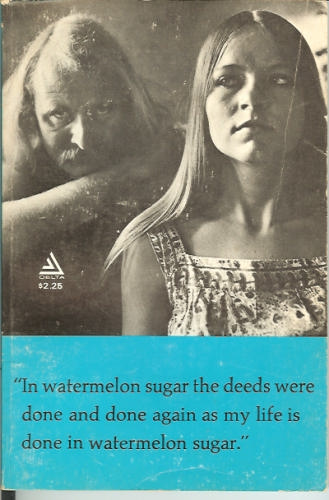
"In Watermelon Sugar the deeds were done and done again as my life is done in watermelon sugar. I'll tell you about it because I am here and you are distant.

Wherever you are, we must do the best we can. It is so far to travel, and we have nothing here to travel, except watermelon sugar. I hope this works out.

I live in a shack near iDEATH. I can see iDEATH out the window. It is beautiful. I can also see it with my eyes closed and touch it. Right now it is cold and turns like something in the hand of a child. I do not know what that thing could be.

There is a delicate balance in iDEATH. It suits us.

The shack is small but pleasing and comfortable as my life and made from pine, watermelon sugar and stones as just about everything here is.

Our lives we have carefully constructed from watermelon sugar and then travelled to the length of our dreams, along roads lined with pines and stones.

I have a bed, a chair, a table and a large chest that I keep my things in. I have a lantern that burns watermelontrout oil at night.

That is something else. I'll tell you about it later. I have a gentle life.

I go to the window and look out again. The sun is shining at the long edge of a cloud. It is Tuesday and the sun is golden.

I can see piney woods and the rivers that flow from those piney woods. The rivers are cold and clear and there are trout in the rivers.

Some of the rivers are only a few inches wide.

I know a river that is half-an-inch wide. I know because I measured it and sat beside it for a whole day. It started raining in the middle of the afternoon. We call everything a river here. We're that kind of people.

I can see fields of watermelons and the rivers that flow through them. There are many bridges in the piney woods and in the fields of watermelons. There is a bridge in front of this shack.

Some of the bridges are made of wood, old and stained silver like rain, and some of the bridges are made of stone gathered from a great distance and built in the order of that distance, and some of the bridges are made of watermelon sugar. I like those bridges best.

We make a great many things out of watermelon sugar here -- I'll tell you about it -- including this book being written near iDEATH.

All this will be gone into, travelled in watermelon sugar."

Richard Brautigan, 1968.

That's the first chapter in Richard's third novel, also my favorite of his books.

I cannot explain what it is about this book. I do think that it is the most psychedelic novel I've ever read, and that's a part of what I love about it.

There is a quality of Brautigan's writing that some people find lazy and unfocused. Some people don't. I'm one of those who doesn't.

The original printing was a paperback by Dell with the cover shown here. The current edition has a completely different cover that, in my opinion, does the book no favors.

I wonder why publishers will change the cover art of a classic novel while record companies never (or rarely) change the covers of classic LPs. The 40th Anniversary of The Beatles Sgt. Pepper album was a few days ago and I can't help but think that, had it been a novel, the anniversary would have been celebrated with a new edition in a brand new sleeve.

I was already pretty happy that it wasn't a novel but now, even more.

Reading Vonnegut's A Man Without A Country last week, and re-reading Slaughterhouse Five at the moment, made me think of Richard Brautigan, and thinking of Richard always makes me pull out a copy of In Watermelon Sugar.

Friday, June 1, 2007

I Miss Him Already....

Kurt Vonnegut had a way with words.

In his last book, written after he claimed there would be no more books, there was one passage I found so perfect an expression of what it was I loved about Vonnegut's writing that I want to share it here. The book is called A Man Without a Country and this link will take you to Amazon where I hope you will buy a copy (or head off to the library if you're like me and just don't need any more stuff).

"Persuasive guessing has been at the core of leadership for so long, for all of human experience so far, that it is wholly unsurprising that most of the leaders of this planet, in spite of all the information that is suddenly ours, want the guessing to go on. It is now their turn to guess and guess and be listened to. Some of the loudest, most proudly ignorant guessing in the world is going on in Washington today. Our leaders are sick of all the solid information that has been dumped on humanity by research and scholarship and investigative reporting. They think that the whole country is sick of it, and they could be right. It isn't the gold standard that they want to put us back on. They want something more basic. They want to put us back on the snake-oil standard.

Loaded pistols are good for everyone except inmates in prison or lunatic asylums.

That's correct.

Millions spent on public health are inflationary.

That's correct.

Billions spent on weapons will bring inflation down.

That's correct.

Dictatorships to the right are much closer to American ideals than dictatorships to the left.

That's correct.

The more hydrogen bomb warheads we have, all set to go off on a moment's notice, the safer humanity is and the better off the world will be that our grandchildren inherit.

That's correct.

Industrial wastes, and especially those that are radioactive, hardly ever hurt anybody, so everybody should shut up about them.

That's correct.

Industries should be allowed to do whatever they want to do: Bribe, wreck the environment just a little, fix prices, screw dumb customers, put a stop to competition, and raid the Treasury when they go broke.

That's correct.

That's free enterprise.

And that's correct.

The poor have done something very wrong or they wouldn't be poor, so their children should pay the consequences.

That's correct.

The United States of America cannot be expected to look after its own people.

That's correct.

The free market will do that.

That's correct.

The free market is an automatic system of justice.

That's correct.

I'm kidding."

I miss him.

Sunday, May 27, 2007

History and Mythology and Methamphetamine

Back in the 70s I had a friend who was heavy into speed. He had a tiny little house on a back alley and there were many nights when I’d be bored or coming down from some drugs of my own and I’d drop in. He worked at a little desk with a little lamp and stacks of books and he was always writing in this perfect handwriting smaller than anyone’s I’d ever seen. He was working on some grand theory of everything, tying together ancient civilizations and contemporary cultural theory in way I don’t think anyone but he understood.

What he was doing then, long before personal computers and the internet, is what I think we would all do today if we had a high-speed internet connection, a blog, and some crystal meth. I can remember how those little lines of fine white powder just burnt like hell, very different from the coke we’d sometime share that would numb the back of your throat and make everything glow a wee little bit as it made everything slightly more interesting.

For a lot of people I think drugs are all about the pleasure. But for some, for the curious, it’s all about how they make the world more… interesting.

Anyway… I don’t do those things anymore, my body can’t survive the strains it could shake off thirty years ago. But I was playing on line a while ago and had a kind of metaphorical flashback to 4 or 5 in the morning, in that little house on the alley as I started to write something about the ancient Greeks and the British invasion.

So, you need to understand that Euhemerus was a Greek mythographer (4th Century BC) at the court of Cassander, the king of Macedonia. He is chiefly known for a rationalizing method of interpretation, known as Euhemerism, that treats mythological accounts as a reflection of actual historical events shaped by retelling and traditional mores.

The writer Robert Graves said of Greek myth: "True myth may be defined as the reduction to narrative shorthand of ritual mime performed on public festivals, and in many cases recorded pictorially." (The Greek Myths, Introduction). Graves was deeply influenced by Sir James George Frazer's mythography The Golden Bough, and he would have agreed that myths are generated by many cultural needs.

Myths authorize the cultural institutions of a tribe, a city, or a nation by connecting them with universal truths. Myths justify the current occupation of a territory by a people, for instance. All cultures have developed over time their own myths, consisting of narratives of their history, their religions, and their heroes. The great power of the symbolic meaning of these stories for the culture is a major reason why they survive as long as they do.

Myths that are based on a historical events over time become imbued with symbolic meaning, transformed, shifted in time or place, or even reversed. One way of conceptualizing this process is to view 'myths' as lying at the far end of a continuum ranging from a 'dispassionate account' to 'legendary occurrence' to 'mythical status'. As an event progresses towards the mythical end of this continuum, what people think, feel and say about the event takes on progressively greater historical significance while the facts become less important. By the time one reaches the mythical end of the spectrum the story has taken on a life of its own and the facts of the original event have become almost irrelevant.

This method or technique of interpreting myths as accounts of actual events, euhemerist exegesis, dates from antiquity and can be traced back (from Spencer) to Evhémère's Histoire sacrée (300 BCE) which describes the inhabitants of the island of Panchaia in the Indian Ocean as normal people deified by popular naivety.

As Roland Barthes affirms, "Myth is a word chosen by history. It could not come from the nature of things.”

Roland Barthes (1915 – 1980) was a French literary critic, literary and social theorist, philosopher, and semiotician. Barthes's work extended over many fields and he influenced the development of schools of theory including structuralism, semiology, existentialism, Marxism and post-structuralism.

Barthes' 1957 book Mythologies was a collection of interrogations of pieces of cultural materia conducted to expose how bourgeois society used them to assert its values upon others. For instance, portrayal of wine in French society as a robust and healthy habit would be a bourgeois ideal perception contradicted by certain realities (i.e. that wine can be unhealthy and inebriating). He found semiology, the study of signs, useful in these interrogations. Barthes explained that these bourgeois cultural myths were second-order signs, or significations. A picture of a full, dark bottle is a signifier relating to a signified: a fermented, alcoholic beverage - wine. However, the bourgeois take this signified and apply their own emphasis to it, making ‘wine’ a new signifier, this time relating to a new signified: the idea of healthy, robust, relaxing wine. Motivations for such manipulations vary from a desire to sell products to a simple desire to maintain the status quo. These insights brought Barthes very much in line with similar Marxist theory.

Now, the thing that I want to take from all of this is this notion of “mythology” not as some imaginary realm of dragons and elves, but as the end of a process that involves the removal of actual events from their concrete historical moorings.

And so we fast forward to early 1964 and the beginning of what we all now call the “British invasion.”

I started thinking about the British invasion as an example of cultural mythology when I read the article “Before the Beatles: International Influences on American Popular Recordings, 1940-63” by William L. Schurk, B. Lee Cooper and Julie A. Cooper in the May 2007 issue of the journal Popular Music and Society. It is an academic journal and, as such, most often stuffed full of the self-evident nit-picked into absurdity. I published a couple times in the journal, presented papers at their conferences over the years and, because of my odd mix of academic and music business credentials, I am a member of their advisory board (which is to say, I don't pay for the journal).

But I digress….

In their introduction the authors write that, “This discographic compilation is designed to debunk the myth of 1964 as the foreign influence watershed year in American recorded music. . . . The misconception being examined is that, until the arrival of The Beatles, Dave Clark Five, Herman’s Hermits, Hollies, Kinks, Zombies, and others in 1964, American recording charts were largely devoid of foreign-born performers.”

In 40 pages chock full of charts and tables these scholars present a very well-reasoned argument that there was a significant non-US presence in the pop charts well before the supposed invasion, and that US-artists fared far better during the invasion than is generally believed. But I would extend this conclusion a bit farther.

The mythology of the British invasion is tied to a much larger mythology of America in the 1960s, and an even larger mythology of the 1960s itself. The exit of Eisenhower, the arrival of JFK, Kennedy’s subsequent assassination, the baby boom, Vietnam, rise of drug use, etc., all neatly places the 1950s in a conservative pin-striped box and the 1970s into a polyester disco shirt box, the 80s into a Reagan-Gordon Gekko-shaped box and so on.

If there is anything the culture needs to get over more than the myth of the 1960s I don’t know what that might be.

The essence of that myth is that we had our chance, the planets were aligned, we could have had a utopia, but we blew it. Now the planets won’t align for another 9,000 years so, really, what’s the point? This is a horrible, self-centered, banal, and destructive mythology, more destructive than any Reagan-based mythos the Republicans can muster.

I still like paisley, I long for the return of ruffled cuffs and collarless jackets, and I kind of miss the beads. But perhaps it’s time to see the 1960s as the superficial paper-thin bourgeois “revolution” that it was (and take another look at the 1950s while we’re at it) and try walking forward one more time before the light fades entirely.

Tuesday, May 15, 2007

Bob Dylan and Lonesome Rhodes....

Sean Wilentz at BobDylan.com has written a piece called The Roving Gambler at Scenic Newport which is one of the more worthwhile things I've read on Dylan in quite some time. I am a big fan of anything that makes me go "Oh yeah! Why didn't I see that? It's so... so... clear." I've pasted an excerpt below, but you should go here and read the whole thing.

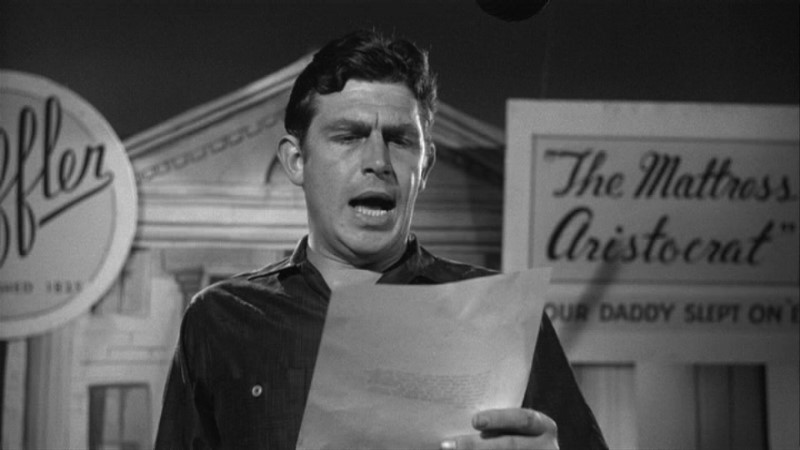
"In 1957, Andy Griffith starred in the Budd Schulberg-Elia Kazan film A Face in the Crowd, playing Lonesome Rhodes, a convicted hobo and country singer who, thanks to a shrewd producer (played by Patricia Neal) becomes a nationwide T.V. celebrity and reactionary demagogue -- a forerunner of Rush Limbaugh and Bob Roberts. Bob Dylan saw A Face In The Crowd, and, reportedly, was more shaken by it than by any film he'd seen since Rebel Without a Cause. At a crucial moment in the film, Griffith's character realizes he's going to make a fortune and starts singing an exuberant and menacing version of 'The Roving Gambler.'

On August 24, 1997, Bob Dylan -- who had cheated death weeks earlier and was now on the verge of releasing an album, Time Out Of Mind, that would reclaim his career -- played a concert in Vienna, Virginia. The songs included 'The Roving Gambler,' which Dylan and his new band had added to their set list a few months earlier. (They would eventually alternate it with 'Duncan and Brady.') Three songs later, after 'Blind Willie McTell,' Dylan introduced his band and acknowledged the presence in the audience of one of the men 'who unlocked the secrets of this kind of music,' Alan Lomax. (At Newport, in 1965, Lomax along with Pete Seeger led the old guard that objected to the blasts of white-boy electricity, including Dylan's. Now all seemed forgiven.) Then, with a mischievous audible chuckle, Dylan and the band kicked into a roaring 'Highway 61 Revisited,' a consummate Dylan rocker of the kind that had so enraged Lomax in 1965. 'This kind of music,' indeed - except that except that 'Highway 61' includes the following verse, with ominous undertones of both ancient folk music and A Face in the Crowd:

Now the rovin' gambler he was very bored
He was tryin' to create a next world war
He found a promoter who nearly fell off the floor
He said I never engaged in this kind of thing before
But yes I think it can be very easily done
We'll just put some bleachers out in the sun
And have it on Highway 61.

On July 19, 2002, two weeks before what the New York Times would soon be hyping as Bob Dylan's triumphant return to Newport, Alan Lomax died. But something of his spirit, and that of the recently dead Dave Van Ronk, and also those of Tennessee Ernie Ford, Don and Phil Everly, Robert Mitchum, Lonesome Rhodes, and Tony Glover, hit the stage running when Dylan, in a cowboy hat, a fake beard, and a wig that made it seem, from five rows back, as if he'd sprouted enormous flowing orthodox Jewish ear locks, opened his set with the Brothers Four's arrangement of 'The Roving Gambler.'"

Go read the Wilentz piece now, and if you've never seen Kazan's A Face in the Crowd you really need to go find a copy as soon as possible. About a third of the way through you'll be reaching for the box, checking the date and wondering how this documentary on the rise of George Bush the First could have been made so long before anyone had heard of him.