Friday, July 20, 2007

The White Album - Two

I blogged earlier about a writing exercise in which the first lines of all the songs on The Beatles' White Album were used as the first lines in a short story or poem. Here is the very first song on the album, "Back in the U.S.S.R."

1)

Flew in from Miami Beach, BOAC

she was at the gate
we didn’t speak until the car ride home
it was pleasant
but there were undercurrents
churning up the waters

we left
a wake
all the way on I-70

in the
rearview
I could see
the other cars and SUVs

changing lanes

trying to avoid it.

Tuesday, July 17, 2007

10,000....

Not being much of a sports fan I wouldn’t expect to blog about sports, but if I did I imagine it would be about baseball. Not contemporary baseball, I don’t follow it, though we usually do watch the World Series each year providing one of the two teams is one I recognize from my youth. A few years back both teams sounded like bowling leagues to me and I skipped it. I dream about a San Francisco versus New York series.

When I was a kid, even though I grew up in Philadelphia, my teams were the Giants and the Cardinals. The Giants because San Francisco seemed a galaxy away and because of all the great players of the 60s, the sluggers Willie Mays and Willie McCovey, and the pitcher Juan Marichal, whose wind up included a high kick never seen in the majors before or since. Every kid in the neighborhood seemed to try it at least once. Most of us simply fell over backwards.

I loved the Cards because of Stan Musial. The magic of compound interest being what it is, had I a dollar for every time someone called me “Stan the Man” as I was growing up I could probably afford a major league franchise of my own today. I also loved the Cards for the white and red of the uniforms and my first memory of watching a World Series on a color television in the appliance department of the big department store across from my house. We would go over, most series games were day games back then, and stand there watching a field of twenty or more color console sets, all tuned to the series, and each one with the color saturation turned up to eleven. The impossibly white and scarlet red against the impossibly green grass of the outfield and tan brown dirt of the infield was like a great abstract painting awash in pure affect.

In 1957 Roy Sievers was an outfielder for the 8th place Washington Senators but, as one of three players to receive over 200 votes that year, managed to come in third behind Mickey Mantle and Ted Willams for the American League Most Valuable Player award. His batting average was .301 and he hit a career high 42 home runs, 114 RBIs and 172 hits. It was his best of his 17 seasons as a major league ballplayer. But it is not what I remember. In 1964 he hit 8 home runs and it is one of those that is framed in my memory.

The home of the Philadelphia Athletics and named for Ben Schibe, a major stockholder and sporting goods manufacturer, Shibe Park opened in April of 1909. In 1953 I was born and the stadium’s name was officially changed to Connie Mack Stadium. I believe those events are unrelated.

In 1964 Roy Sievers was the first baseman for the Philadelphia Phillies. Most games were still played in the afternoons and my friends and I would sometimes hop on a bus and a train and buy the cheap “obstructed view” seats in the upper deck of the ballpark. Ballparks of this era had vertical iron girders set throughout the stadium and the seats directly behind one of these could be had for under a dollar.

When I think about baseball the earliest and clearest memory I have is like a perfect color snapshot in my head. I can call it up anytime; I’ve been able to do that as long as I can remember. I’m doing it now.

It is a sunny day. The sky is clear and blue and dotted with a few puffy white clouds. The outfield is below me, that perfect green. The fence is covered with advertisements; the scoreboard perched on top. I’m sitting up high in left field. The left side of my photograph is filled with an old dark iron girder, peppered with rivets. The arms of the people in the seats below me are all raised.

There. In the air. Round and white. Still rising in a perfect arc from home plate. The impossible object.

Think about it. A small round ball traveling at just under 100 miles an hour from sixty feet, six inches, away must be struck with a round stick. And, as hard as that alone sounds, it has to be struck just so. Struck too high and the ball will hit the ground and lose its energy and roll weakly back to the pitcher’s mound. Hit too low and the ball will fly straight up with no points awarded for how high that might be.

But hit it just so…. The gravitational pull of the Earth is helpless to stop it. Sometimes, at the maximum point of its rise, you feel it wouldn’t be a surprise if it burst suddenly into flames and exploded.

What a thing that must be. I can almost close my eyes and imagine what that might feel like, but I know from the thousands of things I have imagined before that have completely surprised me when I experienced them (from escargot to sex) that I only imagine what it is like to imagine what it must be like.

But I digress.

Anyday now, almost certainly by the time you read this, the Philadelphia Phillies will have passed a milestone no other team in baseball or any other sport has reached: They will have lost 10,000 games.

Unlike the Cubs or the Red Sox (both of whom you might imagine would have arrived here first) the Phillies have no appealing underdog tragedy or “curse” to blame for their lot. The Phillies do not lose with “style.” They do not lose with grace. They just lose. They’ve ended the season better than .500 less than 50 times in their 124 year history. In 1883 they played their first season and ended with a record of 17 wins and 81 losses. Ten years later they won 52 and lost 100. Between 1918 and 1948 the Phillies managed to finish only once above .500. Philadelphia’s long and wretched history of race relations is mirrored in the fact that the Phillies remained all white by design for ten full years after Jackie Robinson’s debut in the majors.

This brings us to the season that eclipses all other losing seasons in baseball, and maybe all sport. In 1964, bolstered by the arrival of Dick Allen who would win Rookie of the Year honors, the Phils came into the home stretch in first place, needing only one win in the final ten games to secure the pennant. They lost ten games in a row and the Cardinals came up from behind to win the pennant. In 1980, their 98th season, the Phillies finally won their first World Series, but even that accomplishment was muted by the 1964 season.

Back in the mid 1980s when I was in grad school I worked at a record store in Athens, Ohio, and one of the two friends I made working there was Edwin Hill, another OU student. We were both fans of the band Steely Dan who once sang, "They got a name for the winners in the world / I want a name when I lose."

Edwin was a much bigger baseball fan than I was and when we parted ways I gave him a present that I would imagine he still has today. Two box seat tickets to the 1964 World Series, game one, at Connie Mack Stadium. Tickets to the series that never was. Those tickets ought to be taken out and prominently displayed the day the Phils reach 10,000.

Monday, July 16, 2007

More Kurt....


Rereading Slaughterhouse Five sent me back to the stacks for something I had not read previously and that led me to Timequake, a 1997 novel. It is filled with many delightful moments even if the overall feeling is one of a very old man gradually slowing down. Two passages in particular are worth sharing here:

"I remember labor history, too, because the first effective strikes by American working people for better pay, and more respect, and safer working conditions, were called against the railroads. And then against the owners of coal mines and steel mills and textile mills, and on and on. Much blood was shed in what appeared to most members of my generation of American writers to be battles as worth fighting as any against a foreign enemy.

The optimism that infused so much of our writing was based on our belief that after the Magna Carta, and then the Declaration of Independence, and then the Bill of Rights, and then the Emancipation Proclamation, and then Article XIX of the Constitution, which in 1920 entitled women to vote, some scheme for economic justice could also be devised. That was the next logical step.

And even in 1996, I in speeches propose the following amendments to the Constitution:

Article XXVIII: Every newborn shall be sincerely welcomed and cared for until maturity.

Article XXIX: Every adult who needs it shall be given meaningful work to do, at a living wage.

What we have created instead, as customers and employees and investors, is mountains of paper wealth so enormous that a handful of people in charge of them can take millions and billions for themselves without hurting anyone. Apparently.

Many members of my generation are disappointed." (pp. 151-152)

In the other the real Vonnegut volunteers to go stand beside his fictional alter-ego, the science ficton writer Kilgore Trout to help with a demonstration.

Trout asks him to look into the night sky and select two twinkling stars. Trout explains that "the universe has expanded so enormously that light is no longer fast enough to make any trips worth taking even in the most unreasonable lengths of time. Once the fastest thing possible, they say, light now belongs in the graveyard of history, like the Pony Express."

Explaining that light traveling between the two stars that Vonnegut has selected would take millions of years to make the trip he instructs his volunteer to "look precisely at one, and then precisely at the other."

This done, Trout continues:

"It took a second, do you think?" he said.

"No more," I said.

"Even if you'd taken an hour," he said, "something would have passed between where those two heavenly bodies used to be, at, conservatively speaking, a million times the speed of light."

"What was it?" I said.

"Your awareness," he said. "That is a new quality in the Universe, which exists only because there are human beings. Physicists must from now on, when pondering secrets of the Cosmos, factor in not only energy and matter and time, but something very new and beautiful, which is human awareness. . . . I have thought of a better word than awareness," he said. "Let us call it soul." (pp. 213-214)

So it goes.

Thursday, June 28, 2007

The White Album - One

A year or so ago I was in a writer's group and I came up with an exercise that involved writing on slips of paper the first lines of every song on The Beatles' White Album and handing them out. The idea is that the paper is no longer blank once you copy that line, where you go can be anywhere, though you should have no connection with whatever narrative might be in the song.

I thought I'd return to that and try to do all thirty odd songs in the next, oh, I don't care how long it takes. I have a few from the exercise and I'll start with a favorite from one of George's songs.

Piggies

“Have you seen the little piggies?” she asked the child. The little boy looked to be about four and enraged over the fundamental unfairness of the world as only a four year old can be. Purple with anger, screaming; perhaps nature’s way of weeding out those of us born with arterial faults before we can reproduce. The boy seemed pretty strong, and inconsolable. But the woman tried, gently pulling him over to the enclosure where a smiling Llama stood by the rail. The beast had a genuine oddness about it that stopped the boy in his tracks. Face still wet, his color returned and he stared at the shaggy chewing orange-brown monster that towered over him. Now the child had that look of awe that Huxley described, albeit in a different context altogether, as seeing “what Adam saw on the morning of creation.” The thought struck me as I watched the boy’s face; this is a brave new world each and every time.

Saturday, June 16, 2007

Henry Miller, Man Ray and Me.....

The scene is an art studio in Clarion, PA, sometime in 1980-1981. Al Charley was an art professor at Clarion State College, a sculptor, and a guy who always made me think of Ken Kesey because they both were artists who’d been champion wrestlers in their youth. There’s something about former wrestlers, something centered about their personalities. I don’t think I have ever met a former wrestler that I didn’t take an immediate liking to. The same is true for physicists, though I don’t really know why. Maybe it’s all the mental wrestling with the fundamental nature of the universe that gives them a similar edge. You might think the same would be true for philosophers or artists but it isn’t. It’s easier for a philosopher to just completely fake it than for a wrestler or physicist. There’s not the arm of someone who isn’t faking it wrapped around your throat; nor is there any math. And I don't know if "faking it" even makes sense in refence to art.

But I digress.

This story involves a cast of characters that include George Barber, Henry Miller, Gilbert Neiman, Man Ray, Earnest Hemmingway and Allen Ginsberg’s father. It may take a while, but it will be worth your time.

George Barber was a professor of English at Clarion State College in Western Pennsylvania, arriving there sometime in the late 1950s (maybe the early 60s) I think. It was George who gave me the answer to a question I had after my first few years at Clarion. During my first year I encountered an array of the most interesting people I’d ever met, people from the arts, sciences, from everywhere, and I was puzzled by how they all arrived in this remote little town of 6,000 hidden in the hills of rural Pennsylvania. George told me that you would find a population of east coast intellectuals stuck away in every small nondescript state college across the eastern half of the country because that’s where they all went to hide in the face of Joe McCarthy and the “red scare” of the 1950s. They taught their classes and lived quiet lives, received the slight protections that academic tenure provides and plugged away in sections of basic composition and surveys of English Lit until they could retire and go off into a forest somewhere and read.

Some would go on to write. A younger colleague of George’s, Terry Caesar, later wrote the finest book about the experience of being an academic I’ve ever found or hope to find, Conspiring with Forms: Life in Academic Texts (University of Georgia Press, 1992). That book reprints Caesar’s earlier essay “On Teaching at a Second-Rate University,” whose publication made his life at Clarion… interesting. Hard to find now, but well worth your trouble.

In 1947, another Clarion refugee had written There’s a Tyrant in Every Country, of which Henry Miller said. “Myself, I’ve never read a better novel about Mexico.”

For a time, Gilbert Neiman lived near Miller in Big Sur and is written about by Miller in his book, Big Sur and the Oranges of Hieronymus Bosch. The excerpt below is from the last part of the section about Gilbert:

The Music! One night, about two in the morning, the door of our shack was thrown open with a bang and, before I knew what was happening, I felt a hand gripping my throat, squeezing it viciously. I knew damn well I wasn’t dreaming. The a voice, a boozy voice which I recognized instantly and which sounded maudlin and terrifying, shouted in my ear, “Where’s that damned gadget?”

“What gadget?” I gurgled, struggling to release the grip around my throat.

“The radio! Where are you hiding it?”

With this he let go his grip and began dismantling the place. I sprang out of bed and tried to pacify him.

“You know I have no radio,” I shouted. “What’s the matter with you? What’s eating you?”

He ignored me, went on pushing things aside, tearing at the walls with furious talons, upsetting chinaware and pots and pans. Finding nothing, he soon relented, though still furious, still cursing and swearing. I thought he had gone out of his mind.


“What is it, Gilbert? What’s happened?” I was holding him by the arm.

“What is it?” he yelled, and I could feel his glare even through the darkness. “What is it? Come on out here!” He grabbed my arm and started dragging me.

After we had gone a few yards in the direction of his house he stopped suddenly, and gripping me like a demon, he shouted: “Now! Now do you hear?”

“Hear what?” I said innocently.

The music! It’s the same tune all the time. It’s driving me crazy.”

“Maybe it’s coming from your place,” I said, though I knew damned well it was coming from inside him.

“So you know where it is,” said Gilbert, accelerating his pace and dragging me along like a dead horse. Under his breath he mumbled something about my “cunning” ways.

When we got to his house he dropped to his knees and began sniffing around, just like a dog in the bushes and under the porch. To humor him, I also got down on all fours, to search for the concealed gadget that was giving out Beethoven’s Fifth. After we had crawled around the house and under it as far as we could, we lay on our backs and looked up at the stars.

“It’s stopped,” said Gilbert. “Did you notice?”

“You’re crazy,” I said. “It never stops.”

“Tell me honestly,” he said, in a conciliating tone of voice, “where did you hide it?”

“I never hid anything,” I said. “It’s there . . . in the stream. Can’t you hear it?”

“He turned over on the other side and cupped his ear, straining every nerve to hear.

"I don't hear a thing," he said.

"That's strange," said I. "Listen! It's Smetana now. You know the one . . . Out Of My Life. It's as clear as can be, every note."

He turned over on the other side and again he cupped his ear. He held this position for a few moments then rolled over on his back, smiling the smile of an angel. He gave a little laugh, then said:

“I know now . . . I was dreaming. I was dreaming that I was the conductor of an orchestra. . . . “

I cut him short. “But how do you explain the other times?”

“Drink,” he said. “I drink too much.”

“No you don’t,” I replied, “I hear it just the same as you. Only I know where it comes from.”

“Where?” said Gilbert.

“I told you . . . from the stream.”

“You mean someone has hidden it in the creek?”

“Exactly,” I said.

I allowed a due pause, then added: “Do you know who?”

“No,” he said.

“God!”

He began to laugh like a madman.

“God!” he yelled “God!” Then louder and louder. “God, God, God, God, God! Can you beat that?”

He was now convulsed with laughter. I had to shake him to make him listen to me.

“Gilbert,” I said, just as gently as could be, “if you don’t mind, I’m going back to bed. You go down by the creek and look for it. It’s under a mossy rock on the left hand side near the bridge. Don’t tell anybody, will you?”

I stood up and shook hands with him.

“Remember,” I said, “not a soul!”

He put his fingers to his lips and went “Shhhh! Shhhh!” (pages 73-75)

When I got to Clarion in the Summer of 1971 Gilbert was teaching in the English department. He was a raging alcoholic and students avoided his classes as much as was possible. He would stagger into his Shakespeare class and talk for an hour about Ginsburg’s Howl, and then spend an hour in his American Poetry class diving into the subtext of The Tempest.

I signed up for one of his classes, I don’t remember what it was, but I was 17 and not at all prepared to be in the presence of that much pain. I dropped the class after one session.

In 1980 I was living in Clarion again. Gilbert’s alcoholism had reached such epic proportions that the college finally revoked his tenure and fired him. He died very quickly after that. Some people felt that the college dismissing him was what killed him, others felt that he would have died on schedule regardless. A story circulated that, like the story that was told after Dylan Thomas died, when an autopsy was performed and the coroner opened him up the room was immediately filled with the overpowering smell of whiskey.

Back to the Art Department and Al Charley….

One afternoon I went into the foundry and up to Al’s office. I was working in the University’s TV studios and Al wanted to record some things he was working on. What it turned out to be was simply a video record; Al would stand in a single light in front of a permanent living room set that took up one corner of the studio where a cable exercise show was taped. The program was The Paul Gaudino Family Fitness Hour which, in 2007, is still running and is now enshrined in the Guiness Book of Records as the longest running exercise program in TV history. I ran a studio camera for the program back in the day when you could still smoke in the studio during a production so long as you had something to use as an ashtray. Al brought a notebook with him and he would read from it; mostly fragments and partial ideas. I think he was just in a very preliminary stage of thinking about how video might be used in his work.

When I went into his office I noticed some bandages on his hands. He told me he’d gone over to visit Gilbert’s widow. She let him in and they went out to the back of the house where she’d built a fire and was burning some of Gilbert’s things. His hands were bandaged because he’d burnt them reaching into the fire to pull out a shoe box. He showed me the box, it was burnt on the bottom and around the edges of the lid. Then he opened it.

I’ve never had any experience that is anything like the experience of going through the papers that were inside the scorched box. I wish my memory were better. I wish I’d just made an inventory. Gilbert had been good friends with the artist Man Ray and there was a stack of cards that Man Ray had sent Gilbert over the years to mark special occasions, Christmas, birthdays, etc. These cards were a thick cardboard onto which was stitched with thread an original black & white photograph. The backs were covered with notes in Man Ray’s hand. The photos were all unique and I do not believe they have ever been published anywhere.

Then there were the letters. There were letters from Hemmingway. Letters from Allen Ginsberg’s father filled with worry over his strange son. Letters from various people I was not well read enough to recognize. And one large stack of letters from Henry Miller tied together with a piece of twine.

I sat there and read letter after letter. In one, Miller was describing some pornography he’d seen recently; it was hilarious and explicit. There was one that sticks out from all the others. In it, Miller was replying to a letter Gilbert had sent in which he was worried about being drafted. Gilbert was asking Henry's advice, he was thinking about posing as a homosexual or dope addict to get out of the military if he was called up.

Miller’s letter was handwritten and his advice to Gilbert was to not do any of those things. Instead, and he wrote this in enormous letters at an angle taking up the better part of the page,

"Be a DOPE!!!!!!!!!!!!!!!!!!!!!!!!!!!!!! Nobody wants a dope!!!”

He went on to describe how Gilbert should be the most positive, helpful, energetic, friendly, eager completely bumbling incompetent moron possible!

As I read it I realized that Henry Miller had just sketched out the pilot episode of Gomer Pyle U.S.M.C.

The letters the photos, were a pirate’s treasure chest, burnt around the edges. After an hour or so I came up for air.

“Jesus… Al…. I….”

“I know.” He said.

“I’d like to look through all these Miller letters, could I take them for a little while?” I could barely believe the words as they came out of my mouth, but my mother had advised “You’ll never know if you don’t ask,” advice that, in hindsight I now realize, if I’d have taken more to heart in the 70s I’m sure I would have gotten more sex. A lot more.

But I digress.

Al told me I could take them for a day but that I had to promise that I wouldn’t photocopy them. I thought about it for a moment and, in a rare and completely inappropriate moment of honesty said, “Al, you’re my friend, so I have to tell you that if I take these I’ll go to a Xerox machine so fast I may travel back in time.”

That was the first thing I regret doing in reference to the shoebox.

My second regret was that I didn’t follow my instinct the afternoon I dropped by the college graphics department to say hello to my two friends, Nancy and Mary, who worked there. It was around lunch time and the place was empty, the building was deserted. On the table in the middle of the room were about a dozen of the Man Ray photo postcards, waiting to be photographed. For a moment I thought about taking 3 or 4 of these, but changed my mind and left. Damn.

A little while after that Al Charley got some sort of grant to fund a larger project on Man Ray that would produce a book. The money would have allowed him to spend time in Paris and work with some other Man Ray collections.

A little while after that Al was driving home from Clarion one evening and was killed in a collision with a coal truck.

I don’t remember the dates but I think he died around 1983-1984, shortly after I left Clarion again and moved to Ohio.

I never found out what happened next. I don’t know what happened to that shoebox; I have had a dream in which Al’s widow is placing it into a fire in her back yard. I doubt that would happen. But, to this day, I wonder about those letters from Henry Miller. I wonder if Al, Gilbert, Henry and I remain the only people who have ever read them. Over the years I have mentioned the shoebox to writers and artists and scholars I’ve met, here and in France, but I don’t think I’ve ever managed to get anyone interested in trying to track them down. I imagine starting in Clarion’s art department and asking about Al’s widow would be a start.

Thursday, June 7, 2007

Room to move....

This coming November, UK blues artist John Mayall will turn seventy-four and I think we’ll have a party for him. Clearly, if we started playing his catalog of albums on Friday afternoon, the party could last well into the following week.

One comparison I’ve seen repeatedly throughout Mayall’s career is to jazz legend, Miles Davis. The Miles comparison is in recognition of the parade of musicians who apprenticed in one of Mayall’s bands before moving onto their own bands and careers. And that comparison is an apt one. As Richie Unterberger notes in Mayall’s biographical entry at the All Music Guide web site, "Throughout the '60s, his band, the Bluesbreakers, acted as a finishing school for the leading British blues-rock musicians of the era. Guitarists Eric Clapton, Peter Green, and Mick Taylor joined his band in a remarkable succession in the mid-'60s, honing their chops with Mayall before going on to join Cream, Fleetwood Mac, and the Rolling Stones, respectively. John McVie and Mick Fleetwood, Jack Bruce, Aynsley Dunbar, Dick Heckstall-Smith, Andy Fraser (of Free), John Almond, and Jon Mark also played and recorded with Mayall for varying lengths of times in the '60s.”

But comparisons to Miles, who, along with Louis Armstrong and Duke Ellington, represents one third of the 20th Century’s holy trinity of American music, must always be made with some awareness of their limitations. Mayall’s contributions were early with his trio of 1966-1967 LPs, Bluesbreakers With Eric Clapton, A Hard Road (with Peter Green), and Crusade (with Mick Taylor). By the end of the 60s his band rarely featured players whose later reputations would eclipse his own.

Nor was Mayall’s instrumental prowess on guitar, harp or keyboards comparable in any sense to Miles’ contributions to jazz trumpet.

Still, Miles comparisons aside, Mayall deserves his elder statesman status as richly as anyone. I almost said “as any of his peers” but caught myself. I don’t know that Mayall has any peers. He is a good ten years older than any other UK musician who occupies a similar place in music history. On one of his LPs it’s actually rather shocking to see a 1960’s rock figure in his British military uniform during his service in the Korean war.

There are two Mayall records that I would find it hard to live without. The first is, of course, his 1966 Bluesbreakers With Eric Clapton. Returning to Miles comparisons, the effect of this record on the rock music that followed was not dissimilar to the impact of either Kind Of Blue (1959) or In A Silent Way (1969) on jazz. There is a new “Deluxe Edition” on Decca, a 2 CD set that has the entire original LP in both mono and stereo mixes on the first disc and stuffs the second disc with 19 bonus tracks including a variety of BBC Saturday Club sessions and a number of rare Immediate label 45s (including “I’m Your Witchdoctor”). It’s one of those “Christmas and your birthday” kind of records.

The other Mayall LP I have burned into my brain’s hard drive is his 1969 album The Turning Point. In the context of its release it was almost as impressive a rock record as In A Silent Way was a jazz LP. 1969 was a time of supergroups, screaming electric guitars and twenty-minute drum solos. In the midst of this Mayall appeared in a quartet setting following Mick Taylor’s departure to The Stones. In any setting, but particularly in the musical climate of 1969, this is a stunningly quiet record. Mayall eliminates drums entirely, and replaces the electric guitar with not just an acoustic, but a nylon string acoustic played fingerstyle by Jon Mark joined by the flute and tenor and alto sax of John Almond (whose later Mark-Almond albums would try, with questionable results, to duplicate this sound). The result was to introduce a shocking quiet in the middle of all the loud. The 1969 Fillmore appearance was recorded and released as The Turning Point and became one of Mayall’s most successful albums. The fact that it was one of the 2 or 3 greatest records to smoke pot to late into the evening didn't hurt either.

Mayall’s longevity is also proof that Keith Richards was right when he answered a question about whether it would be silly to still be a rocker at 70 by saying that his role models were Muddy Waters and other blues greats who played until they had to be carried off the stage. At 65, Bob Dylan seems to be following similar advice. Come this November “Room To Move” “California” and “The Laws Must Change” will be on heavy rotation.

Monday, June 4, 2007

In Watermelon Sugar the deeds were done....

"In Watermelon Sugar the deeds were done and done again as my life is done in watermelon sugar. I'll tell you about it because I am here and you are distant.

Wherever you are, we must do the best we can. It is so far to travel, and we have nothing here to travel, except watermelon sugar. I hope this works out.

I live in a shack near iDEATH. I can see iDEATH out the window. It is beautiful. I can also see it with my eyes closed and touch it. Right now it is cold and turns like something in the hand of a child. I do not know what that thing could be.

There is a delicate balance in iDEATH. It suits us.

The shack is small but pleasing and comfortable as my life and made from pine, watermelon sugar and stones as just about everything here is.

Our lives we have carefully constructed from watermelon sugar and then travelled to the length of our dreams, along roads lined with pines and stones.

I have a bed, a chair, a table and a large chest that I keep my things in. I have a lantern that burns watermelontrout oil at night.

That is something else. I'll tell you about it later. I have a gentle life.

I go to the window and look out again. The sun is shining at the long edge of a cloud. It is Tuesday and the sun is golden.

I can see piney woods and the rivers that flow from those piney woods. The rivers are cold and clear and there are trout in the rivers.

Some of the rivers are only a few inches wide.

I know a river that is half-an-inch wide. I know because I measured it and sat beside it for a whole day. It started raining in the middle of the afternoon. We call everything a river here. We're that kind of people.

I can see fields of watermelons and the rivers that flow through them. There are many bridges in the piney woods and in the fields of watermelons. There is a bridge in front of this shack.

Some of the bridges are made of wood, old and stained silver like rain, and some of the bridges are made of stone gathered from a great distance and built in the order of that distance, and some of the bridges are made of watermelon sugar. I like those bridges best.

We make a great many things out of watermelon sugar here -- I'll tell you about it -- including this book being written near iDEATH.

All this will be gone into, travelled in watermelon sugar."

Richard Brautigan, 1968.

That's the first chapter in Richard's third novel, also my favorite of his books.

I cannot explain what it is about this book. I do think that it is the most psychedelic novel I've ever read, and that's a part of what I love about it.

There is a quality of Brautigan's writing that some people find lazy and unfocused. Some people don't. I'm one of those who doesn't.

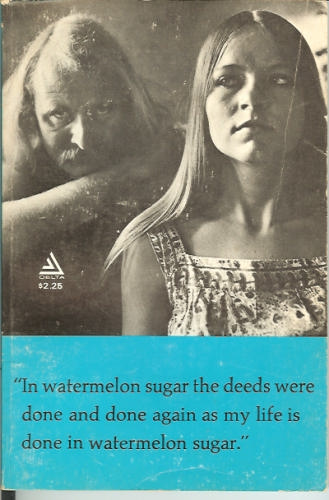
The original printing was a paperback by Dell with the cover shown here. The current edition has a completely different cover that, in my opinion, does the book no favors.

I wonder why publishers will change the cover art of a classic novel while record companies never (or rarely) change the covers of classic LPs. The 40th Anniversary of The Beatles Sgt. Pepper album was a few days ago and I can't help but think that, had it been a novel, the anniversary would have been celebrated with a new edition in a brand new sleeve.

I was already pretty happy that it wasn't a novel but now, even more.

Reading Vonnegut's A Man Without A Country last week, and re-reading Slaughterhouse Five at the moment, made me think of Richard Brautigan, and thinking of Richard always makes me pull out a copy of In Watermelon Sugar.