Friday, July 10, 2009
The 38th Annual Woody Guthrie Birthday Party....
In the Summer of 1971 I left Philadelphia to go to college in Clarion, Pennsylvania. Clarion would become my other hometown. That Summer I met my friend Tom DiStefano who was, like most of the friends I made in Clarion, not a college student at the time, but a local guy. His parents ran the Vowinkel Hotel in Vowinkel, PA, and we would spend the better part of the next four decades fighting over whose mom's spaghetti sauce was better.
One day that first summer I found him clutching a newspaper and sputtering in anger. He'd just read that Woody Guthrie's hometown had refused to celebrate Woody's birthday because they thought he was "un-American."
Tom was perhaps the first true believer I ever met; he believed in that "other" America, the one that wasn't going to re-elect Richard Nixon, the one that wasn't spending thousands of lives in Southeast Asia, the one that had a national health care system. To him, Woody was a patriot on par with Jefferson and Pane; fellow Thomases.
"This shall not stand."
He most likely didn't actually say that. But he did proclaim that afternoon that, if Woody's hometown wasn't up to the task, we were. Thus began preparations for the First Annual Woody Guthrie Birthday Party. It wasn't until three or four years later that we'd find out that it shouldn't be "first annual" but we did not care; it sounded good.
For a small town in rural Western Pennsylvania, Clarion had a thriving population of local musicians. Bands were quickly arranged for; the headliner would be the band with what is still to this day one of my favorite "sixties" band names: One Hundred and Ninety Eight Hubby Subby Indians. "One Ninety Eight" as they were called if time was short, was led by Scott Garvey, who played a solid body Fender electric 12 string guitar that he ran through a fuzz-wah-wah pedal that gave it him genuinely unique sound, and Terry Rhodes, the local guitar hero of the time who played a black Les Paul. Ken Ponchell, a local poet, wrote their lyrics but didn't actually perform with the band.
It's funny the stuff that I still remember (even though I may be remembering most of it wrong).
The Ross Memorial Library was set back off the town's Main Street, just behind the post office. At the back was a small auditorium that was used for local dances and events. Even though I had just started in school, I played my part by getting one of my professors to agree to sign off on the form requesting permission to use the facility and to attend as "chaperon."
As the day approached, it suddenly dawned on the organizers that neither they, nor any of the assembled musicians, actually knew an actual Woody Guthrie song.
Our young charge, Dick Eustice, an enthusiastic 15 year-old folk singer at the time, was dispatched to learn one.
The event was a success. Woody's patriotism proclaimed and celebrated. The close-mindedness of his home town, cursed and condemned.
This coming July 14th marks Woody's 97th birthday and the 38th anniversary of ours. What better way to celebrate it than this.


Thursday, July 2, 2009
WWWD (*What Would W Do?)
 An armed guard poses beside pallets of $100 bills in Baghdad
 There's no question that the US economy is hurting. Unemployment is at record levels, retail sales are down, energy prices are heading back up, things are looking more than a little gloomy.
As odd as it sounds, it may be time to look at a tactic used by the Bush Administration at the height of the Iraq war.
I'd like to propose to President Obama that he load $12 billion dollars in cash onto pallets and ships it to the Midwest on Air Force transports. As happened with the $12 billion dollars W shipped off to Iraq, the money would quickly disappear, leaving nothing but a few scraps of wood and a crumpled $20 or two hiding in the weeds.
But that $12 billion would fairly quickly reappear. It would show up in money paid to utility companies for past due accounts, to car dealerships for new or late model pick ups, to fast food restaurants, video game arcades, local bars, gentlemen's clubs (might be best to ship a couple tons of $1 dollar bills in the mix), supermarkets, coffee houses, etc.
W may have had the right idea, just the wrong country.
Tuesday, June 23, 2009
You're Under Arrest
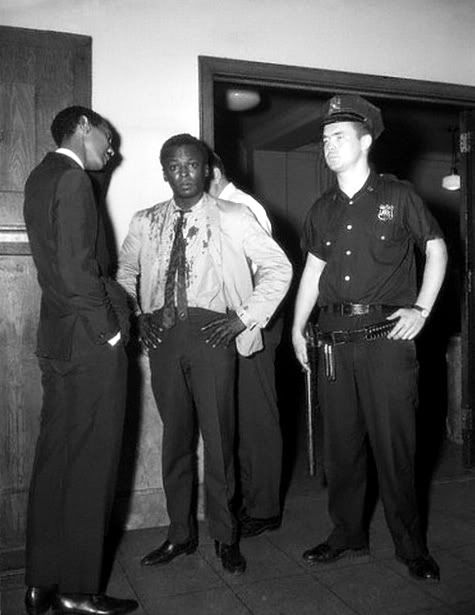 Original Caption: Musician Arrested.
New York -- Miles Davis, 32, of 881 10th Avenue, a trumpeter now appearing in Birdland, 52nd Street and Broadway, was arrested after fighting with patrolman Gerald Kilduff, who had ordered him to move from crowded sidewalk. In the scuffle, Davis was hit on the head with a blackjack for which a St. Clare's ambulance had to be called.
On August 25, 1959, Miles Davis had these words uttered to him: "You're under arrest!" (which became the title of his 1985 album). After doing a set for an Armed Forces Day broadcast at Birdland, Miles was escorting his friend, a white woman, to a cab. He was stopped by the police, got beaten and was arrested.
The following is an extract from Miles - The Autobiography (Miles Davis with Quincy Troupe, Touchstone Book, 1989):
"I had just finished doing an Armed Forces Day broadcast, you know, Voice of America and all that bullshit. I had just walked this pretty white girl named Judy out to get a cab. She got in the cab, and I'm standing there in front of Birdland wringing wet because it's a hot, steaming, muggy night in August.
"This white policeman comes up to me and tells me to move on. At the time I was doing a lot of boxing and so I thought to myself, I ought to hit this motherfucker because I knew what he was doing. But instead I said, "Move on, for what? I'm working downstairs. That's my name up there, Miles Davis," and I pointed to my name on the marquee all up in lights.
"He said, "I don't care where you work, I said move on! If you don't move on I'm going to arrest you."
"I just looked at his face real straight and hard, and I didn't move. Then he said, "You're under arrest!" He reached for his handcuffs, but he was stepping back. Now, boxers had told me that if a guy's going to hit you, if you walk toward him you can see what's happening. I saw by the way he was handling himself that the policeman was an ex-fighter. So I kind of leaned in closer because I wasn't going to give him no distance so he could hit me on the head.
"He stumbled, and all his stuff fell on the sidewalk, and I thought to myself, Oh, shit, they're going to think that I fucked with him or something. I'm waiting for him to put the handcuffs on, because all this stuff is on the ground and shit. Then I move closer so he won't be able to fuck me up.
"A crowd had gathered all of a sudden from out of nowhere, and this white detective runs in and BAM! hits me on the head. I never saw him coming. Blood was running down the khaki suit I had on. Then I remember Dorothy Kilgallen coming outside with this horrible look on her face... and saying, "Miles, what happened?" I couldn't say nothing. Illinois Jacquet was there too.
"It was almost a race riot, so the police got scared and hurried up and got my ass out of there and took me to the 54th Precinct where they took pictures of me bleeding and shit. So, I'm sitting there, madder than a motherfucker, right? And they're saying to me in the station, "So you're the wiseguy, huh?" Then they'd bump up against me, you know, try to get me mad so they could probably knock me upside my head again. I'm just sitting there, taking it all in, watching every move they make...
"Later I sued the police department for US$500,000. Harold (Lovett) wasn't doing negligence suits, so he got another lawyer, who forgot to file the claim before the statute of limitations ran out. We lost the damage suit, and I was madder than a motherfucker, but there wasn't nothing I could do about it. The police revoked my cabaret license, and that prevented me from playing New York clubs for a while."
Photo found at "If Charlie Parker Was a Gunslinger, There'd Be a Whole Lot of Dead Copycats."
Story found at Rate Your Music.
Common Sense says....

Mirriam-Webster defines "common sense" as "sound and prudent judgment based on a simple perception of the situation or facts."
The term "common sense," as it is used in the general population has always fascinated me. My late friend, Chuck Schulz, was a race car driver, a Navy demolition diver, MENSA member, and diesel truck mechanic. We became friends at a local bar, played on a darts team together and generally enjoyed each others company. He would joke about my level of formal education, explaining to anyone who would listen that "Ph.D." stood for "post hole digger."
"You may be smart, but you don't have any common sense."
"Charles, common sense tells you that the Earth is flat and that the Sun revolves around it. And common sense has next to nothing to do with pulling the transmission out of a Peterbuilt. I'm thinking that that takes some uncommon sense."
"Shut up and throw the damn dart."
Common sense, of course, has some serious limits. Even more, common sense often describes political structures mistaken for the natural world, a phenomenon well worth your time to read up on in places like here and here.
But all of that aside, common sense can represent a starting point in some discussions taking place in and around current US politics [and hey, why HAVE a blog if you can't rant from time to time?].
In no conceivable order.....
The Nixon Tapes
Earlier this morning, the National Archives made public about 125 hours of tape and about 30,000 pages of documents from former President Richard M. Nixon’s administration. These documents are from 1973-74, thirty-five years ago, and they're just being made public now. There are countless more tapes and documents yet to be released.
I'm sorry, but Common Sense suggests that there's no possible reason to dribble this stuff out over the past three and a half decades. Are there sensitive national security concerns? Probably. But Common Sense suggests that the question ought to be: Are there really sensitive national security concerns that couldn't have been identified and addressed in thirty five years?
Drugs
Common Sense suggests that the "war on drugs" is over. We lost.
Common Sense also suggests that terms like "drug legalization" and "drug decriminalization" are empty and mean next to nothing and will continue to be empty of meaning until we have a rational national conversation about what they might mean.
Common Sense also says that if sanitation workers and police officers have to pee in a cup to do their jobs, so should mayors, police chiefs, judges and prosecutors. Common Sense imagines that if the law worked that way "drug test" would assume a position between "cassette deck" and "rotary phone" in the lexicon.
Same Sex Marriage
Miscegenation laws, were laws that banned interracial marriage and sometimes interracial sex between whites and members of other races. In the United States, laws against interracial marriage and interracial sex existed and were enforced in the Thirteen Colonies from the late seventeenth century onwards, and subsequently in several US states and US territories until 1967. Common Sense would suggest that the current brouhaha over same sex marriage is little more than the extension of this.
Common Sense also says that the fact that similar laws were also enforced in Nazi Germany, from 1935 until 1945, and in South Africa during the Apartheid era, from 1949 until 1985 ought to tell you something.
Health Care
Common Sense says that designing health care as a "for profit" enterprise makes no more sense than designing law enforcement and all other emergency services as for profit enterprises as well.
[RING... RING... RING... CLICK] 911 emergency, what credit card will you be using today?
Common Sense also says that if a national health care system is "socialist" then so is the United States Marine Corps. And, following the path of a popular conservative argument, if we can't trust government to run health care why do we entrust the largest nuclear arsenal in the history of the world to it? Wouldn't we be safer if Blackwater had all the nukes?
Common Sense says "Go to jail. Go directly to jail. Do not pass go, do not collect $200."
Credit Cards
Common Sense says that if you borrow $2,000 at 6% interest and then the credit card company raises your interest rate to 14%, that 14% can only apply to any money you borrow AFTER the rate was raised. Common Sense says that it can't retroactively be applied to the original two grand. Common Sense may not have a Post Hole Digger, but Common Sense wasn't raised by fools.
Education
Common Sense says every problem that is faced by educators in secondary school and college are problems that can best be addressed in primary school. It's nice that a mildly autistic fellow who lectures on Elizabethan footwear at Yale pulls down $80,000 a year; but Common Sense believes that, in a more perfect world, a third grade teacher in North Philadelphia would be making $200,000.
Common Sense also says school boards should be stripped of any power to do anything but issue collective suggestion slips. It denigrates the entire profession of education that people with no discernible skills other than an ability to pop out a kid can run roughshod over decisions educators make regarding curriculum, text books, and so on. Common Sense asks that we consider for a moment how absurd such a system would look if it were applied to any other professional setting.
Neo-Con Jerk Weeds
Common Sense believes that talk radio dirt bag Rush Limbaugh's current campaign to boycott GM products because "Barack Obama cannot be allowed to succeed" will magically transform hundreds of thousands of "Reagan Republicans" into a generation of "Limbaugh Democrats."
It's things like this that makes Common Sense tingly all over.
Monday, June 22, 2009
Bob Dylan in Tehran

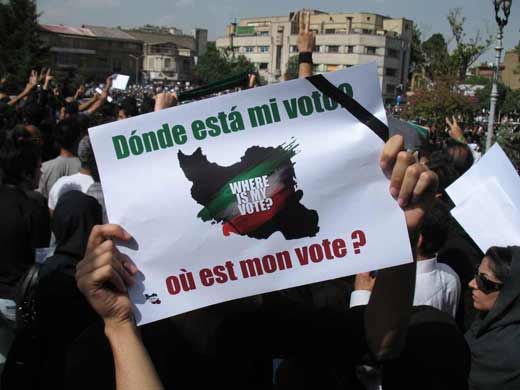
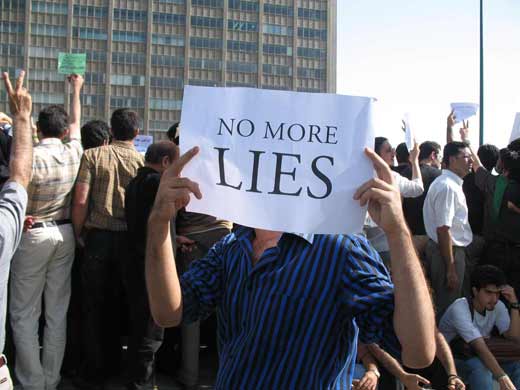

These photographs of demonstrators in Imam Khomeini square, Tehran, were taken by Saeed Kamali Dehghan and appeared the British newspaper, The Guardian. The entire set of thirteen can be seen here.
Iran represents maybe the greatest "what if" in the history of US foreign policy. Documents declassified in the 1990s provided the details to the 1953 CIA-engineered coup that deposed the democratically-elected government of Iranian Prime Minister Mohammed Mosaddeq in response to his nationalizing Iran's oil industry which had been completely controlled by British petroleum. You can read the details here.
It's that last photo that caught my attention; Bob Dylan's lyric from "Knocking On Heaven's Door" held up by an Iranian protester in 2009. But it isn't the song that comes to mind when I look through the images emerging from Tehran.
Ring them bells, ye heathen
From the city that dreams,
Ring them bells from the sanctuaries
Cross the valleys and streams,
For they're deep and they're wide
And the world's on its side
And time is running backwards
And so is the bride.
Ring them bells St. Peter
Where the four winds blow,
Ring them bells with an iron hand
So the people will know.
Oh it's rush hour now
On the wheel and the plow
And the sun is going down
Upon the sacred cow.
Ring them bells Sweet Martha,
For the poor man's son,
Ring them bells so the world will know
That God is one.
Oh the shepherd is asleep
Where the willows weep
And the mountains are filled
With lost sheep.
Ring them bells for the blind and the deaf,
Ring them bells for all of us who are left,
Ring them bells for the chosen few
Who will judge the many when the game is through.
Ring them bells, for the time that flies,
For the child that cries
When innocence dies.
Ring them bells St. Catherine
From the top of the room,
Ring them from the fortress
For the lilies that bloom.
Oh the lines are long
And the fighting is strong
And they're breaking down the distance
Between right and wrong.
Sunday, June 21, 2009
Under Their Thumb....

"Money changes everything." - Cyndi Lauper
I've been a fan of the Rolling Stones for a long time. My appreciation for them peaked a few years back when I spent about 8 months building a collection of every US and UK release in the original mono versions. In the US that ends with Satanic Majesties, in the UK it ends with Let It Bleed, after which everything is in stereo only. There are some interesting differences; for example, the UK mono debut LP (on the Decca label) sounds unmixed. When you listen to it cranked up pretty high you have the impression of standing on the other side of the studio glass with the band recording a few yards away. The US mono pressing (on the London Label) sounds fantastic - like a great vinyl LP. The low end is much fuller, meatier; the record has balls to spare.
But I digress.
Under Their Thumb: How a Nice Boy from Brooklyn Got Mixed Up with The Rolling Stones (and Lived to Tell About It) is a brand new memoir by Bill German. A 16 year-old kid in Brooklyn in 1978, German started the Stones fanzine Beggars Banquet from his bedroom, selling copies for a few cents at local record shops.
It was a matter of perfect timing. The Stones took up residence in New York in the early 1980s and German's network of fellow Stones fans would tip him to the clubs and parties where the band members were likely to show. Eventually German became friends with Keith Richards and Ron Wood, visiting their homes and hotel rooms and always following the one rule of Stones etiquette: Never be the last one to leave.
One review of German's book in The Washington Post takes it to task for spending all of its time on what may well be the least interesting period of the band's history. And, while that may be true, it is also the least documented period, and living it through the eyes of a "super fan" who still manages to maintain a small distance between himself and the object of his obsession makes for a thoroughly unique and enjoyable read.
There's precious little trash talk here, but if you're a fan of the Stones and are looking for some Summer reading this is a good choice.
Saturday, May 16, 2009
Saving Grace and Henry Miller

"I have found God, but he is insufficient." — Henry Miller
I've been a fan of Holly Hunter's forever. Her performance in Raising Arizona (1987) is one of a handful of the best comedic performances, by anybody, ever. But I only get about eight channels on my TV cable and whatever channel her series, Saving Grace, is on isn't one of them.
My local library has the first season DVD and I'm about half way through the episodes. The basic story is about a cop, Grace (Hunter), in Oklahoma City, who is visited by a "last chance angel" named Earl who wants her to, in effect, "get right" with God.
There are some things about the series I really like. Hunter's character is wonderfully complex and masterfully played. Her dog, Big Head Gus, is fantastic. Set in Oklahoma City, the series makes regular references to the 1995 bombing of the Murrah Building, something that's hardly ever mentioned in a post-9/11 world. The writing is excellent, as is the cast. But the presence of the angel, who shows up, offers some brief new-agey sounding advice, flexes his wings and splits, is like some unnecessary artifice overlain on the story. The series would be pretty much exactly the same without the angel. The angel has no ability to intercede in the lives of the characters in each story, or in Grace's life either for that matter.
And it is in this respect that it reminds me of Henry Miller's solution to the question of God. It makes no difference, Miller said, whether there is or isn't a God because, if there is, God is utterly insufficient to make any difference in our day to day lives. The decisions we make, the actions we take, these are always our own. If it comforts you to imagine someone on the sidelines, offering the occasional commentary on things that are all going to proceed anyway, so be it. But it doesn't matter.
Grace does what she wants. The people around her get hurt, get saved, go on with their lives like all of us do. It is an interesting take on the interaction of humans with angels. I think Henry would have enjoyed it.
Subscribe to:
Posts (Atom)


